US payrolls clues

Most investors will be glad to see the back of August, a month that marked the biggest monthly decline in US stocks in nine years. The main imponderable is whether September will be any better. A series of manufacturing surveys globally today will do little to restore confidence although there was some good news in a slight increase in China’s official August purchasing managers index (PMI) as well a stronger than forecast increase in Australian Q2 GDP, which will likely provide some short-term relief for risk trades.

There was also some slight solace for markets in terms of US data at least from the point of view that the data was not as disappointing as many recent releases. Although the August Chicago PMI slipped (to 56.7) consumer confidence increased (to 53.5) though admittedly confidence remains at a relatively low level. The job market situation detailed within the consumer confidence report was more pessimistic in August than the previous month, however, with those reporting jobs hard to get moving higher. This sends a negative signal for Friday’s payrolls data.

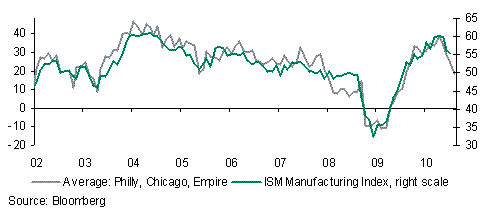
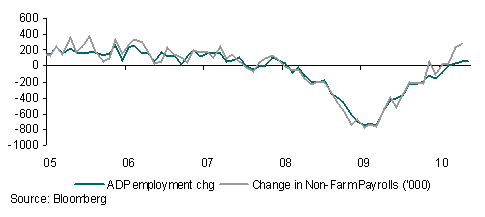
There will be more clues to Friday’s US jobs report today which will enable any fine tuning of forecasts to take place in the wake of the August ADP employment report and ISM manufacturing survey. Consensus forecasts centre on a 15k increase in private jobs. Despite the slight increase in the Empire manufacturing survey in August, the falls in other manufacturing surveys point to some downside risks to the ISM today, with a simple average of the three pointing to the ISM closer to the 50 mark, which will highlight a loss in US manufacturing momentum.
Manufacturing surveys elsewhere will also be in focus, with the final PMI readings scheduled to be released for the eurozone and UK. There is likely to be confirmation of the slight drop in the eurozone PMI to 55.0 in August while the UK PMI is likely to drop to around 57.0 over the month. Both surveys remain at a relatively high level but it is clear that activity is moderating in H2 2010 from a healthy level in H2. The data will give little support to the EUR but the currency has found a degree of stability over the last couple of days. Nonetheless, a further downward move is in prospect.

The Fed FOMC minutes provided little for markets to get excited about. The minutes noted concerns about large scale asset purchases from some Fed officials, indicating resilience to increasing quantitative easing despite acknowledging increased downside risks to the growth and inflation outlook. It is unclear exactly what will be the trigger for further QE as acknowledged by Fed Chairman Bernanke last week.

The minutes will do little to help market confidence given the hesitancy to pursue further QE and provide further stimulus to the economy but the USD is likely to benefit from the fact that the Fed may not be as eager to expand its balance sheet further. Other currencies that remain beneficiaries in the current risk averse environment are the JPY and CHF. The JPY may find further upside more difficult given ongoing intervention fears but the trend remains for a lower USD/JPY in the coming weeks.
Split personality

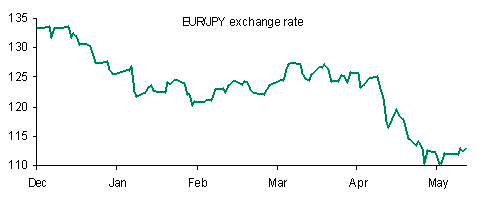
Markets are exhibiting a Strange Case of Dr Jekyll and Mr Hyde, with a clear case of split personality. Intensifying risk aversion initially provoked USD and JPY strength, with most crosses against these currencies under pressure. Both USD/JPY and EUR/JPY breezed through psychological and technical barriers, with the latter hitting a nine-year low. However, this reversed abruptly in the wake of extremely poor US existing home sales, which plunged 27.2% in July, alongside downward revisions to prior months, a much bigger drop than forecast.

Obviously double-dip fears have increased but how realistic are such fears? Whilst much of the drop in home sales can be attributed to the expiry of tax credits, investors can be forgiven for thinking that renewed housing market weakness may lead the way in fuelling a more generalized US economic downdraft. The slow pace of jobs market improvement highlights that the risks to the consumer are still significant, whilst tight credit and weaker equities, suggests that wealth and income effects remain unsupportive.

FX markets will need to determine whether to buy USDs on higher risk aversion or sell USDs on signs of weaker growth and potential quantitative easing. I suspect the former, with the USD likely to remain firm against most risk currencies. The only positive thing to note in relation to the rise in risk aversion is that it is taking place in an orderly manner, with markets not panicking (yet).

European data in the form of June industrial new orders delivered a pleasant surprise, up 2.5%, but sentiment for European markets was delivered a blow from the downgrade of Ireland’s credit rating to AA- from AA which took place after the close. The data suggests that the momentum of European growth in Q3 may not be as soft as initially feared following the robust Q2 GDP outcome.

Japan has rather more to worry about on the growth front, especially given the weaker starting point as revealed in recently soft Q2 GDP data. Japan revealed a wider than expected trade surplus in July but this was caused by a bigger drop in exports than imports, adding to signs of softening domestic activity. The strength of the JPY is clearly making the job of officials harder but so far there has been no sign of imminent official FX action.

Japan’s finance minister Noda highlighted that recent FX moves have been “one sided” and that “appropriate action will be taken when necessary”. The sharp move in JPY crosses resulted in a jump in JPY volatility, a factor that will result in a greater probability of actual FX intervention but the prospects of intervention are likely to remain limited unless the move in the JPY accelerates. USD/JPY hit a low of 83.60 overnight but has recovered some lost ground, with 83.50 seen as the next key support level. JPY crosses may see some support from market wariness on possible BoJ JPY action, but the overall bias remains downwards versus JPY.

Week Ahead

The market mood can be characterised as uncertain and somewhat downbeat, as reflected by the downdraft in US equity markets which posted their second weekly loss last week. Conversely, there has been a bullish run in government bonds, with the notable exception of peripheral debt. Over the last week markets had to contend with more data disappointment, in the wake of soft Japanese Q2 GDP, and a plunge in the August Philly Fed into negative territory, its first contraction since July 2009. Additionally a jump in jobless claims, which hit 500k highlighted the slow improvement in US job market conditions currently underway.

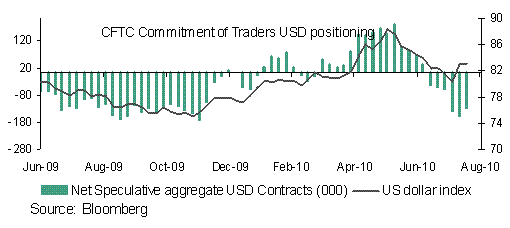
Despite all of this, the USD proved resilient and instead of the usual sell-off in the wake of soft data it benefited instead from increased risk aversion. The USD is set to retain some of this resilience though range-trading is likely to dominate over much of the weak. Reflecting the USD’s firmer stance, speculative positioning in the form of the CFTC IMM data revealed a reduction in aggregate USD short positioning in the latest week and although positioning is well below the three-month average, the improvement over the latest week and current magnitude of short positioning, highlights the potential and scope for further short-covering.

Negative data surprises have forced many to downgrade their forecasts for growth and policy implications, especially in the US. Markets will look for further clarity on the economic outlook this week but it is not clear that anything conclusive will be delivered. At the end of the week Q2 GDP will be revised sharply lower and whilst the data is backward looking it will reveal the weaker momentum of growth going into the second half of the year.

US Housing data will be mixed, with existing home sales set to drop in July as the impact of the expiration of home buyers tax credits continues to sink in whilst new home sales will likely increase but only marginally and will remain well below the April levels. Overall the picture of housing market activity remains bleak and this week’s data will do little to shake this off. On a more positive note July durable goods orders and August Michigan confidence will rise, the latter only marginally though. There will be plenty of attention on Fed Chairman Bernanke’s speech at the Jackson Hole Fed conference at the end of the week, especially given speculation of more quantitative easing in the pipeline.

The European data slate kicks off today with the release of manufacturing and service sector PMIs. Both are likely to register small declines, albeit from high levels. Nonetheless, taken together with a likely drop in the August German IFO survey on Wednesday and weaker June industrial orders tomorrow, the data will highlight that the momentum of growth in the region is coming off the boil, with the robust GDP outcome registered in Q2 2010 highly unlikely to be repeated. Against this background EUR/USD will find it difficult to make any headway. Technically further donwnside is likely over the short-term, with a test of 1.2605 support on the cards

Japan releases its slate of month end releases including jobs data, household spending and CPI. A slight improvement in job market conditions and increased spending will be insufficient to allay growth and deflation concerns, especially with CPI remaining firmly in negative territory. The onus will remain on the authorities to try to engineer a weaker JPY, which remains stubbornly around the 85.00 level versus USD. Talk of a BoJ / MoF meeting today has been dismissed, suggesting the prospect of imminent action is small. Meanwhile, speculative JPY positioning has dropped slightly in the last week but remain close to historical highs.

Aside from various data releases this week markets will digest the outcome of Australia’s federal elections. From the point of view of markets the outcome was the worst possible, with no clear winner as both the incumbent Prime Minister of the ruling Labour Party and opposition Liberal-National Party leader Tony Abbot failed to gain an outright majority. The outcome of a hung parliament will likely keep the AUD on the back foot, with trading in the currency likely be somewhat volatile until a clear outcome is established as both candidates try to garner the support of a handful of independents. However, it is notable that apart from an initial drop the AUD has managed to hold its ground. Nonetheless, the given the fluidity of the political situation there will be few investors wanted to take long positions at current levels around 0.8900 versus USD.

The Week Ahead

As last week progressed there was a clear deterioration in sentiment as growth worries crept back into the market psyche. It all started well enough, with a positive reaction to China’s de-pegging of the CNY but the euphoria faded as it became evident that there was still plenty of two-way risk on the CNY. A change in Prime Minister in Australia, which fuelled hopes of a resolution to a controversial mining tax, and an austere budget in the UK, were also key events. However, sentiment took a hit as the Fed sounded more cautious on the US economy in its FOMC statement.

The US Congress finalised a major regulatory reform bill towards the end of the week and markets, especially financial stocks, reacted positively as the bill appeared to give some concessions to banks and was not as severe as feared. However, equity market momentum has clearly faded against the background of renewed growth concerns including sprouting evidence of a double-dip in the US housing market as well as fresh worries about the European banking sector. As if to demonstrate this US Q1 GDP was duly revised lower once again, to a 2.7% annualised rate of growth.

The US Independence Day holiday and World Cup football tournament will likely keep liquidity thin in the run up to month and half year end. However, there is still plenty to digest this week including the all important employment report and consumer confidence data in the US. In Europe economic sentiment gauges, purchasing managers indices and the flash CPI estimate will be in focus. Elsewhere, Japan’s Tankan survey and usual slate of month end Japanese releases, Switzerland’s KoF leading indicator and Australian retail sales will be of interest.

On balance, economic data this week is unlikely to relieve growth concerns, with Eurozone, US and UK consumer and manufacturing confidence indicators likely to post broad based declines due to a host of factors. The data will further indicate a slowing in growth momentum following Q2 2010, with forward looking surveys turning lower, albeit gradually. Whilst a double-dip scenario still seems unlikely there can be no doubt that austerity measures and the waning of fiscal stimulus measures are beginning to weigh on growth prospects even if there is still plenty of optimism for emerging market and particularly Asian growth prospects.

This suggests that Q3 could turn into a period of heightened uncertainty in which equity markets and risk assets will struggle to gain traction. In addition to growth worries, some tensions in money markets remain in place whilst banking sector concerns seem to be coming back to the fore, especially in Europe and these factors will prevent a sustained improvement in risk appetite from taking place over the coming quarter. Some more clarity may come from the results of European stress tests but much will depend on just how stressful the tests are.

In the near term, the main focus of attention will be on the US June jobs report released at the end of the week. Non-farm payrolls are set to record a decline over the month due to a reversal in census hiring, with a consensus expectation of a 110k fall. Private sector hiring is likely to record a positive reading, however, suggesting some improvement in the underlying trend in jobs growth, albeit a very gradual one. Downside risks to consensus suggest plenty of scope for disappointment.

Interestingly, weaker US data of late, has managed to restrain the USD, suggesting that cyclical factors and not just risk aversion are beginning to play into FX movements. Notably the USD was on the back foot against a number of currencies as last week progressed. Even the beleaguered EUR managed to end the week well off its weekly low and close to where it closed the previous week whilst risk currencies such as the AUD and NZD as well as GBP also posted firm performances.

Perhaps some reversal of the optimism towards US recovery prospects give USD bulls some cause for concern, but pressure is likely to prove temporary, especially given that the US economy is still on course to outperform many other major economies. Over the short-term, especially ahead of the US jobs report markets are set to remain cautious with range trading likely to dominate in the week ahead, suggesting that EUR/USD is unlikely to breach the key level of 1.2500. GBP performance has been robust but even this currency is likely to make much headway above GBP/USD 1.5000, where there are likely to be plenty of sellers.

Wait And See

It’s difficult to be too conclusive in my blog post today given that markets are in waiting mode for a number of events to pass. First and foremost is the US May jobs report. The consensus forecast is for a gain of 536k in nonfarm payrolls and a slight drop in the unemployment rate to 9.8%. Payrolls estimates range from a high of 750k to a low of 220k, the wide margin likely reflecting the uncertainty of the amount of census hiring.

On the face of it a 500k+ gain in payrolls looks strong, but the bulk of this, probably about three-quarters, will made up of census hiring which by its nature is transitory. Therefore, only about 100k in payrolls will be due to private sector jobs growth, which is still not bad. Most of the clues leading up to the jobs data are consistent with the consensus, including the 55k increase in the May ADP.

The second event is the change in Prime Minister in Japan. Naoto Kan, the previous Finance Minister is set to take over the helm. His job is going to tough, with all eyes on how and when the government begins to get to grips with Japan’s burgeoning debt burden which is approaching 200% of GDP. Most of this, around 96% is held by domestic investors, so Japan is less exposed to foreign investor sentiment.

Nonetheless, even domestic investors including many large life insurance companies are increasing their overseas investments at the expense of Japanese debt. Kan is also a supporter of weaker JPY so at the least the rhetoric from Japanese officials to weaken the JPY will step up, especially given the very painful move in EUR/JPY over recent months.

Finally, the G20 meeting beginning today in South Korea will garner attention. Topics will include bank regulation and capital requirements, the European debt crisis, and policy tools such as the recent suggestion by South Korea to make permanent the currency swap agreements between central banks. Aside from a commitment to keep policy supportive, and likely talking up the efforts to combat the crisis in Europe, it is difficult to see anything particularly market moving emerge from the meeting.