Euro pressure mounts

The effects of eurozone peripheral bond concerns are cascading through eurozone markets and hitting risk appetite in the process. The EUR is a clear casualty having dropped further against the USD and versus other currencies. EUR/Asian FX remains a sell in the current environment. Contagion outside Greece, Portugal and Ireland had been limited but Italy and Spain have also seen a growing impact on their bond markets. Having broke below support around 1.3734, EUR/USD will target 1.3508 support.
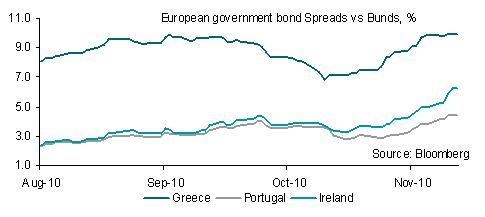
Speculation that Ireland will be forced to follow Greece in seeking international financial support has intensified. Although Ireland has sufficient funds to last until next spring, yields on its debt are already higher than Greek debt before it received funds a few months back. Attention is firmly fixed on the country’s budget on 7 December and the prospects of an agreement between the government and opposition in its austerity plans.

Not helping is the fact that the Irish government has a very slim majority. Even if the budget is passed there is no guarantee that sentiment will improve given the negative impact of even deeper fiscal tightening announced last week will have on economic growth. Moreover, Germany’s insistence that the cost of any Greek style bailout should be borne mostly by private investors has only added to market tension. Even the European Central Bank is unlikely to provide much support, with ECB member Stark suggesting that ECB bond purchases will remain limited.

This leaves eurozone markets in a precarious state and the EUR continues to look heavy as further downside opens up. Moreover, the problems in peripheral Europe are beginning to have a broader impact on risk appetite, with equity markets slipping, although some of this was related to a weaker sales forecast from Cisco in the US. Nonetheless, spreading risk aversion could also dampen sentiment for Asian currencies, which is why selling EUR/Asian FX looks a better bet than selling USD/Asian FX over the short term.

In contrast sentiment for the US is undergoing an improvement. Data releases over recent weeks have generally beaten forecasts and there is even growing speculation that the Fed’s calibrated asset purchases may end up being smaller than planned. Such speculation has boosted the USD but it is premature to suggest that the Fed is on the verge of scaling back asset purchases even as the program of purchases gets going. Although there are clearly some FOMC members who are opposed to significant asset purchases the probability that the Fed remains set to carry out its full $600 billion of planned purchases.

Attention today will focus squarely on day 2 of the G20 meeting and any resolution to disputes over trade imbalances and currencies. Unfortunately none is likely to be forthcoming. Despite a reported 80 minute meeting between US and Chinese leaders little agreement was reached, with plenty of finger pointing remaining in place. It appears that the mantra of moving towards “market-determined exchange rates” and efforts at “reducing excessive imbalances” as agreed at the G20 meeting of finance ministers and central bankers will be as far as any agreement reaches. As a result markets will be left with very little to chew on.

Contrasting Stance

Despite some recent Fed speakers putting doubts into the minds of the many now looking for the Fed to embark on QE2 in November, the minutes of the 21 September FOMC meeting gave the green light to the commencement of asset purchases next month. Although there is clearly no unanimity within the FOMC the majority favour further easing. Incremental data dependent asset purchases will be the most likely path.

The minutes leave the USD vulnerable to further declines but extreme short USD positioning suggest that there is plenty of risk of short covering and more likely we are probably set for a period of consolidation over coming weeks before the USD resumes its decline.

Unlike the Fed, BoJ and BoE, which remain in easing mode the ECB is already veering towards an exit strategy, albeit one that is unlikely to take effect for some time. Hawkish comments by the ECB’s Weber overnight managed to give a lift to the EUR in the wake of a further widening in interest rate differentials between the eurozone and US. Indeed, interest rate differentials (2nd contract futures) are at the widest since Feb 2009, a factor that is providing plenty of underlying support for the EUR.

Further out the follow through on the EUR will depend on whether markets believe Weber’s stance is credible. Germany’s economy is doing well but it is highly likely that Southern European officials would oppose any premature tightening in policy given the parlous state of their economies. The stronger EUR will also do some damage to growth, with its recent appreciation acting as a de facto monetary tightening.

Despite the positive influence of Weber’s comments short-term technical indicators show that the trend in EUR is vulnerable, with clear signs of negative divergence as the spot rate is still trending higher whilst the relative strength indices (RSI) are trending lower. Moreover, EUR speculative positioning is at its highest in a year, albeit still well of its all time highs. Speculators may be reluctant to build on longs in the near term. A clean and sustained break above EUR/USD 1.4000 level still looks like a stretch too far though any downside is likely to be limited to strong support around 1.3895.

Unlike the perception that the ECB is highly unlikely to follow the Fed in a path of QE2 the policy stance of the BoE is far more uncertain, a fact that continues to weigh on GBP, especially against the EUR. Recent data in the UK has played into the hands of the doves, with housing market activity and prices coming under renewed pressure, retail sales surveys revealing some deterioration and consumer confidence as revealed in the Nationwide survey overnight, weakening further.

BoE MPC member Miles summarized the situation by highlighting that the UK faces “some big risks” and even hinted that the BoE may “come to use QE”. UK jobs data today is unlikely to give any support to sentiment for GBP although as per its recent trend GBP is likely to remain resilient against the USD whilst remaining under pressure against the EUR, with a move to resistance around EUR/GBP 0.8946 on the cards in the short-term

USD pressure, EUR resilience, GBP whipsawed

Speculation the Fed will begin a new program of asset purchases or QE2 as soon as November is intensifying. The weaker than expected reading for US consumer confidence in September released on Tuesday has only added to this expectation as sentiment continues to be hit by job market concerns. Against this background the USD remains under strong downward pressure, with little sign of any turnaround.

The prospects of further USD debasing as well as intervention in many countries to prevent their currencies from strengthening against the USD continues to power gold prices which hit a new record high having breezed through the $1300 per troy ounce mark. In the current environment it is hard to see gold prices turning much lower although there may be some risk of profit taking in the weeks ahead.

The EUR remains a key beneficiary of USD weakness but this currency has problems of its own to contend with. Indeed, peripheral debt concerns, especially with regard to Ireland and to a lesser extent Portugal have increased, with borrowing costs rising as the yield on their debt widens against core eurozone debt. The stronger EUR will only make it harder for these countries to achieve any sort of recovery and could also damage the stronger exporting countries of Northern Europe led by Germany.

So far however, the EUR has managed to show some impressive resilience to renewed peripheral country sovereign debt concerns including comments by S&P about the high costs of rescuing an Irish Bank. Perhaps the knowledge that there is a still a huge bailout fund from the EU and IMF available if needed and also the prospect that the ECB will increase its buying of eurozone debt, has provided a buffer for the EUR.

At some point the ECB may be forced to join the battle in at least attempting to talk its currency lower but at this stage the central bank is showing no inclination to either talk down the currency or physically intervene to weaken the EUR. In the meantime, EUR/USD is likely to strengthen further despite the likely negative impact on European growth, with the currency likely to set its sights on an eventual break above 1.40.

One currency that may struggle in the wake of expectations of Fed QE2 is GBP. Uncertainty over whether the Bank of England will follow the Fed in implementing further quantitative easing could see GBP lag the gains in other currencies against the USD. Conflicting comments from MPC members Posen who noted that there may be a need for further QE in the UK to support the faltering economy were countered by Sentance who noted that there was no need for more QE. GBP/USD is likely be whipsawed as the debate continues and is set to lose further ground against the EUR.

What Stress?

Fed Chairman Bernanke has inadvertently fuelled an increase in risk aversion in the wake of his testimony to the Senate. Although Bernanke noted that he did not see the prospects of a double-dip as a high probability event he stated that the economic outlook is “unusually uncertain”. Nonetheless, although such measures would be implemented if the situation deteriorated further, the Fed was not planning on extending its non-traditional policy options in the near term.
USD benefits as Bernanke does not indicate more quantitative easing.

A combination of caution about growth prospects and disappointment that Bernanke stopped short of indicating that the Fed would embark on further non-conventional policy measures left equities weaker, but the USD was stronger, both due to higher risk aversion as well as less risk of the Fed turning the USD printing press back on again. Bernanke is back at Congress today, with a speech to the House Panel. Although this is effectively a repeat of yesterday’s testimony, the Q&A session may throw up additional clues to Fed thinking and potential for extending quantitative easing but I suspect the USD will retain its firmer tone.

In Europe, most attention remains on the upcoming release of EU bank stress test results. Leaks suggest most banks will likely pass the EU bank stress tests, with the notable exceptions of a few Spanish Cajas and German Landesbanks. Already governments in Germany, France, Greece and Belgium have said their banks are likely to pass. We should all be bracing ourselves for relief to flow through European financial markets, but somehow this does not feel like an environment that will welcome such a result. More likely questions will be asked about why did so few banks fail and why the tests were not rigorous enough?

For example, the test for “sovereign shock” is said to affect only the value of government bonds that banks mark to market, but what about the far larger proportion of government debt that is held in banking books? There are also question marks over the capital hurdle, with the most adverse scenario that banks need to reach a maximum Tier 1 capital ratio of at least 6% by end 2011. Moreover, there have also been reported divisions within European Union (EU) members about how much information to divulge. EUR has also ready lost ground over recent days but the currency could face much more selling pressure into next week if the tests are found to lack credibility.

Please note that econometer.org will take a break until the week of 16th August. Good Luck.

Sell Risk Trades On Rallies

It seems that every time there is a bounce in risk appetite it quickly dissipates as worries about growth, fiscal deficits, sovereign debt, etc, return to dent sentiment. This was again the case overnight as markets sold off late in the US session, with an early bounce in sentiment proving too fragile to last. This pattern of trading is set to persist for a long while yet, with the overall tone of selling risk trades on rallies remaining in place.

Fears over a double dip global recession have increased since the release of Friday’s disappointing US jobs report even if it is too early to pass judgment based on the basis of one month’s data. Coupled with worries about slowing growth momentum in China, hopes that slower growth in the eurozone could be counterbalanced by firm growth elsewhere are being dashed. The problem is that despite a strong quarter of growth for most economies in Q2 2010 the outlook for the second half of the year is far more uncertain.

European Union officials sought to calm worries about the potential for renewed fiscal crises in the future by agreeing to monitor national budgets more closely and at an earlier stage whilst introducing a wider range of sanctions on excessive deficits. Unfortunately this is akin to the idiom about closing the stable door after the horse has bolted. The steps aren’t going to help resolve the current crisis. Evidence of implementation, execution and results on the deficit cutting front will help however, but this is a process that will take months rather than days or weeks.

A couple of factors may have prevented the EUR from extending losses overnight. 1) Germany announced EUR 80 billion in spending cuts along with 15,000 public sector job cuts. Germany also is pushing for a financial transactions tax on tap of the bank levy. 2) European finance ministers finalised details of the EUR 440 bn Financial Stability Facility which aims to sell AAA rated bonds to make loans to eurozone countries. The only question is the approval process. The statement on the funds operations only said that “national legal procedures to participate in the facility are well on track”. EUR/USD is likely to range between 1.1826 and 1.2110 over the short-term.