What To Watch This Week

The end of last week proved to be a calmer affair than the preceding few days. There was some encouraging news on the Greek front, with Germany finally approving its share of the European Union (EU) aid package whilst Greece appeared to be on track with its budget deficit reduction as the country recorded a cash deficit of EUR 6.3billion in the first four months of the year, a 42% reduction compared to a year earlier. EU officials also agreed on tougher sanctions for countries breaching austerity rules.

There were plenty of negatives to offset the good news however, as European business surveys including the German IFO index and flash eurozone purchasing managers indices (PMIs) revealed some loss of momentum in growth as well as increased divergence. European banking sector concerns intensified as the Bank of Spain was forced to take control of CajaSur, a small savings bank holding 0.6% of total Spanish banking assets, which faced difficulties due to distressed real estate exposure. Its woes highlighted the problems faced by many Spanish savings banks due to property market exposure.

US data releases this week will confirm that economic recovery gathered steam in Q2. May consumer confidence data is likely to record a small gain, due in large part to improving job market conditions, whilst the Chicago PMI is set to retrace slightly in May, albeit from a healthy level. Both new and existing home sales are set to record gains in April, the former following a sizeable gain in March although the drop in house prices likely to be revealed by the Case-Shiller index will continue to fuel doubts about the veracity of the turnaround in the US housing market.
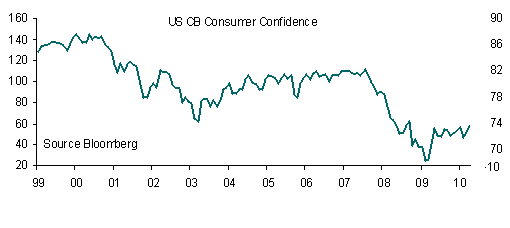
In Europe there is not much in terms of first tier releases and highlights include sentiment data such as German Gfk and French consumer confidence indices, and the May French business confidence indicator. The data are likely to be mixed, and as indicated by last week’s surveys will reflect a relatively healthy Q2 2010, but a worsening outlook for the second half of the year.

In the absence of UK data today there will be plenty of attention on the details of plans by Chancellor Osborne to cut GBP 6 billion from the budget deficit. The measures will be small change ahead of the emergency budget package on June 22nd when much bigger cuts are expected. Nonetheless, the first step today will be a crucial test of the new government’s ability to convince ratings agencies and markets that it is serious about reducing the burgeoning fiscal deficit.

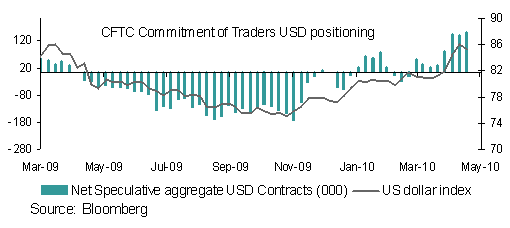
Following the massive positioning adjustments of the last week markets will look somewhat calmer over coming days but risk aversion is likely to remain elevated, suggesting little respite for most currencies against the USD. The recent moves have left net aggregate USD positioning registering an all time high according to the CFTC Commitment of Traders data, in the latest week, but after the slight retracement lower in the USD index, it is set to make further gains over coming days.
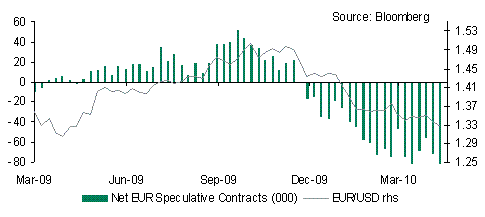
It was notable that EUR and GBP looked more composed at the tail end of the week whilst attention turned to the liquidation of long positions in CHF, AUD, NOK and SEK. These risk currencies are set to remain under pressure but there will be little respite for EUR which is set to drift lower, albeit a less aggressive pace than over recent weeks and a re-test of EUR/USD technical support around 1.2296 is likely. GBP/USD has showed some resilience over recent days but remains vulnerable to further downside pressure, with 1.4310 immediate support.
Will the ECB intervene to support the Euro? (Part 2)

Click here to read Part 1

The last official intervention by the European Central Bank (ECB) in the currency markets took place in November 2000 and at the time the Bank stated that “the external value of the EUR does not reflect the favourable conditions of the euro area”. The ECB also noted the impact of a weaker EUR on price stability, with inflation at the time running above the ECB’s 2% threshold. This followed intervention a couple of months earlier in September 2000 when the ECB jointly intervened with the US Federal Reserve, Bank of Japan and other central banks in a concerted manner due to “shared concerns about the potential implications of recent movements in the euro exchange rate for the world economy”.

Conditions in the euro area could hardly be described as favourable at present, suggesting that this rationale would be very unlikely to be used to justify intervention. Conversely, a weaker EUR may actually contribute to making conditions in the eurozone more favourable. The rationale used for the September 2000 intervention holds more sway in the current environment. Nonetheless, the move in the EUR is very unlikely to do any serious damage to the world economy even if some Japanese exporters are suffering.

In the past the ECB has given various verbal warnings about the volatility of the EUR being too high, and this could potentially be utilized as rationale for FX intervention. However, implied volatility in EUR/USD is not particularly high when compared to the levels it reached during the recent financial crisis. Currently 3-month implied volatility is at its highest level since June 2009 but well below the peak in volatility recorded in December 2008. Clearly if EUR/USD volatility continues to rise there will be a greater cause for concern but at current levels the ECB is unlikely to even crank up verbal intervention let alone actual FX intervention.

One of the main benefits of the decline in the EUR is the support that it will provide to the eurozone economy. At a time when growth in Europe is slowing EUR weakness will be particularly welcome. Germany and other countries in Northern Europe will be major beneficiaries of EUR weakness given their export dependence. Given such benefits and the currently limited risks to inflation, the ECB is highly unlikely to intervene to strengthen the EUR.

Given the current very negative mood in the market, officials in Europe would do better to rectify some of the structural issues that markets are concerned about. This may provoke a more sustainable rally in the EUR but until there are concrete signs of progress on the fiscal front sentiment towards the EUR will remain negative. Against this background FX intervention to prop up the EUR would face more of a risk of failure, and in turn damage to the credibility of the ECB. This is perhaps as good a reason as any not to expect intervention.

Will the ECB intervene to support the Euro? (Part 1)

The EUR has lost around 23% since it all time high in April 2008 when it traded close to 1.6000. The EUR failed to rally even in the wake of the EUR 750 billion European Union / International Monetary Fund support package, a fact that has highlighted the weight of negative sentiment towards the currency. The latest blow to the currency came from the announcement of unilateral measures from Germany to ban naked short selling on sovereign debt and some financial stocks, actions that only highlighted the lack of policy co-ordination within the eurozone.

The rationale for further EUR/USD weakness is clear and justified partly by growth divergence within the eurozone countries, with Germany on the one extreme and weaker Southern European countries on the other. Moreover, relatively weaker overall growth in the eurozone compared to the US economy, a delay in interest rate hikes by the European Central Bank (ECB) and ongoing concerns about implementation and execution of deficit cutting plans, will also weigh on the EUR.

The EU/IMF support package and in particular ECB interventions in the Eurozone bond market have managed to alleviate some of the strain on European bond markets, but without similar intervention in the FX markets the EUR has become the release valve for Europe’s fiscal and debt problems. As a result the EUR’s fall has accelerated over recent weeks, only showing any sign of stability as fears of currency intervention increased.

The quickening pace of EUR depreciation has led to growing speculation of FX intervention by the ECB and other central banks to support the currency. I believe intervention is highly unlikely and see little reason for panic about the drop in the EUR. Once markets realise that there is indeed little risk of intervention the EUR will resume its downtrend.

One of the main reasons behind this view is that the EUR is not particularly “cheap” at current levels. In fact, “fair value” estimates based on the OECD measure of purchasing power parity (PPP) suggest that EUR/USD is around 5.6% overvalued at current levels, based on an implied PPP rate of around 1.17. Therefore, the drop in the EUR over recent months has only brought it back close to PPP fair value estimates.

Moreover despite the fact that there has been a large nominal depreciation of the EUR its trade weighted exchange rate has declined by much less, around 8.5% since the beginning of the year and around 11.3% since its high in October 2009. Although the trade weighted EUR is around its lowest level since October 2008, taking a longer term view shows that it is slightly above its average over the past 20-years.

Greece Bailed Out, Euro Unimpressed

After much debate eurozone ministers along with the International Monetary Fund (IMF), finally announced an emergency loan package for Greece amounting to  EUR 110 billion. In return for the bailout Greece agreed to enhanced austerity measures. The good news is that the package covers Greece’s funding requirements until 2012, and is sufficient to avoid debt restructuring and default. The loan package has also removed uncertainty ahead of bond redemption on May 19th.

One aim of the package was to prevent contagion to other eurozone countries, especially Portugal and Spain, where there has been growing pressure on local bond and equity markets. However, the path ahead is strewn with obstacles and it is too early to believe that the package has ensured medium term stability for the EUR.

The challenges ahead are two-fold, including both the implementation of the measures in Greece in the face of strong domestic opposition and the approval of the loans by individual country parliaments within the eurozone, both of which are by no means guaranteed.

The toughest approval process is likely to be seen in Germany where the government will face a grilling in parliament and a challenge in the constitutional court ahead of official approval of the package. European Union leaders are scheduled to meet on May 7th to discuss the parliamentary approval of loans to Greece whilst German officials meet on the same day.

Implementation risk is also high. Although the Greek government appears to be sufficiently committed, opposition within Greece is growing; various strikes planned over coming days. Aside from union opposition, the scale of the budgetary task ahead is enormous, having never been undertaken on such a large scale in recent history. The sharp decline in growth associated with the austerity measures will make the task even harder.

The EUR bounce on the news has been limited, with the currency failing to hold onto gains. The announcement seems to have triggered a “buy on rumour, sell on fact” reaction, with the size of the loan package falling within the broad estimates speculated upon over the last week. The lack of EUR bounce despite the fact that going into this week the CFTC Commitment of Traders report revealed record net short speculative positioning in EUR/USD, reveals the extent of pessimism towards the currency.

The EUR may benefit from a likely narrowing in bond spreads between Greece and Germany. Given that sovereign risk is being increasingly transferred from the periphery to the core, the net impact on bond markets may not be so positive for the EUR. Over the short-term there will be strong technical resistance on the upside around EUR/USD 1.3417 but more likely the currency pair will target support at around 1.3114.

The Herculean task ahead for the Greek government suggests that markets will not rest easy until there are credible signs of progress. Investors would be forgiven for having a high degree of scepticism given the degree of “fudging” involved in the past, whilst Greek unions will undoubtedly not make the government’s task an easy one by any means. Such scepticism will prevent a sustained EUR recovery and more likely keep the EUR under pressure.

As noted above the divergence in growth for the eurozone economy between Northern and Southern Europe will make policy very difficult. Moreover, the EUR is set to suffer from an overall weak trajectory for the eurozone economy, relative to the US and other major economies. The widening growth gap with the US will also fuel a widening in bond yield differentials, a key reason for EUR/USD to continue to decline to around or below 1.25 by the end of the year.

Greek bailout edges closer

A semblance of calm appears to have returned into the weekend following a fit of nervousness about all things Greece.  For currency markets this means that the EUR has recovered some composure after hitting 2010 lows around 1.3115 but direction next week will largely depend on the much anticipated announcement from European officials over coming days on the size and conditionality of a loan package to the country.   In return Greece is reported to be planning a EUR 24 billion package of additional measures to cut its burgeoning fiscal deficit.

Over recent days the consensus on how much funding Greece will need has increased to EUR 120 billion from the initial EUR 45 billion announced just over a couple of weeks ago.   Presumably the jump in size of assistance will be sufficient to convince markets that Greece’s default risk will be minimal, not just in the coming year but over the next few years.   It may also help to prevent further credit ratings downgrades following the decision by S&P ratings agency to downgrade Greece to junk status.  Moody’s left Greece on review for a downgrade but may also cut its ratings to junk if the situation does not improve. 

There are still many obstacles to an improvement in confidence towards Greece, however including the willingness of Germany to contribute to any aid package ahead of regional elections on May 9th and the ability of the Greek government to push through austerity measures in the face of growing social unrest in the country.   Moreover, the task ahead for Greece which aims at cutting the budget deficit down to 2% by 2013 is enormous having never been achieved in modern history.  Given the outlook for much weaker growth in the months and years ahead as well as growing domestic resistance in Greece, it will be all the more difficult. 

The likely announcement of an aid package over coming days will keep market sentiment relatively well supported and as reflected in the narrowing in Greek debt spreads, which seem to be trading more like equities, it is already having a positive impact.  Nonetheless, the bounce to markets will be limited and whilst a EUR 100-120 billion package will help to shore up confidence, there is just too much uncertainty remaining.  This points to continued volatility in the weeks ahead and very limited upside for EUR/USD and more likely a test of technical support around 1.3091 in the short-term then down to 1.2885.