Some Respite For The Euro

Following several days in which confidence in Greece’s ability to weather the storm was deteriorating, news that Greece asked for EU/IMF help helped to boost global markets and the EUR.  Meanwhile strengthening economic and earnings news helped to provide an undercurrent of support for markets, which boosted the end week rally in risk appetite.  

A 27% jump in US new home sales in March, a firm durable goods orders report as well better than expected earnings, with around 80% of companies reporting first quarter earnings beating expectations, highlight that US economic recovery is becoming increasingly well entrenched.  This is likely to be confirmed by the release of US Q1 GDP this week, set to register over 3% annualised quarterly growth.  

In Europe the picture is far more divergent, with exporting countries such as Germany doing well as evidenced from surveys such as the IFO and ZEW surveys, but in contrast the club med countries are not doing so well.  The highlights of the data calendar this week are April confidence indicators and the flash reading of Eurozone CPI.  Confidence indicators are likely to reveal some improvement, but despite Friday’s EUR/USD bounce, the data will be insufficient to prevent EUR/USD continue to move lower, with 1.3150 still a firm target over coming weeks.  

The official request for aid from Greece from the EU/IMF begins a new chapter in the long running saga for the country.  Greece will officially detail the amount of aid needed in a letter to the European Commission and European Central Bank who will then decide whether to approve it.  

A few dates to note are the maturing of EUR 8.5 billion in bonds on May 19, the completion of discussion with the IMF, EU and ECB on May 6 and state elections in Germany on May 9, which could throw a spanner in any financial support from Germany for Greece.   Meanwhile Greek unions are threatening further strikes to protest against austerity measures that Greece needs to carry out to win any aid package.   

Aside from Greece, attention will continue to be focussed on earnings but the main event of the week will be the Fed FOMC meeting on 27/28 April. Whilst a no change outcome is highly likely, with interest rates set to be left at between 0-0.25%, there will be plenty of attention on whether the Fed removes the comment that policy rates will remain low for an “extended period”. If the comment is removed the statement will be taken in somewhat of a hawkish context, which would boost the USD.
For A Few Dollars More…

…or should I say a few EUR more.   This is what the Greek authorities must be wondering.  Once again Greek worries weighed on equities and risk appetite as a whole.  Although the saga is turning into one big yawn, markets have not had their fill with the bad news coming from this small eurozone economy.  Talks between Greek officials, International Monetary Fund (IMF), European Central Bank (ECB) and European Union (EU) began yesterday but are expected to go on for several days or weeks until a joint text is issued on May 15, just days ahead of a EUR 8.5 billion bond redemption by Greece. 

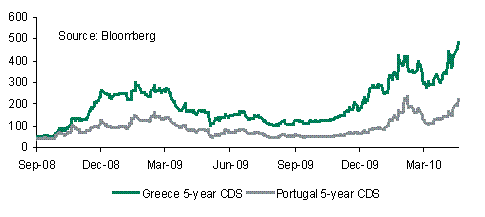
The talks have done nothing to prevent Greece’s bond yields moving higher, with the yield on 10-year bonds pushing well over 8% whilst the spread with Germany debt also blew out to over 500bps.  The main fear in the market is that Greece will ultimately end up restructuring its debt.  Moreover, contagion fears have dealt a blow to southern European sovereign CDS especially Portugal.  It wasn’t plain sailing for German bonds either, with yesterday’s auction of EUR 3 billion of 30-year Bunds failing to sell the full amount. 

Another casualty of ongoing Greece concerns is the EUR, with the currency under performing other majors and still on its path towards EUR/USD 1.3300 in the near term and onto 1.3150 after.   EUR also looks vulnerable on the crosses and EUR/GBP in particular is one to watch, with the 28 January low around 0.86029 likely to be targeted over the near term.  UK employment data gave some relief to GBP yesterday, with further direction coming from retail sales data today and the next televised leaders’ debate.  

At some point the market will become fatigued with consensus beating earnings and the positive impact on equities will become less marked.  This point is approaching but we’re not quite there yet.  Apple, Morgan Stanley and Boeing did not disappoint, with earnings easily beating forecasts.  Boeing’s earnings in particular helped industrials to be the best performing sector on the S&P 500 although the overall index closed marginally lower.

Earnings today include Amazon.com, American Express, Credit Suisse, Microsoft, Nokia, and PepsiCo.  It is becoming plainly obvious that market expectations for earnings are too pessimistic but as noted above the positive market impact of good earnings is likely to wane. 

On the data front, highlights include March existing home sales, jobless claims and Producer Price Index (PPI).   There will be less focus on PPI given that the Consumer Price Index (CPI) over the month has already been released whilst claims are likely to resume a path lower following the jump over the past couple of weeks.   Existing home sales are likely to post an impressive gain as indicated by firm pending home sales data.   

Overall, it appears that risk appetite is creeping back into the market psyche but the ongoing battle between positive earnings/data versus European/Greek woes suggests that there will be no clear direction for markets.  Improving risk appetite will ultimately win but current conditions will leave currencies trading within well worn ranges, with the exception of the underperforming EUR. In contrast the USD index is likely to remain supported, taking solace from positive data releases.

What To Watch This Week

Well so much for a “risk on” week. Market sentiment soured at the end of last week following The US Securities and Exchange Commission (SEC) civil action against Goldman Sachs, in which they accused the bank of fraud. The impact reverberated across markets and risk trades were pulled back as a consequence. Bulls shouldn’t be too downhearted though as the drop in risk trades followed several days of gains and part of the pullback could be attributed to profit taking.

Speculation of similar probes in Europe by financial regulators will cast a shadow over markets early this week. Nonetheless, direction will at least in part come from earnings. So far the run of earnings looks upbeat, with around 83% of the 48 S&P 500 companies reporting, beating analysts’ estimates. Overall profits are forecast to increase by around 30% from a year ago but are on track to easily beat this estimate. Bellwether names including IBM, Apple, Coca-Cola, Boeing, Microsoft, and AT&T report this week.

The meeting between Greek officials, ECB, IMF and EU has been delayed until Wednesday. There is little likelihood of Greece seeing any loan money soon as the need for parliamentary approval in some EU countries and upcoming regional elections in Germany on 9 May will put a spanner in the works. An issue of EUR 1.5bn of 3-month Greek debt tomorrow will act another test of market confidence but the recent widening in Greek debt spreads suggests a less positive reception than the previous sale.

There are also a few central bank meetings to contend with this week including Canada, Sweden, India, Philippines and Thailand. The only Bank likely to hike interest rates out of this bunch is the RBI in India with another hike expected, following closely on the heels of the March move. Canada and Sweden are unlikely to shift policy until at last after the end of Q2 whilst protests in Bangkok, Thailand, and the knock on impact on consumer confidence, have effectively sealed the case for no rate move there.

On the data front, attention will turn to US housing market activity. Markets will be able to gauge further clues to whether recovery in the housing market has stalled. An increase in both existing (Thu) and new home sales (Fri) in March is expected, which may allay some concerns although any improvement is likely to continue to fragile against the background of tight credit and high foreclosure levels.

In Europe, aside from the ongoing Greek sage, sentiment surveys will garner most attention, with the release of the German ZEW (Tue) and IFO (Fri) surveys as well as manufacturing and service sector purchasing managers indices (PMIs) across Europe. On the whole the surveys are likely to reveal some improvement as confidence.

Risk aversion will be slightly elevated at the beginning of this week but strong earnings and improving data will help to prevent too much damage. Consequently Risk currencies will start the week under pressure but any pullback will be limited. Given that speculative positioning in risk currencies such as the AUD, NZD and CAD is well above their three-month average according to the latest Commitment of Traders’ IMM data there will be some scope for profit taking. EUR speculative sentiment has seen some improvement but EUR/USD remains vulnerable to a further pull back to technical support around 1.3302 this week.

Shaping up to be a “risk on” week

It’s most definitely turning into a “risk on” week. On the earnings front both JP Morgan Chase and Intel beat forecasts whilst data releases did not disappoint either. In particular, US retail sales came in much stronger than expected. The Fed’s Beige Book also gave markets some good news to chew on. The reports from the twelve Federal Reserve Districts noted that economic activity “increased somewhat” since the March 3rd report.

The positive tone will continue today with the release of the March industrial production data, expected to show a strong gain over the month (consensus 0.7%), whilst both the Empire State and Philly Fed manufacturing surveys are set to post small gains in April, consistent with strengthening manufacturing activity in the months ahead.

Fed speakers have also been helpful for market sentiment. Fed Chairman Bernanke sounded a little more upbeat on the economy but highlighted the “significant restraints” remaining in the US economy. Bernanke maintained the “extended period” of low rates statement despite some speculation that the Fed was verging on removing this. The net impact of the testimony, improved data and earnings and firmer risk appetite is to keep the USD on pressure. In contrast, commodity currencies including AUD, NZD and CAD, will benefit, both from firmer risk appetite and an upturn in commodity prices.

Despite the positive reception to Greece’s debt auction there is not a lot of faith in the ability of Greece to weather the storm. Reports that Greece will need far more funding than has been initially promised by the EU/IMF – potentially as high as EUR 90 billion over coming years – together with worries about selling the loan package to the public in Germany and other eurozone countries, as well EU comments that Portugal will need further fiscal consolidation, have not done much good for confidence. Technically EUR/USD will see plenty of resistance around 1.3692.

After Singapore’s move to tighten monetary policy via the SGD revaluation, and following close on the heels of India, Malaysia and Vietnam, attention has turned to who’s next in line. South Korea must be a prime candidate, especially following data yesterday revealing a drop in the unemployment rate. Of course, China is very much in the spotlight and is set to embark on monetary tightening measures as well as CNY revaluation soon.

India is set to move again as early as next week, with inflation data today likely to seal the case for another hike (consensus 10.37% in March). The risk remains however, that many Asian central banks are moving too slowly to curb building inflation pressures and may find that they ultimately need to tighten more than they otherwise would have done.

China’s heavy slate of data released will if anything fuel greater expectations of an imminent CNY revaluation as well as monetary tightening. China’s economy grew a very strong 11.9% in Q1, above already strong consensus expectations, whilst CPI rose 2.4% YoY in March.

The growth data alongside further evidence of accelerating real estate prices highlight the risks of overheating in the economy and the need to act quickly to curb inflation threats. Given this expectation, firm risk appetite, and more follow through from Singapore’s FX move, the outlook for other Asian currencies remains positive.

Greek Saga Rumbles On – Does Anybody Care?

The debate over Greece continues to rumble on. France and Spain requested a separate summit meeting of the 16 heads of eurozone countries immediately before the full 27-member EU summit starting tomorrow but this was met with resistance. Meanwhile, Germany has called for “a substantial contribution” from the IMF towards a Greek aid package, whilst maintaining that no EU deal will be reached for Greece at the summit.

Frankly, the whole Greek saga has become extremely boring, with the lack of agreement about how to fix it doing little to inspire confidence. In particular the fractured opinion amongst EU leaders highlights the difficulties in reaching an agreement in a union made up of so many conflicting interests. At most the summit may agree on the conditions for a rescue package for Greece rather than a package itself. This will leave markets unimpressed,

US new home sales data today is likely to paint a slightly better picture with a small gain expected, albeit following the 11.2% plunge in the previous month. Sales will be helped by the extension of the home buyer tax credit. The US February durable goods orders report is also released today, with a small increase expected. A smaller gain in transport orders suggests that the 2.6% jump last month will not be repeated.

In Europe, the key release is the March German IFO business climate survey and a rebound is likely following February’s decline, helped by warmer weather and a weaker EUR. Flash readings of Eurozone March purchasing managers indices (PMIs) are also released but these are unlikely to extend gains from the previous month. Despite expectations of firmer data the EUR/USD is vulnerable to a further decline, with support around 1.3432 in sight for an imminent test.

Attention in the UK will turn to the pre-election Budget and particularly the government’s plans to cut spending and reduce the fiscal deficit. Failure to provide a credible blue print to restore fiscal credibility will damage confidence, heightening the risks of an eventual sovereign ratings downgrade and more pressure on GBP which appears destined for another drop below 1.50 versus USD.

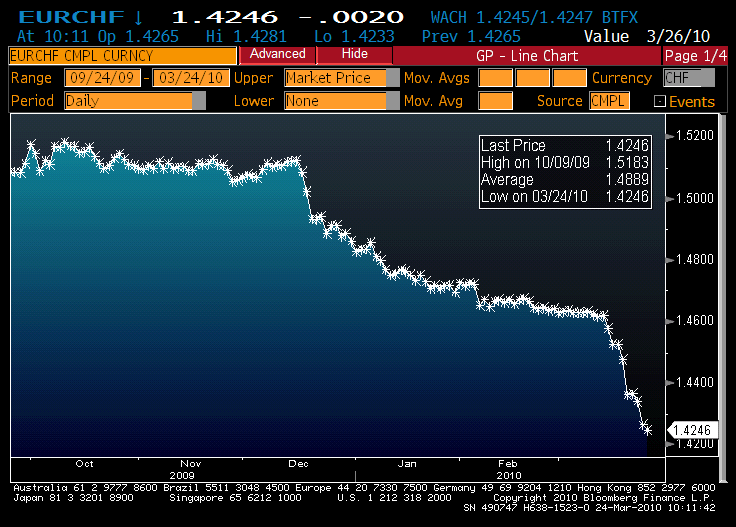
Most currencies have remained within ranges and the most interesting currency pair is EUR/CHF having failed to react to verbal warnings from the Swiss National Bank (SNB) about excessive CHF strength. EUR/CHF looks vulnerable to a further decline unless the SNB follows up rhetoric with action. Even if there is FX intervention by the SNB it may prove to be a temporary barrier to a market with an eye on the psychologically important 1.4000 level.

Despite the pressure on the Japanese government and Bank of Japan (BoJ) to engineer a weaker JPY, export performance has proven resilient, with exports jumping 45.3% on the year in February, helped by the strength of demand from Asia. Unfortunately this is doing little to end Japan’s deflation problem and even if there is less urgency for a weaker JPY to boost exports, JPY weakness will certainly help to reduce deflationary pressures in the economy. USD/JPY is stubbornly clinging to the 90.00 level, with little inclination to move in either direction.