Draghi shakes things up

European Central Bank President Draghi shook things up overnight providing a major backstop for risk assets. Draghi effectively noted that the ECB “is going to do whatever is necessary to preserve the EUR”. The aggressiveness of his comments left no doubt that the ECB chief means business.

Whether this translates into renewed bond buying by the central bank is debatable but this is what the market is now hoping for at next week’s ECB policy meeting. Anything less would provoke disappointment.

At the least Draghi has helped to put a floor under the EUR ahead of the policy meeting. After dropping to a low around 1.2117 the currency bounced sharply but its gains were exhibited mainly against the USD rather than on the crosses. Further short covering could see EUR/USD move up to around the 1.2350 resistance level but much further gains are expected to be limited.

The biggest beneficiaries of Draghi’s comments were equity volatility which dropped sharply and Spanish stocks, which rallied by over 6% yesterday. Gold also rallied in the hope of central bank action next week. In terms of Asian currencies, those most sensitive to risk gyrations including KRW, MYR, INR and IDR will be the biggest beneficiaries.

Attention today will turn to data releases including July German inflation data and Q2 US GDP. A weak US GDP may put a bit of a dampener on sentiment especially as it will highlight the sharp slowing in growth over the quarter.

Nonetheless, markets are likely to move into consolidation mode ahead of next week’s ECB and Fed meetings, with risk assets generally supported by expectations / hopes of policy actions by both or either central bank. One index which remains on a downward trajectory is the Baltic Dry Index, which dropped further overnight, highlighting the growing risks to the global economy.

Is gold losing its lustre?

Hopes and expectations of more Fed quantitative easing in the wake of a run of weak US data, including the US May jobs report, has been attributable to the bounce in gold prices over recent weeks. However, Fed Chairman Bernanke dampened such hopes in his speech to Congress, in which he did not indicate a desire to move towards more QE. The Fed is unlikely in my view to embark on more QE any time soon.

Clearly, should the Fed implement more QE it will help to renew the attraction of gold. Once again markets will see the consequences of Fed QE as a means to debase the USD. A shift in Fed stance cannot be ruled out if US economic conditions worsen further and/or the Eurozone crisis escalates. Assuming no more QE and no more USD debasement, gold prices ought to decline over coming months.

One of the biggest factors putting downward pressure on gold prices has been the strength of the USD. While I do not expect the USD to continue to strengthen at the same pace as it has done recently, further gradual gains in the currency are likely. My FX forecasts predict a further small gain for the USD index by the end of the year but I also believe that the recent run up in the USD may have been too rapid. Assuming that the USD continues on a gradual upward trajectory I expect it to exert a negative influence on gold prices.

Gold appears to have lost its sensitivity to risk aversion. Indeed, gold’s relationship with risk has actually inverted over recent months, with a negative but significant relationship registered over the past 3 months between gold prices and my Risk Aversion Barometer. In other words as risk aversion goes up, gold prices actually drop.

The lack of reaction to higher risk aversion shows that the lustre of gold as a safe haven has faded as investors pull capital out of this as well as many other asset classes. However, gold’s drop is not unusual when compared to other commodity prices, with oil and copper prices falling too and gold maintaining a strong correlation with these commodities.

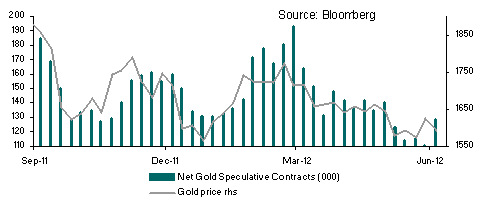
Some deterioration in sentiment towards gold prices has been reflected in the drop in speculative appetite for the commodity. Speculative demand for gold hit a cyclical high in August 2011 but since then there has been a steady reduction in appetite for gold from these investors. Indeed, CFTC IMM data reveals that speculative gold positioning dropped well below its three-month average. However, positioning is still well above its all time lows reached in February 2005, suggesting if anything, there is scope for more declines.
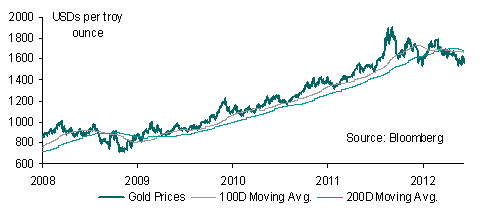
On top of the drop in speculative appetite for gold the technical picture has turned bearish. Since March 2009 at the height of the financial crisis the 100 day moving average price of gold had been trading above the 200 day moving average. On 27 March 2012 the 100 day moving average crossed below the 200 day moving average. Moreover, gold is now trading below both the 100 and 200 day moving average prices which sends a bearish technical message. Over the near term some key levels to look for are the 100 day moving average around 1658 on the topside and trendline support around the 1530 level on the bottom.
Another determinant of gold prices is demand from India and China. Growth in both countries is slowing, suggesting that gold demand is also weakening. While I certainly do not expect a collapse in demand from either country I have no doubt that compared to last year the strength of demand will be softer over coming months. Although I still look for a soft landing in China the Indian economic picture has clearly deteriorated while the Indian rupee has weakened. A weaker INR means that has become increasingly more expensive to import gold to India for domestic purchasers.

Overall, a weaker real demand picture taken together with reduced speculative appetite implies little support for gold prices. Moreover, a firmer USD in general will continue to weigh on prices. Perhaps a dose of inflation would help gold prices but there is little risk of this given the still sizeable amount of excess capacity in major economies.

Uncertainty about QE will help to limit any downside pressure on gold prices but elevated risk aversion will provide little assistance to gold. If however, the Eurozone and global picture deteriorates further gold will find itself with a lifeline but only if this means more currency debasement and a Fed engineered lower USD. If not, a further decline is on the cards and I forecast a drop in gold prices to around USD 1475 by the end of the year.

Waiting for a solution to Europe’s crisis

The boost to sentiment following Germany’s approval of changes to the EFSF bailout fund was brief. Although the outcome of the vote was not particularly surprising political concerns were assuaged by the fact that Chancellor Merkel secured support from within her coalition. Markets were also helped by a bigger than expected drop in weekly US jobless claims but this also failed to provide a lasting impact.

The bottom line is that there is still a huge degree of scepticism on the ability of policymakers to resolve the crisis in the eurozone periphery while growth worries have not receded. Even the approved changed to the EFSF bailout fund are increasingly being seen as old news given the view that it will need deeper changes including ‘leveraging’ it up.

Consequently risk aversion remains at a highly elevated level and is showing no sign of easing. It may be difficult to turn sentiment around as we go into the final quarter of the year, especially as those investors registering profits for the year may want to capitalise on these profits rather than sit through continued volatility in the weeks ahead. Indeed the sharp drop in gold prices over the last couple of weeks even in an environment of elevated risk aversion may reflect this.

Similarly risk assets may struggle to recover over coming weeks unless there is a major improvement in the situation in Europe or in growth data. Markets will go into the end of this week looking ahead to key events next week including an Ecofin meeting at the beginning of next week, a European Central Bank (ECB) meeting and the US September jobs report.

There will be plenty of attention on the Ecofin meeting of European Finance Ministers on Monday especially given that much of the reason for the stability in markets recently is the hope of concrete measures to resolve the crisis in the region. In this respect the scope for disappointment is high, suggesting that the EUR is vulnerable to a further drop.

While the extent of short market positioning at the beginning of week left open some scope for EUR short covering the absence of any good news will mean the impetus for short covering diminishes. Unless the Ecofin meeting delivers on expectations EUR/USD will likely re-test the 26 September low around 1.3363.

Greece’s trials and tribulations

Two main influences on markets continue to weigh on sentiment. Firstly the trials and tribulations of the eurozone periphery remain centre of attention. The failure of Greek Prime Minister Papandreou to win cross party support for austerity measures at the end of last week highlights the problems Greece is facing both domestically and externally.

Reports that European officials are negotiating tough bailout conditions including major external intervention in terms of tax collection and privatisation suggest that gaining further aid will not be easy. The second weight on market sentiment is global growth concerns, with a string of disappointing data releases over recent weeks leading to an intensification of concerns about the pace of recovery.

Markets will likely remain nervous in this environment and it is difficult to see risk appetite improving to any major degree. This has proven bullish for bond markets, with the tone set to continue this week. Currencies remain in ranges and holidays today in the US and UK will likely result in thin trading. The resilience of the EUR to peripheral concerns has been impressive but at the same time Greek concerns will limit any gains. Meanwhile, gold and precious metals look to remain well supported, with gold’s safe haven bid remaining solid.

USD sentiment has improved sharply according to the latest CFTC IMM report which reveals that net USD short positions have been cut in half over the last two weeks with positioning well above the 3-month average. Conversely net EUR longs continue to shrink as speculative investors off load the currency. The fact that the EUR is not weaker than it is points to the influence of official demand for the currency, especially from Asia.

This week will likely be dominated by ongoing discussions about Greece and given the opposition to austerity measures and potentially strict bailout terms, forging an agreement will not be easy. Reports suggest that around half of Greece’s financing needs until the end of 2013 could be accounted for without new loans via privatisation and changes in terms for private bondholders, with Europe and the IMF needed to lend an additional EUR 30-35 billion on top of the EUR 110 already slated.

Data releases are likely to take a back seat but there will still be plenty of attention on the key release of the week, namely the May US jobs report. The market looks for a 185k increase in payrolls, with the unemployment rate edging lower to 8.9%. This would mark the lowest payrolls reading in 4 months. Clues to the jobs data will be garnered from the May ADP jobs report, ISM manufacturing survey and consumer confidence data earlier in the week.

Egypt Unrest Hits Risk Trades

Recent weeks have seen a real contrast in policy and growth across various economies. A case in point was the surprise drop in UK GDP in Q4 contrasting sharply with the solid (albeit less than forecast) rise in US Q4 2010 GDP. The resilience of the US consumer was particularly evident in the data. The European Central Bank’s (ECB) hawkish slant as reflected in comments from President Trichet compared to the dovish pitch of the Fed FOMC is another clear contrast for markets to ponder.

The ECB’s hawkish tone gave the EUR a lift but expectations of an early Eurozone rate hike looks premature. Although Eurozone inflation data (Monday) will reveal a further rise in CPI above the ECB’s target, to around 2.4% in January, this will not equate to a policy rate hike anytime soon. This message is likely to be echoed at this week’s ECB meeting where policy will be characterised as “appropriate”.

Whilst monetary tightening expectations look overdone in the Eurozone the same can be said for hopes of an expansion in the EU bailout fund (EFSF). Indeed, the fact that EU Commissioner Rehn appeared to pour cold water over an expansion in the size of the fund could hit the EUR and the currency may find itself struggling to extend gains over coming weeks especially if interest rate expectations return to reality too, with a move to EUR/USD 1.4000 looking far harder to achieve than it did only a few days ago.

It’s worth noting that a renewed widening in peripheral debt spreads will also send an ominous signal for the EUR. Against this background the EU Council meeting on February 4 will be in focus but any expectation of a unified policy resolution will be disappointed.

However, markets perhaps should not solely focus on peripheral Europe as the downgrading of Japan’s credit ratings last week highlights. Warnings about US credit ratings also demonstrate that the US authorities will need to get their act together to find a solution to reversing the unsustainable path of the US fiscal deficit, something that was not particularly apparent in last week’s State of the Union Address.

Last week ended with a risk off tone filtering through markets as unrest in Egypt provoked a sell-off in risk assets whilst worries about oil supplies saw oil prices spike. Gold surged on safe haven demand too. This week, markets will focus on events in the Middle East but there will be thinner trading conditions as Chinese New Year holidays result in a shortened trading week in various countries in Asia.

The main release of the week is the US January jobs report at the end of the week. Regional job market indicators and the trend in jobless claims point to a 160k gain in January although the unemployment rate will likely edge higher. Final clues to the payrolls outcome will be deemed from the ISM manufacturing confidence survey and ADP private sector jobs report this week. Whilst the January jobs report is unlikely to alter expectations for Fed policy (given the elevated unemployment rate) the USD may continue to benefit from rising risk aversion.