Money Printing

It was a day of surprises on Tuesday as the Bank of Japan (BoJ) not only created a JPY 5 trillion fund to buy domestic assets including JGBs but also cut interest rates to zero. Expect more measures to come in the fight against a stronger JPY and deflation. The Reserve Bank of Australia (RBA) also surprised markets by leaving its policy rate unchanged at 4.5% delaying another rate hike yet again despite expectations by many including ourselves of a 25bps rate hike.

The easier policy stance from the BoJ and RBA taken together with firmer service sector purchasing managers indices – including the September US ISM non-manufacturing survey, which came in at 53.2 from 51.5 – gave risk appetite a solid lift. Even the AUD which dropped sharply following the RBA decision, managed to recoup all of its losses and more overnight.

Japan’s decision could have set the ball rolling for a fresh round of quantitative easing (QE) from central banks as they combat sluggish growth prospects ahead and ongoing deflation risks. The US Fed as has been much speculated on and the Bank of England (BoE) are likely candidates for more QE. Whilst the European Central Bank (ECB) is unlikely to adopt such measures there are reports that board members are split over the timing of exit policy. The BoE decision on Thursday may provoke more interest than usual against this background although the Bank is unlikely to act so quickly. The Fed on the other hand appears to be gearing up for a November move.

Growing prospects of fresh QE looks likely to provide further impetus for risk trades. Notably commodity prices jumped higher, with the CRB commodities index at its highest level since the beginning of the year. Although there is plenty of attention on the gold price which yet a fresh record high above $1340 per troy ounce as well as tin which also hit new highs, the real stars were soft commodities including the likes of sugar, coffee and orange juice up sharply.

The main loser once again is the US dollar and this beleaguered currency appears to be finding no solace, with any rally continuing to be sold into, a pattern that is set to continue. Although arguably a lot is in the price in terms of QE expectations, clearly the fact that the USD continues to drop (alongside US bond yields) highlights that a lot does not mean that all is in the price.

The USD is set to remain under pressure against most currencies ahead of anticipated Fed QE. The fact that the USD has already dropped sharply suggests a less pronounced negative USD reaction once the Fed starts buying assets but the currency is still set to retain a weaker trajectory once the Fed USD printing press kicks into life again as a simple case of growing global USD supply will push the currency weaker.

USD weakness will only spur many central banks including across Asia to intervene more aggressively to prevent their respective currencies from strengthening. A “currency war” looms, a fact that could provoke some strong comments at this weekend’s IMF and World Bank meetings. In the meantime intervention by central banks will imply more reserves recycling, something that will continue to benefit currencies such as EUR and AUD.
USD pressure, EUR resilience, GBP whipsawed

Speculation the Fed will begin a new program of asset purchases or QE2 as soon as November is intensifying. The weaker than expected reading for US consumer confidence in September released on Tuesday has only added to this expectation as sentiment continues to be hit by job market concerns. Against this background the USD remains under strong downward pressure, with little sign of any turnaround.

The prospects of further USD debasing as well as intervention in many countries to prevent their currencies from strengthening against the USD continues to power gold prices which hit a new record high having breezed through the $1300 per troy ounce mark. In the current environment it is hard to see gold prices turning much lower although there may be some risk of profit taking in the weeks ahead.

The EUR remains a key beneficiary of USD weakness but this currency has problems of its own to contend with. Indeed, peripheral debt concerns, especially with regard to Ireland and to a lesser extent Portugal have increased, with borrowing costs rising as the yield on their debt widens against core eurozone debt. The stronger EUR will only make it harder for these countries to achieve any sort of recovery and could also damage the stronger exporting countries of Northern Europe led by Germany.

So far however, the EUR has managed to show some impressive resilience to renewed peripheral country sovereign debt concerns including comments by S&P about the high costs of rescuing an Irish Bank. Perhaps the knowledge that there is a still a huge bailout fund from the EU and IMF available if needed and also the prospect that the ECB will increase its buying of eurozone debt, has provided a buffer for the EUR.

At some point the ECB may be forced to join the battle in at least attempting to talk its currency lower but at this stage the central bank is showing no inclination to either talk down the currency or physically intervene to weaken the EUR. In the meantime, EUR/USD is likely to strengthen further despite the likely negative impact on European growth, with the currency likely to set its sights on an eventual break above 1.40.

One currency that may struggle in the wake of expectations of Fed QE2 is GBP. Uncertainty over whether the Bank of England will follow the Fed in implementing further quantitative easing could see GBP lag the gains in other currencies against the USD. Conflicting comments from MPC members Posen who noted that there may be a need for further QE in the UK to support the faltering economy were countered by Sentance who noted that there was no need for more QE. GBP/USD is likely be whipsawed as the debate continues and is set to lose further ground against the EUR.

Pandemonium and Panic

Pandemonium and panic has spread through markets as Greek and related sovereign fears have intensified. The fears have turned a localized crisis in a small European country into a European and increasingly a global crisis.  This is reminiscent of past crises that started in one country or sector and spread to encompass a wide swathe of the global economy and financial markets such as the Asian crisis in 1997 and the recent financial crisis emanating from US sub-prime mortgages.  

The global financial crisis has morphed from a credit related catastrophe to a sovereign related crisis. The fact that many G20 countries will have to carry out substantial and unprecedented adjustments in their fiscal positions over the coming years means the risks are enormous as Greece is finding out. The IMF estimate that Japan, UK, Ireland, Spain, Greece, and the US have to adjust their primary balances from between 8.8 in the US to 13.4% in Japan. Such a dramatic adjustment never been achieved in modern history.

Equity markets went through some major gyrations on Thursday in the US, leading to a review of “unusual trading activity” by the US Securities and Exchange Commission in the wake of hundreds of billions of USDs of share value wiped off in the market decline at one point with the Dow Jones index recording its biggest ever points fall before recouping some of its losses. Safe haven assets including US Treasuries, USD and gold have jumped following the turmoil in markets whilst risk assets including high equities, high beta currencies including most emerging market currencies, have weakened. Playing safe is the way to go for now, which means long USDs, gold and Treasuries.

There is plenty of expectation that the G7 teleconference call will offer some solace to markets but this line of thought is destined for disappointment. Other than some words of comfort and support for Greece’s austerity measures approved by the Greek government yesterday, other forms of support are unlikely, including intervention to prop up the EUR. The ECB also disappointed and did not live up to market talk that the Bank could embark on buying of European debt and it is highly unlikely that the G7 will do so either. Into next week it looks like another case of sell on rallies for the EUR.   Remember the parity trade, well it’s coming back into play. 

Aside from the turmoil in the market there has been plenty of attention on UK elections. At the time of writing it looks as though the Conservatives will win most seats but fall short of a an overall majority. A hung parliament is not good news for GBP and the currency is likely to suffer after an already sharp fall over the last few days. GBP/USD may find itself back towards the 1.40 level over the short-term as concerns about the ability of the UK to cut its fiscal deficit grow. A warnings by Moody’s on Friday that the “UK can’t postpone fiscal adjustments any longer” highlights the risk to the UK’s credit ratings and to GBP.

Gold / FX correlations

There is no shortage of cash rich investors in Asia even amidst the current troubles in Dubai. Indeed, sentiment in the gemstones market is particularly upbeat, with a rare five-carat pink diamond selling for a record HK$84.24 million in Hong Kong. Perhaps this is a good reflection of abundant liquidity and of course wealth in Asia and in particular China, with talk that mainland Chinese investors were strong participants in the diamond auction.

It’s not just diamonds that are selling for record prices; gold hit a fresh high above $1,200 and once again at least part of this is attributable to the appetite of Asian central banks as well as demand from China as the country tries to increase its gold reserves. The rise in gold prices has coincided with a bullish announcement from the world’s top gold producer that it has completely eliminated its market hedges earlier than forecast due to the positive outlook on prices and waning supply.

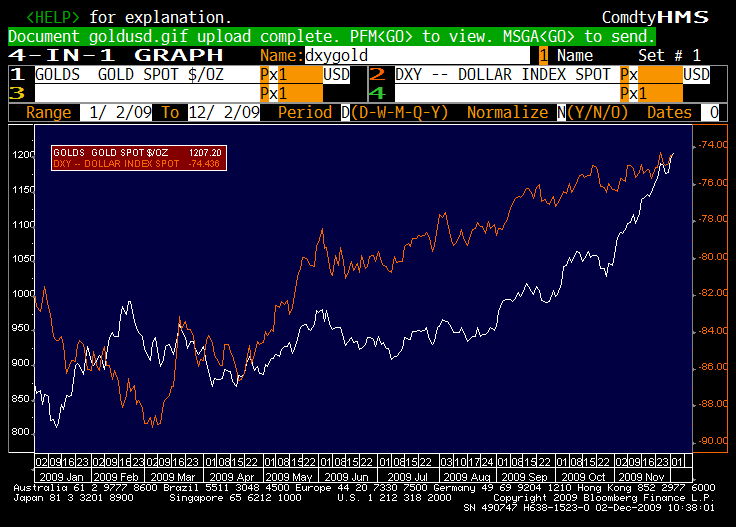
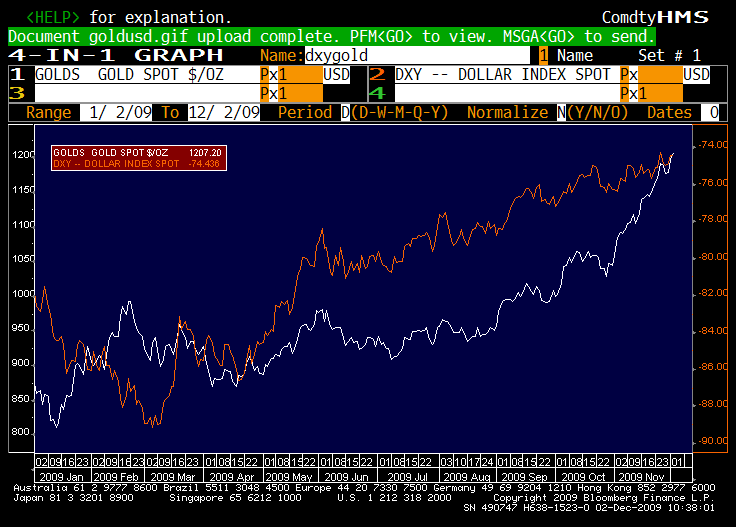
The correlation between gold prices and the USD remains very strong at -0.88 over the last 3-months, with firmer gold prices, implying further USD weakness. In fact, the gold / USD correlation has been consistently strong over the past few months and is showing little sign of diminishing.

Over the past 6-months the correlation has been -0.91 and over the past 1-month it was -0.75.  Assuming that anything above 0.70 can be considered statistically significant, the relationship shows that USD weakness has been well correlated with gold strength and that despite talk of a breakdown in the relationship it appears to remain solid. 

As long as the bullish trend in gold continues, the pressure on the USD will remain in place.  Adding to this pressure is the fact that risk is back on for now. Markets took the news of a fall in the ISM manufacturing index and in particular the drop in the employment component in its stride even though it supports the view of a weaker than consensus drop in payrolls in November when it is published on Friday.

There are still plenty of reasons to be cautious in the weeks ahead and although we appear to be back in a “risk on” environment markets are likely to gyrate between “risk on” and “risk off” over coming weeks. At least for now, the USD looks to remain under pressure but if risk aversion creeps back up as I suspect it may then the USD will see a bit more resilience into year end. 

Moreover, central banks globally are reaching the limits of their tolerance of USD weakness and will be tested once again, with EUR/USD back above 1.5000, EUR/CHF moving back below 1.5100 and the USD/JPY set to re-test 85.00 following the relatively benign measures announced by the BoJ in which the Bank did little to stem deflationary pressure or weaken the JPY.