Euro extends gains, yen pressured

The EUR found another spurt of life following the release of the stronger than expected February German IFO business confidence survey yesterday. The data helped make up for the disappointment related to the manufacturing and service sector surveys. However, while it may have alleviated concerns about weakening growth in Germany it only serves to highlight the disparities in growth across the Eurozone.

I continue to believe the EUR may struggle to sustain gains. In the near term, after breaking above 1.3320 resistance, EUR/USD will face further resistance around 1.3460. Nonetheless, my 2012 year end forecast of EUR/USD 1.26 shows that despite growing growth pressures in the Eurozone economy the EUR will still find underlying support from a healthy external balance and continued EUR buying from Asian official investors.

Over the near term upcoming votes in various countries on the second Greek bailout deal will provoke some nervousness while Greek reform implementation risks will also act to dampen EUR sentiment.

JPY has faced significant degree of pressure since the beginning of February. As noted previously one of the biggest sources of upward pressure on USD/JPY has been the widening in US – Japan 2-year bond yield differentials. US bonds currently yield around 19 basis points above Japan, the highest gap since August 2011. The widening yield gap already appears to be prompting foreign outflows from Japanese bonds, with outflows registered in six of the seven past weeks. These outflows have helped contribute to the weakness in the JPY.

The fact that the BoJ will step up its purchases of Japanese government bonds (JGBs) will also add to the downward pressure on the JPY as it will mean a further widening in US – Japanese yield differentials. Over the short term USD/JPY may face some resistance above the 80 level and I suspect that it will lose some momentum but maintain my view that it will reach 85.0 by the end of the year.
EUR capped, NOK strength overdone

The positive reaction to the Greek bailout deal failed to gain traction leaving risk assets under a degree of pressure. The fact that the deal was highly expected played a role in the unenthusiastic reaction but markets may also be cautious given the major tasks that still like ahead including a tough reform timetable for Greece, parliamentary approvals in various countries and implementation of the debt swap.

EUR looks stretched. The lack of follow through in terms of EUR upside suggests that the currency will struggle. The news of the deal came as a relief to markets but after so many days of negotiations failure to agree would have been inconceivable. However, the aftermath has seen renewed doubts creep into the market especially given the short time horizon (just nine days) for Greece to implement reform measures.

Market positioning suggests that there is still scope for some EUR upside but I doubt that the deal will be sufficient to prompt a big wave of short covering. Eurozone fundamentals remain weak and if anything the exercise in forming an agreement about Greece has revealed various splits within the Eurozone. Superior US growth expectations plus relatively higher US bond yields suggest EUR will struggle to extend gains in the medium term. Short term EUR/USD gains are likely to be capped at 1.3322.

EUR/NOK has dropped sharply over recent weeks, with NOK strength accelerating in February. The currency has been the second best performer versus EUR so far this year much to the chagrin of Norwegian officials who feel that the strength in the currency will weigh on the economy. Such concerns should be taken at face value. The NOK is highly overvalued according to various measures of ‘fair value’ but I do not expect the strength in NOK to persist over the short term.

Last week, warnings from Norway‘s central bank that they are ready to act to curb NOK strength may provoke some hesitation to enter long NOK positions especially as weakening economic growth will only strengthen the resolve of officials to prevent excessive currency strength. The NOK is sensitive to risk aversion and any correction in the recent rally in risk appetite could render the NOK highly vulnerable to renewed weakness.

Which is the ugliest currency?

The contest of the uglies has once again been set in motion in FX markets as last Friday’s weak US jobs report, which revealed a paltry 18k increase in June payrolls, downward revisions to past months and a rise in the unemployment rate, actually left the USD unperturbed. Europe’s problems outweighed the negative impact of more signs of a weak US economy, leaving the EUR as a bigger loser.

The USD’s resilience was even more impressive considering the drop in US bond yields in the wake of the data. However, news over the weekend that talks over the US budget deficit and debt ceiling broke down as Republicans pulled out of discussions, will leave USD bulls with a sour taste in their mouth.

Should weak jobs recovery dent enthusiasm for the USD? To the extent that it may raise expectations of the need for more Fed asset purchases, it may prove to be an obstacle for the USD. However, there is sufficient reason to look for a rebound in growth in H2 2011 while in any case the Fed has set the hurdle at a high level for more quantitative easing (QE).

Fed Chairman Bernanke’s reaction and outlook will be gleaned from his semi-annual testimony before the House (Wed) although he will likely stick to the script in terms of US recovery hopes for H2. This ought to leave the USD with little to worry about. There will be plenty of other data releases this week to chew on including trade data, retail sales, CPI and PPI inflation and consumer confidence as well as the kick off to the Q2 earnings season.

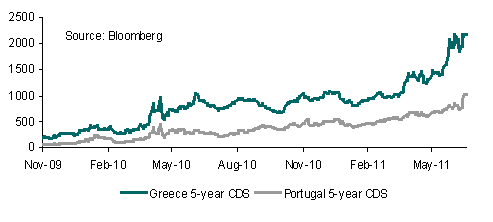
Fresh concerns in Europe, this time with contagion spreading to Italy left the EUR in bad shape and unable to capitalise on the soft US jobs report. In Italy high debt levels, weak growth, political friction and banking concerns are acting in unison. The fact that there is unlikely to be a final agreement on second Greek bailout package at today’s Eurogroup meeting will act as a further weight on the EUR.

Discussions over debt roll over plans, the role of the private sector and the stance of ratings agencies will likely drag on, suggesting that the EUR will not find any support over coming days and will more likely lose more ground as the week progresses. If these issues were not sufficiently worrisome, the release of EU wide bank stress tests on Friday will fuel more nervousness. Against this background EUR/USD looks vulnerable to a drop to technical support around 1.4102.

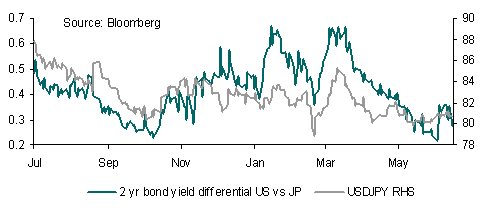
The Bank of Japan is the only major central bank to decide on interest rates this week but an expected unchanged policy decision tomorrow is unlikely to lead to any JPY reaction. In fact there appears to be little to move the JPY out of its current tight range at present. USD/JPY continues to be the most correlated currency pair with 2-year bond yield differentials and the fact that the US yield advantage has dropped relative to Japan has led to USD/JPY once again losing the 81.0 handle.

However, as reflected in the CFTC IMM data the speculative market is still holding a sizeable long position in JPY, which could result in a sharp drop in the currency should US yields shift relatively higher, as we expect over coming months. In the short-term USD/JPY is likely to be well supported around 80.01.