What would a Greek exit mean for the euro?

Excuse the lack of posts over recent days. I’m just finishing up a trip to London and am back in HK at the end of the week. I thought in the meantime it would be worth discussing the impact on the euro of a potential Greek exit.

The fact that European officials are openly talking about the prospects of a Greek exit from the Eurozone highlights just how drastic the situation has become. Much will depend on the outcome of new government in Greece in mid June following inconclusive elections recently. Even fresh elections in mid June does not mean that it will be any easier to form a government, leaving the option of a euro exit firmly on the table.

If Greece was to leave the Eurozone there would be a significant amount of confusion in FX markets. It is not obvious that the EUR would strengthen. It could be argued that the departure of Greece would eliminate the weakest link in the chain thus allowing the EUR some relief. Should Greece default on its debt and leave the Eurozone it would not have a marked direct impact on the Eurozone economy but the biggest risk is the financial contagion to other Eurozone countries.

A Greek exit would imply a new currency (Drachma) for the country, a separate monetary policy etc. However, any competitive gain from a weaker currency would be lost in a huge increase in inflation while the local corporate sector would be forced to default en mass on any EUR debt that they hold. Confidence in the new currency would be weaker leading to an exodus of capital further strengthening the EUR.

Admittedly the Eurozone would be stronger without Greece but it would not be long before market attention turned to Portugal and Ireland and even Spain as the next candidates for exit. Indeed, a Greek exit would set a precedent that did not exist previously. It would imply a significant increase in volatility for the EUR given the uncertainty it would create for other Eurozone members. Any rally in the EUR that would be experienced following a Greek exit would therefore be very short lived.

Ultimately for the EUR to experience a sustained strengthening it would require some sign that policy makers are addressing growth concerns as well as progress on austerity and deficit reduction. The formation of a common Eurobond, increased spending on investment projects to enhance productivity, reform of labour markets and a bolstering of the firewall around other peripheral countries would help confidence.

However, this is a long way off and the EUR is likely to suffer for some months to come as growth worries and peripheral country tensions persist. The downside risks to the EUR are clearly opening. The fact that the market is very short EUR already may limit the pace of decline but not stem it. There may be some stabilisaiton of the EUR towards year end assuming Eurozone officials get their act together.

However, in the interim the situation could become far more dire. If Greece were to exit, the prospects of further financial contagion would result in more and not less pressure on the EUR, leading to a potential drop to around the mid 2010 lows just below 1.20. Even if Eurozone political and debt tensions subside I still believe the EUR will decline based on an unfavourable growth and yield differential trajectory but it is clear that the downside risks are much greater even with short market positioning, should the situation deteriorate. In this event, even the strong bids from official investors (namely Asian central banks and sovereign wealth funds) will pull back and the EUR could plunge sharply.
Greek tensions hit EUR, Aussie jobs boost AUD

Eurozone tensions continue to act as a weight on global market sentiment and the EUR. Talk of a delay of part or all of the second Greek bailout until after elections in April has intensified speculation of a disorderly Greek default. Chinese support for Europe expressed yesterday has done little to alleviate the strain. Attention will now turn to the meeting of the Eurogroup in Brussels on Monday.

Relatively positive US economic data including a jump in the NAHB homebuilders survey to its highest level since May 2007 and hints by Federal Reserve officials of support for more quantitative easing in the minutes of the Jan 24-25 FOMC meeting have failed to outweigh negative developments in Europe.

A ‘risk off’ tone will filter through markets today. Data wise, US Philly Fed and housing starts will continue the positive tone of US releases, while in Europe bond auctions in France and Spain will be watched closely.

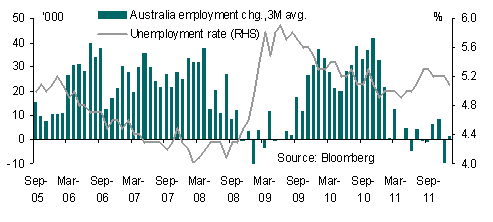
Australian jobs data for January came in stronger than forecast, rising by 46.3k compared to consensus of 10k. The unemployment rate surprisingly dropped to 5.1%. The increase in jobs more than made up for last month’s disappointment and highlights some signs of stability in job market conditions. Moreover, the data supports last week’s decision by the Reserve Bank of Australia (RBA) to keep rates on hold.


AUD jumped on the data but I expect the follow through to be limited especially given the fact that the AUD remains one of the most sensitive currencies to risk aversion. Upside will be restrained to resistance around 1.0788 versus USD today.

Euro slides as Greek worries intensify

The USD ended last week on high a note having overcome speeches by Fed Chairman Bernanke and President Obama. Bernanke’s lack of detail on potential further Fed stimulus offered the USD a lifeline as there was no mention of QE3 but nervousness may mount ahead of the September 21 FOMC meeting.

This week’s data releases (including retail sales, inflation, industrial production and regional manufacturing surveys may offer some direction to the USD and it is likely that the data over coming days will look less negative than in past weeks, giving the USD some support. Having broken above its 200 day moving average around 76.1986 for the first time in a year the USD index is set to begin the week in positive mode and will likely extend its gains over coming days.

In sharp contrast, EUR/USD crumbled at the end of last week dropping through its 200 day moving average despite positive news from Germany (rejection of bills in the constitutional court) and Italy (passage of austerity measures). The European Central Bank (ECB) did not help the EUR’s cause however, with the change in its stance to a more balanced assessment of risks from its more hawkish stance previously.

However, the real damage occurred as speculation of a Greek default intensified and ECB hawk Stark resigned from the ECB council, highlighting the divisions within the governing board. This week attention will remain on Greece as negotiations between the Troika (ECB, EU and IMF) and Greek officials resume.

Ahead of the talks Greece approved a further EUR 2 billion in austerity measures over the weekend but nonetheless, despite denials by Greek officials speculation of a debt default will continue to hammer the EUR lower. Near term technical support is seen around 1.3525 for EUR/USD.

GBP found some relief last week following the decision by the Bank of England to leave policy unchanged though it is unlikely to be able to make much if any headway against the USD over coming sessions as expectations of further UK quantitative easing may simply have been pushed back to the November meeting.

Inflation data this week will give further clues to policy but once again there is likely to be no sign of any easing in inflation pressure, limiting the room for maneuver for the BoE. Moreover, a weak outcome for UK retail sales in August will maintain the trend of soft UK data keeping up the pressure for more BoE action. As a result GBP will struggle against the USD but given that problems in Europe look even worse, GBP will likely extend gains against the EUR this week.