
Last week ended with a downward revision to US Q2 GDP. The data clarified that growth momentum going into Q3 was indeed quite weak though it probably didn’t take the GDP revision to tell us this nugget of information, something that has been evident from the run of weak data over recent months.
Softer growth in Q2 placed particular attention on the Jackson Hole speech by Fed Chairman Bernanke in which he acknowledged the slowing in the pace of growth, but also forecast a moderate economic recovery in H2 2010. Importantly if the Fed is proven wrong he noted the FOMC would undertake unconventional (quantitative easing) QE II measures if needed.
The net impact on Bernanke’s speech and the smaller than expected downward revision to US Q2 GDP was to provide a boost to risk appetite. Sentiment will at least begin this week on a positive note in the knowledge that the Fed stands ready to act although double dip fears are far from over.
One trigger for Fed action will be a further deterioration in job market conditions and markets will pay close attention to the August US jobs report at the end of the week. Bloomberg consensus estimates forecast a 100 drop in payrolls, with private payrolls up 47k and the unemployment rate edging higher to 9.6%. Such an outcome would do little to boost confidence in a jobs market recovery.
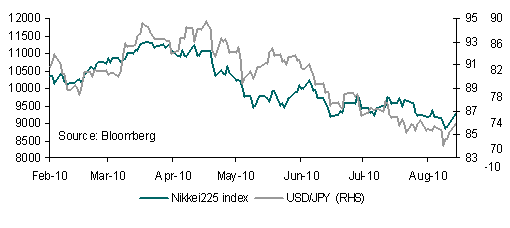
The week begins with all eyes on Japan however, with an emergency Bank of Japan (BoJ) meeting in focus. USD/JPY has already jumped higher on the belief that concrete action will emerge to weaken the JPY. The risk of disappointment is high and at most the BoJ will announce measures to extend loans to banks. A lack of other action especially in the form of FX intervention alongside a likely increase in risk aversion once the Bernanke bounce wares off, will result in a renewed USD/JPY move lower, with a breach of 85.00 likely. As seen in the chart below a decisive turn in the Japanese stocks will be a key factor in helping to eventually drive USD/JPY higher.
Two other central bank meetings of note this week are the European Central Bank (ECB) and Sweden’s Riksbank meetings on Thursday. No change in policy by the ECB will be of little surprise but the release of new staff projections, with growth likely to be revised up in 2010 but left unchanged for 2011, will be of interest. Developments regarding open market operations will also be of attention. In contrast, the Riksbank is widely expected to hike rates by 25bps on the back of a firming economy and house price inflation.
A UK holiday today will likely keep liquidity thin and as noted above risk currencies including AUD, NZD and CAD as well as Asian currencies will start the week firmer but will struggle to hold gains as the week progresses. EUR/USD has benefited little from improved risk appetite and will have a hard time this week making much any headway although potential EUR/CHF buying from the SNB may give some, albeit limited support.
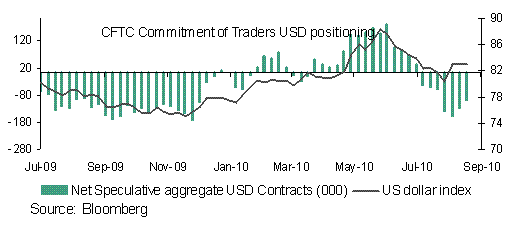
A renewed downside move to support around EUR/USD 1.2455 remains on the cards in the short term. Overall USD sentiment has become less negative as reflected in the CFTC IMM positioning data in contrast to a renewed deterioration in EUR speculative sentiment. We look for more of the same.

 ECONOMETER