
No the title is not meant to describe how I felt this morning when I woke up but how I feel the market is looking at present in terms of risk trades. Firmer than feared economic data in the US and China and the agreement in Basel on new bank capital ratios boosted risk appetite but the moves are already beginning to fade. It would be easy to jump on the bandwagon but after the sharp gains registered over recent days I would suggest taking a cautious stance on jumping into risk trades at present.
The EUR has played a degree of catch up to risk currencies, rallying sharply against the USD, helped in part by the European Commission which raised its forecasts for the eurozone economy from 0.9% for 2010 to 1.7%. Although the change in forecasts should come as little surprise give that it is now in line with the European Central Bank’s (ECB) expectations the news bolstered the view of economic resilience in the eurozone. Unfortunately as the ECB noted following its last meeting there are plenty of downside risks to growth next year and upcoming data releases will be viewed to determine how sharply growth momentum will slow into next year.
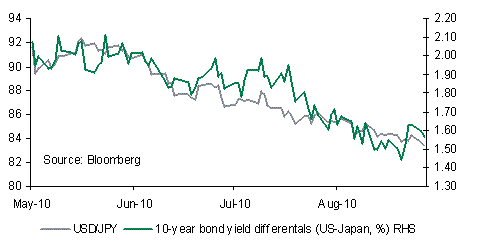
One currency that strengthened was the JPY and this was mainly due the view that Prime Minister Kan will win the contest for leadership of the governing DPJ party in Japan. The race remains very close, with Prime Minister Kan having a slight lead according to Japanese press. The FX market will pay particular attention to the result given that the other contender Ichiro Ozawa has stated his willingness to drive the JPY lower as well as increase fiscal spending. The results of the election will be known shortly and should Ozawa win USD/JPY will likely find support although the bigger influence is likely to be a shift in relative US/Japan bond yields which due to the sell off in US Treasuries over recent days has become more supportive of a higher USD/JPY.
GBP has lagged the move in many risk currencies, failing to take advantage of the weaker USD. There was some relief overnight from an increase in consumer confidence in August according to the Nationwide index, which rose 5 points to 61, from a 14-month low in July. However, any boost to GBP sentiment will have been outweighed by a fall in UK house prices according to RICS, which revealed the sharpest one-month fall in August since June 2004. The data supports the view that the rally in UK house prices could soon be over. Weaker housing activity will also likely limit any further improvement in consumer confidence. Some of this is already priced into GBP however, and over the short-term EUR/GBP may struggle to breach the 0.8400 level.
Another underperformer overnight was the NZD which was hit by disappointing retail sales data for July, which fell 0.4%. Although the drop followed a strong gain in the previous month the data supports the view that the consumer remains cautious in New Zealand, a factor that will likely play into the view that New Zealand’s central bank, the RBNZ will keep policy on hold when they meet tomorrow. NZD slipped off its highs around 0.7347 overnight and also managed to dampen the upside momentum for AUD/USD which will likely struggle to sustain a break through resistance around 0.9350.
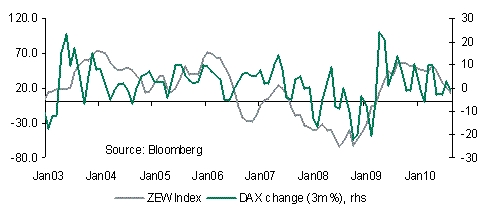
Today’s data will provide further direction for the days ahead, with the September German ZEW survey of investor confidence likely to be closely scrutinized. A drop in the economic sentiment gauge to around 10 is expected from 14 in August, highlighting that eurozone growth momentum is beginning to wane. Hard data in the form of eurozone industrial production will also record a weaker performance, likely to drop 0.3% in July. The data will likely cap the EUR today.
In the US the main release is the August retail sales report for which a 0.3% gain in both headline and ex-autos sales is expected. Sales will have been helped by back to school spending although major discounting will have weighed on retailers’ profits. Nonetheless, any gain even if modest will be a welcome development for Q3 growth in the US.

 ECONOMETER