The Week Ahead

Housing and durable goods orders data will form the highlights of the US calendar this week. Speeches from several Fed speakers will also give some further guidance to the appetite for completing the Fed’s $600 billion in asset purchases. Overall it will be a slow start for FX markets with liquidity thinned by the Presidents Day holiday and as a result currencies are likely to remain in relatively tight ranges. The heavy tone of the USD seen last week is likely to persist over coming days given the absence of driving factors. Even the unrest in the Middle East has been unable to derail the improving trend in risk appetite, another factor dampening USD sentiment.

The EUR held up well last week recouping its early week losses to end on a firm note. The ability of the EUR to shake off various bits of bad news was impressive but whether it can continue to do so is debatable. Data releases are unlikely to provide much of a boost. Whilst eurozone business surveys set to remain at high levels, consistent with a rebound in Q1 GDP growth, further improvements are unlikely. The week kicks off with the February German IFO business confidence survey but at best this will reveal stable reading. The EUR may find some support from signs of higher and in Germany and an above consensus reading for M3 money supply growth though this is not usually a market mover. The data will likely feed nervousness about European Central Bank (ECB) tightening. Ireland could rock the boat however, with general elections likely to keep markets nervous about potential renegotiations of Ireland’s bailout terms.

Although deflationary pressures are easing in Japan there is a long way before the spectre of inflation will emerge. Nonetheless, the Bank of Japan (BoJ) revised up its growth outlook last week, suggesting that the likelihood of more aggressive measures to combat deflation is narrowing. A reminder of ongoing deflation will come with the release of January CPI data this week whilst trade data will be watched to determine what impact the strength of the JPY is having on exports. Both EUR/JPY and USD/JPY are close to the top of their recent ranges and the data are unlikely to provoke a break higher. USD/JPY will likely remain capped around 84.51 whilst EUR/JPY will find tough resistance around 114.02.

GBP performed even better than the EUR last week helped by an even more hawkish sounding than usual BoE Monetary Policy Committee (MPC) member Sentance and a letter from the BoE governor hinting at rate hikes. Even a relatively more slightly dovish Quarterly Inflation Report failed to halt GBP’s ascent. Further direction will come from the February MPC minutes in which we expect to see two dissenters, namely Sentence and Weale who likely voted for a rate hike. However, there is a risk that they may have been joined by at least one other, with speculation that MPC member Bean may have joined the dissenters. Such speculation alongside the jump in January UK retail sales at the end of last week will likely add to more upside potential for GBP, setting it up for another gain this week. Its upward momentum may however, be hampered by the large net long GBP positioning overhang.
The Week Ahead

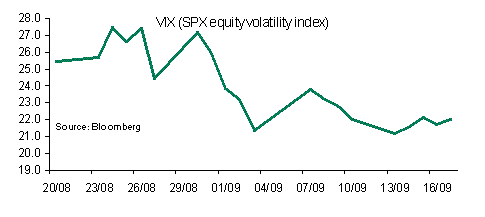
Equity markets and risk trades have generally performed well over the last couple of weeks, with for example the S&P 500 around 7.5% higher since its late August low, whilst equity and currency volatility have been generally low, the latter despite some hefty FX intervention by the Japanese authorities which did provoke a spike in USD/JPY volatility last week.

Risk appetite took a knock at the end of last week in the wake of worries that Ireland may seek EU / IMF assistance although this was denied by Irish officials. A similar worry inflicted Portugal, and as a result peripheral bond spreads were hit. Sovereign worries in Europe have not faded quickly and bond auctions in Greece, Spain and Portugal will garner plenty of attention this week. Renewed worries ahead of the auctions suggest that the market reception could be difficult.

Attention will swiftly turn to the outcome of the Fed FOMC meeting tomorrow and in particular at any shift in Fed stance towards additional quantitative easing following the decision at the August FOMC meeting to maintain the size of the Fed’s balance sheet. Given the recent improvement in US economic data the Fed is set to assess incoming data before deciding if further measures are needed.

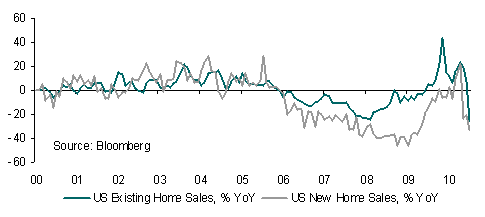
Housing data in the US will also garner plenty of attention, with several releases scheduled this week. Increases in August housing starts, building permits, existing and new home sales are also expected. Whilst this may give the impression of housing market improvement, for the most part the gains will follow sharp declines previously, with overall housing market activity remaining weak following the expiry of the government tax credit.

Weakness in house prices taken together with a drop in equity markets over the quarter contributed to a $1.5 trillion drop in US household net wealth in Q2. Wealth had been recovering after its decline from Q2 2007 but renewed weakness over the last quarter will not bode well for consumer spending. Household wealth is around $12.4 trillion lower than its peak at the end of Q2 2007.

Aside from the impact of renewed sovereign concerns, European data will not give the EUR much assistance this week either, with Eurozone September flash PMIs and the German IFO survey of business confidence set to weaken as business and manufacturing confidence comes off the boil. If the Fed maintains its policy stance whilst risk aversion increases over coming days the USD may find itself in a firmer position to recoup some of its losses both against the EUR and other currencies.

This will leave EUR/USD vulnerable to drop back down to around support in 1.2955 in the very short-term. As indicated by the CTFC IMM data there has been further short EUR position covering last week whilst sentiment for the USD deteriorated, suggesting increased room for short-USD covering in the event of higher risk aversion.

The impact of Sweden’s election outcome over the weekend is unlikely to do much damage to the SEK despite the fact that the coalition government failed to gain an outright majority. EUR/SEK has edged higher over recent days from its low around 9.1528 but SEK selling pressure is unlikely to intensify following the election, with EUR/SEK 9.3070 providing tough technical resistance.

Week Ahead

The market mood can be characterised as uncertain and somewhat downbeat, as reflected by the downdraft in US equity markets which posted their second weekly loss last week. Conversely, there has been a bullish run in government bonds, with the notable exception of peripheral debt. Over the last week markets had to contend with more data disappointment, in the wake of soft Japanese Q2 GDP, and a plunge in the August Philly Fed into negative territory, its first contraction since July 2009. Additionally a jump in jobless claims, which hit 500k highlighted the slow improvement in US job market conditions currently underway.

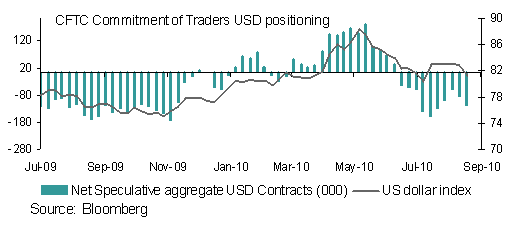
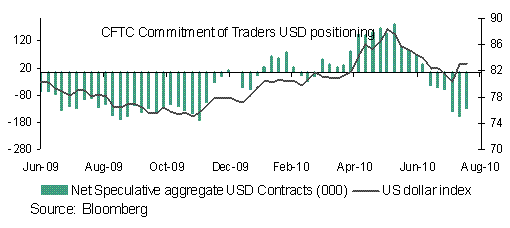
Despite all of this, the USD proved resilient and instead of the usual sell-off in the wake of soft data it benefited instead from increased risk aversion. The USD is set to retain some of this resilience though range-trading is likely to dominate over much of the weak. Reflecting the USD’s firmer stance, speculative positioning in the form of the CFTC IMM data revealed a reduction in aggregate USD short positioning in the latest week and although positioning is well below the three-month average, the improvement over the latest week and current magnitude of short positioning, highlights the potential and scope for further short-covering.

Negative data surprises have forced many to downgrade their forecasts for growth and policy implications, especially in the US. Markets will look for further clarity on the economic outlook this week but it is not clear that anything conclusive will be delivered. At the end of the week Q2 GDP will be revised sharply lower and whilst the data is backward looking it will reveal the weaker momentum of growth going into the second half of the year.

US Housing data will be mixed, with existing home sales set to drop in July as the impact of the expiration of home buyers tax credits continues to sink in whilst new home sales will likely increase but only marginally and will remain well below the April levels. Overall the picture of housing market activity remains bleak and this week’s data will do little to shake this off. On a more positive note July durable goods orders and August Michigan confidence will rise, the latter only marginally though. There will be plenty of attention on Fed Chairman Bernanke’s speech at the Jackson Hole Fed conference at the end of the week, especially given speculation of more quantitative easing in the pipeline.

The European data slate kicks off today with the release of manufacturing and service sector PMIs. Both are likely to register small declines, albeit from high levels. Nonetheless, taken together with a likely drop in the August German IFO survey on Wednesday and weaker June industrial orders tomorrow, the data will highlight that the momentum of growth in the region is coming off the boil, with the robust GDP outcome registered in Q2 2010 highly unlikely to be repeated. Against this background EUR/USD will find it difficult to make any headway. Technically further donwnside is likely over the short-term, with a test of 1.2605 support on the cards

Japan releases its slate of month end releases including jobs data, household spending and CPI. A slight improvement in job market conditions and increased spending will be insufficient to allay growth and deflation concerns, especially with CPI remaining firmly in negative territory. The onus will remain on the authorities to try to engineer a weaker JPY, which remains stubbornly around the 85.00 level versus USD. Talk of a BoJ / MoF meeting today has been dismissed, suggesting the prospect of imminent action is small. Meanwhile, speculative JPY positioning has dropped slightly in the last week but remain close to historical highs.

Aside from various data releases this week markets will digest the outcome of Australia’s federal elections. From the point of view of markets the outcome was the worst possible, with no clear winner as both the incumbent Prime Minister of the ruling Labour Party and opposition Liberal-National Party leader Tony Abbot failed to gain an outright majority. The outcome of a hung parliament will likely keep the AUD on the back foot, with trading in the currency likely be somewhat volatile until a clear outcome is established as both candidates try to garner the support of a handful of independents. However, it is notable that apart from an initial drop the AUD has managed to hold its ground. Nonetheless, the given the fluidity of the political situation there will be few investors wanted to take long positions at current levels around 0.8900 versus USD.