Green light for a break of USD/JPY 100

Growth concerns came back to the fore in the wake of disappointing releases in the US and China as well as a downward revision to global growth forecasts by the International Monetary Fund. Data releases this week will not do much to allay growth fears. Although the advance reading of Q1 US GDP is likely to reveal a firm 3% QoQ annualised outcome the momentum in the US economy clearly tailed off towards the end of the quarter as more forward looking data releases attest to. The US and global economy is likely to pick up steam as the year progresses but admittedly recent data releases point to a similar pattern as recent years of firm Q1 activity followed by weakness later.

Meanwhile in Europe, purchasing managers’ indices and the German IFO business sentiment survey will show some further moderation, while credit conditions remain constrained indicating a downbeat outlook over the rest of the year. Consequently pressure for a policy rate cut from the European Central Bank is likely to intensify, with a cut likely by the end of this quarter. EUR/USD continues to trade above its 1.3001 technical support level but momentum is fading. Weaker economic data this week will likely undermine the EUR further.
gold
Following last week’s strong volatility in commodity and gold prices in particular some stability is likely over coming days, with gold retracing some of its losses and regaining the USD 1400 level. Equity markets finished the week in firmer mood after falls earlier in the week but the plethora of US Q1 earnings scheduled over coming days will help to determine whether the gains can be held. So far earnings have beaten expectations on balance, but notably expectations have been fairly low in the first place.

There was plenty of attention on currencies at the G20 meeting but the final outcome left the door open to further JPY weakness while the communiqué highlighted the “unintended negative side effects” for easier monetary policy. Although this was a veiled warning about potential build up of asset price bubbles as central banks ease policy, it is unlikely to sway the Bank of Japan from accelerating its balance sheet expansion. Aside from a probable breach of USD/JPY 100 there is unlikely to be much follow through from the G20 meeting this week.
Cyprus hits EUR, GBP retracing lower, USD firm ahead of FOMC

There are plenty of events and data to digest on both sides of the pond this week. In Europe, Cyprus’ bailout will be a key focus. The decision to ‘bail in’ in bank depositors aimed at raising EUR 5.8 billion by imposing a levy on deposits will be voted on today in Cyprus. While the EUR 10 billion bailout is small change compared to other Eurozone bailouts the deposit levy could have wide ranging repercussions on Eurozone bank deposits in other peripheral countries despite Cyprus’ case being labelled as “unique”.

Meanwhile, politics in Italy remains unpredictable, with discussions tomorrow between the President and political parties to try and form a government. There is little to suggest a deal is in the offing with the risk skewed towards protracted negotiations and fresh elections.

Data in the Eurozone is expected to a little more encouraging, with gains in Eurozone manufacturing confidence (albeit still in contraction territory), German ZEW investor confidence and IFO business confidence surveys likely. Also of note this week is the Bank of England MPC minutes and UK 2013 Budget and in particularly any change to the BoE’s mandate contained within the budget.

Markets likely to tread water ahead of Fed FOMC outcome. While no change to the USD 85 billion asset purchase program is likely the Fed may actually revise slightly lower their near term growth forecasts due mainly to fiscal policy developments despite recent encouraging data. It seems unlikely that the Fed will hint at any tapering off of QE but nonetheless, it will be difficult for the Fed to ignore recent positive data. On the data front, housing data in the form of housing starts and existing home sales will reinforce evidence of recovery in the housing market.

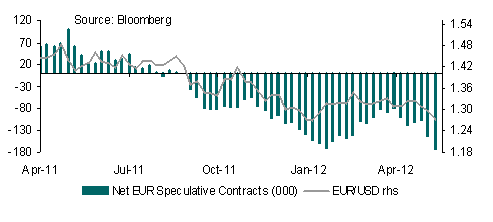
The EUR has already come under pressure as a result of Cyprus concerns and will struggle to reverse its losses. EUR/USD 1.2876 will offer some support in the near term and the fact that the speculative market has been short EUR over recent weeks may also limit some of the downside pressure. Nonetheless, any gains are likely to be sold into.

GBP/USD is also set to retrace lower, especially if the MPC minutes reveal a more dovish bias and/or any new mandate for the BoE is perceived to enable more policy easing. All of this leaves the USD in good form, with the USD index setting its sights on the psychologically important 83.00 level.

Dollar firm, but beware of a short covering euro bounce

The USD has risen sharply since the end of April, benefiting from the ongoing turmoil in the Eurozone and rise in US Treasury yields (2-year). Markets have managed to brush US fiscal and political concerns under the carpet as focus centres on Europe. The USD also managed to shrug off a soft April retail sales report and a slightly more cautious set of FOMC minutes.

A recovery in April durable goods orders, new homes sales and a relatively stable reading for Michigan confidence should ensure that the USD’s upward trajectory remains unimpeded this week. Given the potential for continued uncertainty ahead of Greek elections in mid June, risk aversion and the USD are set to remain elevated.

In Europe, it’s all about Greece and the machinations ahead of fresh elections in mid June. The EUR shows little sign of stabilising ahead of these elections. Data releases will take a back seat although the calendar will be heavy. FX markets will have one eye on the May German IFO survey and the flash readings in purchasing managers indices. The PMI data will give no relief to the EUR, with the data consistent with growth contraction for the most part while the IFO is set to register a decline too.

Meanwhile, pressure on German Chancellor Merkel to accept measures that were previously vetoed at an informal EU summit on Wednesday has also heightened. Such measures include direct recapitalisation of banks and/or unlimited purchases of peripheral country debt by the ECB and through the Eurozone rescue fund.

Admittedly the large extent of short market positioning (the latest CFTC IMM report revealed an all time low for EUR positioning) means that the risk of a bounce is high in the event of any good news or perhaps in the wake of any renewed securities markets purchases by the ECB or fresh hints of a third LTRO. Whether there will actually be any good news is another question entirely.

USD/JPY has been relatively stable despite a rise in US bond yields compared to Japanese JGB yields, with rising risk aversion helping to keep the JPY firm. The Bank of Japan meeting this week has the potential to change the currency pair’s trajectory but is unlikely to do so. No action is expected at the policy meeting on Wednesday, leaving the JPY with a firm bias.

Trade data will provide some justification for a more bearish stance on the JPY, with another deficit set to be registered in April as export conditions remain weak. However, as usual the JPY will continue to ignore domestic economic data and focus more on relative yields and risk.

Euro extends gains, yen pressured

The EUR found another spurt of life following the release of the stronger than expected February German IFO business confidence survey yesterday. The data helped make up for the disappointment related to the manufacturing and service sector surveys. However, while it may have alleviated concerns about weakening growth in Germany it only serves to highlight the disparities in growth across the Eurozone.

I continue to believe the EUR may struggle to sustain gains. In the near term, after breaking above 1.3320 resistance, EUR/USD will face further resistance around 1.3460. Nonetheless, my 2012 year end forecast of EUR/USD 1.26 shows that despite growing growth pressures in the Eurozone economy the EUR will still find underlying support from a healthy external balance and continued EUR buying from Asian official investors.

Over the near term upcoming votes in various countries on the second Greek bailout deal will provoke some nervousness while Greek reform implementation risks will also act to dampen EUR sentiment.

JPY has faced significant degree of pressure since the beginning of February. As noted previously one of the biggest sources of upward pressure on USD/JPY has been the widening in US – Japan 2-year bond yield differentials. US bonds currently yield around 19 basis points above Japan, the highest gap since August 2011. The widening yield gap already appears to be prompting foreign outflows from Japanese bonds, with outflows registered in six of the seven past weeks. These outflows have helped contribute to the weakness in the JPY.

The fact that the BoJ will step up its purchases of Japanese government bonds (JGBs) will also add to the downward pressure on the JPY as it will mean a further widening in US – Japanese yield differentials. Over the short term USD/JPY may face some resistance above the 80 level and I suspect that it will lose some momentum but maintain my view that it will reach 85.0 by the end of the year.

Plenty of event risk

This week is heavy with event risk, with a lot expected from EU leaders. So far the risk on tone to markets has held up, with for example the VIX fear gauge resting below the key 30.0. The G20 meeting over the weekend set the deadline for action for concrete solutions to the eurozone debt crisis for the October 23 EU Summit.

However, there will be little detail on issues such as banking sector recapitalisation, private sector involvement in any debt restructuring or ‘leveraging’ the EFSF bailout fund until the report on Wednesday night by the Troika on Greece. The reward to EU leaders would be the potential for more aid from the IMF but even now it seems that a German government official has poured cold water of a plan being announced at the EU Summit which will disappoint markets.

There are also plenty of data releases for markets to digest over coming days including inflation releases, manufacturing surveys and industrial production data in the US while in Europe the German IFO and ZEW surveys are scheduled for release. The data will follow on from the better than expected September US retail sales releases at the end of last week continuing to dampen expectations that the global economy is falling in recession though there will be a marked deceleration in European data.

Meanwhile the US Q3 earnings season rolls. The risk on tone will likely continue to weigh on the USD and weigh on bonds but unlike a few weeks ago when a lot of bad news was priced in, the scope for disappointment is becoming increasingly high.

Many currencies remain highly correlated with gyrations in risk and in this respect the improvement in risk appetite is good news for high beta / commodity. AUD, NZD, CAD and JPY are amongst the most sensitive currencies and therefore prone to a bigger reaction as risk improves, with the former three strengthening and the JPY weakening. Asian currencies poised to benefit from firmer risk appetite include INR and KRW, both with relatively high correlations with risk.

EUR/USD has made a solid recovery over recent days from its lows around 1.3146 spurred by hopes of action by European officials. Such hopes may yet be dashed but the EUR looks supported over coming days ahead of the EU summit Speculative positioning also reflects a slight improvement in EUR sentiment as IMM short positions have declined in the last week but its worth noting that this week’s European data are unlikely to be supportive for the EUR.