Euro vulnerable to event risk

The USD is benefitting in the current environment of elevated risk aversion reflected in a jump in USD speculative positioning over recent weeks, with current IMM positioning currently at its highest since June 2010.

Admittedly there is still plenty of scope for risk aversion to intensify but what does this mean for the USD? The USD index is currently trading just over 78 but during the height of the financial crisis it rose to around 89, a further gain from current levels of around of around 14%.

The main obstacle to further USD strength in the event of the current crisis intensifying is if the Fed implements QE3 but as the Fed has indicated this is unlikely to happen anytime soon, as “Operation Twist” gets underway.

Now that the Fed FOMC meeting is out of the way markets will also be less wary of buying USDs as the prospect of more QE has diminished for now. Data this week will likely be USD supportive too, with increases in consumer confidence, durable goods orders, an upward revision to Q2 GDP expected.

The EUR remains highly vulnerable to event risk this week. Various votes in eurozone countries to approve changes to the EFSF bailout fund will garner most attention in FX markets, with the German vote of particular interest although this should pass at the cost of opposition from within Chancellor Merkel’s own party.

The EUR may garner some support if there is some traction on reports of a three pronged approach to help solve the crisis which includes ‘leveraging’ the EFSF fund, large scale European bank recapitalisation and a managed default in Greece, but there has been no confirmation of such measures.

Meanwhile, the potential for negotiations between the Troika (EC, IMF, ECB) and the Greek government to deliver an agreement on the next loan tranche for the country has increased, which could also offer the EUR a boost this week, albeit a short lived one.

Speculation of a potential European Central Bank (ECB) rate cut has increased a factor that could undermine the EUR depending on whether markets see it as growth positive and thus EUR positive or as a factor that reduced the EUR’s yield attraction. There is also more speculation that the ECB will offer more liquidity in the form of a 1-year operation but once again there has been no confirmation.

A likely sharp drop in the German IFO survey today and weakness in business and economic confidence surveys on Thursday will support the case for a rate cut, while helping to maintain the downward pressure on the EUR.

Given the potential for rumours and events to result in sharp shifts in sentiment look for EUR/USD to remain volatile, with support seen around 1.3384 and resistance around 1.3605.
All Eyes On Jackson Hole

It’s all about Jackson Hole and ahead of the Fed symposium the USD index is likely to maintain its place in towards the middle end of its recent 73.47 – 75.12 range helped by weaker equity markets. Expectations or hopes that Fed Chairman Bernanke will announce or at least hint at a fresh round of quantitative easing have receded allowing the USD to escape further pressure. Bernanke will likely keep all options open but there are still some in the FOMC who do not want to embark on QE3.

Although the USD may be saved from a further drubbing the commitment to maintain exceptionally accommodative monetary policy through Q2 2013 has contributed to a relative reduction in US bond yields and in turn is acting to restrain the US currency. A likely revision lower to US Q2 GDP will not help the USD in this respect.

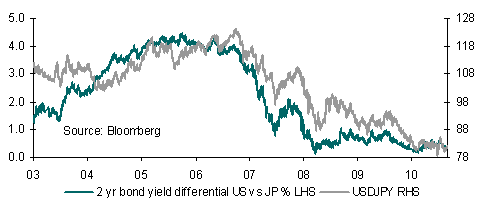
One currency in particular that is reactive to yield differentials is USD/JPY, which registers an impressively high correlation with US – Japan yield differentials. Attempts this week by the Japanese authorities to encourage capital outflows and a downgrade of Japan’s credit ratings by Moody’s have done little to weaken the JPY.

Even the usually bearish JPY Japanese margin traders have been scaling back their long USD/JPY positions over recent weeks while speculative investors remain overly long (well above the three-month average) JPY according to IMM data. The risk of a shake out of long JPY positions is high but unless yield differentials reverse renewed JPY weakening looks unlikely in the short-term.

Eurozone peripheral issues will be put on the backburner ahead of the Jackson Hole meeting but that doesn’t mean they have gone away. As the continued pressure on Greek bonds shows markets continue to be fixated on the country’s problems and there may be growing nervousness ahead of the decision to distribute the next IMF loan tranche at the end of September. Nervousness also extended to Germany, with ratings agencies having to confirm the country’s AAA rating.

So far this week EUR has shown impressive resilience despite weak data in the form the German August IFO business and ZEW investor confidence surveys. However, there is a risk of EUR weakness should Bernanke not hint at QE3, with the currency already trading around the bottom of its multi-day range.

AUD has failed to recoup its end July losses and is still some 5% below its high above 1.10 versus USD. There is scope for some AUD appreciation especially as AUD speculative positioning has dropped sharply over recent weeks reducing sharply the net long overhang in the currency.

Moreover, markets have become overly aggressive in pricing in interest rate cuts in Australia and as evidenced from the AUD bounce following RBA Governor Stevens comments this morning (in which he referred to inflation data as still being concerning) there is an asymmetric risk to the AUD on the upside.

Nonetheless, AUD has experienced an increase in sensitivity to risk over recent weeks and will continue to be driven by gyrations in risk appetite. In this respect it is too early to assume the worst is over, suggesting that any further gains in AUD will be limited.

US Dollar Under Broad Based Pressure

ThE USD has registered broad based losses over recent days and the longer the stalemate with regard to extending the US debt ceiling the bigger the problem for the currency. Indeed, it appears that the USD is taking the brunt of the pressure compared to other assets. For example, although US treasury yields have edged higher there is still no sense of panic in US bond markets.

Failure to raise the debt ceiling does not automatically imply a debt default but it will raise the prospect should an agreement not be reached in the weeks after. However, the impact on US bonds maybe countered by the increased potential for QE3 or safe haven flows in the event that no agreement is reached.

The worst case scenario for the USD remains no agreement on the debt ceiling ahead of the August 2 deadline but a short term solution that appears to be favored by some in the US Congress may not be that much better as it would effectively be seen as ‘kicking the can down the road’.

The better than hoped for agreement to help resolve Greece’s debt problems at the end of last week came as a blow to the USD given the almost perfect negative correlation between the USD and EUR over recent months. Moreover, the debt ceiling stalemeate is pouring salt into the wound. However, the situation is highly fluid and should officials pull a rabbit out of the hat and find agreement the USD could rally sharply.

All is not rosy for the EUR either and its gains have largely come by courtesy of a weaker USD rather than positive EUR sentiment. Economic news hardly bodes well for the EUR, with data in the eurozone looking somewhat downbeat. For instance, the Belgian July business confidence indicator dropped to a 9-month low in line with the weaker than expected outcome of the July German IFO survey last week.

Moreover, there are still several questions about last week’s second Greek bailout agreement and contagion containment measures including parliamentary approvals and lack of enlargement of the EFSF which could keep markets nervous until there are clear signs that implementation is taking place successfully.

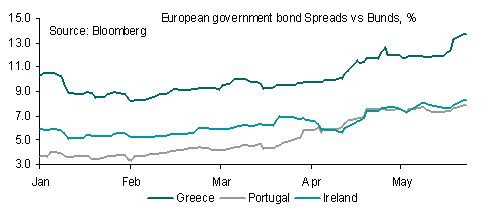
A clear sign that the EU agreement has failed to inspire as much confidence as officials had hoped for is the lack of traction in terms of narrowing peripheral bond spreads, with the exception of Greece. This partly reflects a renewed ‘risk off’ tone to markets but this is not the sole reason.

EUR/USD has extended gains benefiting from USD weakness rather than any positive sentiment towards EUR, breaking above 1.4446, the strong multi-month corrective channel resistance, signalling a bullish move. The next level of technical resistance is around 1.4568 but direction will continue to come from the debt ceiling talks.

US Dollar Ugly But Not Hideous

The USD has strengthened by around 5% since the beginning of the month. The move has been particularly sharp this week as higher risk aversion and intensifying fears about the eurozone periphery have given the currency a boost, albeit with the USD remaining one of the least ugly currencies amongst a fairly hideous bunch.

Eurozone country and overall ‘flash’ May purchasing managers indices (PMI) managed to further sour an already fragile mood yesterday, with the data revealing bigger than expected declines, albeit still at levels that are high in absolute terms. Data today is unlikely to result in any improvement in sentiment for eurozone assets, with the Germany IFO Business Climate index likely to slip, albeit from a relatively high level.

The EUR doesn’t need much of an excuse to sell off at present, with a softer IFO likely to provide further reason for investors to offload long positions in the currency. Against this background EUR/USD is likely to sustain a drop below the 1.4000 level, with the 100 day moving average level of 1.3972 likely to be breached shortly.

More importantly in terms of sentiment drivers the malaise in the eurozone periphery especially Greece remains the biggest risk for the EUR. As much as officials in Europe and Greece deny speculation of debt restructuring the market is far from convinced as reflected in the widening in peripheral debt spreads.

Greece’s Prime Minister Papandreou’s attempt to push through austerity measures in the Greek parliament yesterday by announcing accelerated asset sale plan and EUR 6 billion in budget cuts have done little to turn market sentiment despite the fact that at the least it shows a willingness to stick to the plan in the face of growing domestic resistance.

The USD has also edged higher against the JPY over recent days despite a rise in risk aversion. As revealed in the latest IMM data markets have been net long JPY over the past couple of weeks, with positioning well above the 3-month average, suggesting some scope for a liquidation of long positions. Nonetheless, the rise in USD/JPY has occurred despite 2-year US / Japan yield differentials remaining at a relatively low level suggesting that the USD may lose momentum, with USD/JPY resistance around 82.74 likely to cap gains.

GBP has also slid suffering in the wake of a resurgent USD and unconfirmed reports that Moody’s ratings agency is expected to announce that is placing 14 out of 18 UK banks on review for a downgrade. GBP is likely to trade nervously ahead of UK data releases today including public finances and CBI data, with further downside risks opening up. A drop below GBP/USD 1.6000 could see the currency pair test support around 1.5972.

Euro resilient but for how long?

The resilience of the EUR to bad news has been impressive but is unlikely to persist. The recent negatives include 1) the rejection of the Portuguese government’s austerity plan and the increased likelihood of a bailout, 2) a likely delay in the decision on increasing the size and scope of the EFSF EU bailout fund, 3) a drop in Eurozone purchasing managers indices in March, 4) downgrades to Portugal’ sovereign credit ratings by Fitch last night and S&P and 5) Moodys downgrades of 30 Spanish banks. Despite all of this, and after hitting a low of around EUR/USD 1.4054, EUR has bounced back close to the 1.4200 level.

Further direction will come from the outcome of the EU leaders’ summit today and the March German IFO business confidence survey. For the former there is unlikely to be a decisive result, with the optimism following the informal March 11 leaders’ summit likely to give way to delay due to wrangling over details. For the latter, a slight moderation in the IFO is expected following February’s upside surprise. However, there is a bigger risk of a downside surprise following the softer than forecast March German manufacturing PMI released. Against this background, EUR/USD is likely to struggle to break resistance around 1.249.

In general FX markets look somewhat more stable and even the pressure on the USD appears to have abated slightly despite a much weaker than expected outcome for US February durable goods orders yesterday, which revealed a drop in both headline and ex-transportation orders. My composite FX volatility measure has dropped sharply over recent days, led by short term implied JPY volatility which has dropped close to pre-crisis levels. Lower volatility has also likely reduced the prospects of further FX intervention although USD/JPY 80 will continue to be well defended.

Lower volatility as also reflected in the sharp drop in the VIX index has corresponded with a general easing in risk aversion as both Middle East and Japan tensions have eased slightly. US data today are unlikely to offer much direction, with a slight upward revision to US Q4 GDP and an unchanged outcome for the final reading of Michigan consumer confidence expected.