EUR higher but resistance looms

EUR and risk currencies in general were buoyed by the passage of the austerity bill in the Greek parliament. The implementation bill is also likely to be passed later today opening the door for the disbursement of EUR 12 billion from the European Union / IMF from the EUR 110 bailout agreed for the country. Combined with news that German banks are progressing towards agreeing on a mechanism to roll over Greek debt alongside French banks as well as likelihood of an European Central Bank (ECB) rate hike next week, the EUR is set to remain supported over the short term.

Nonetheless, it once again looks as though a lot of good news is priced in and it would be surprising if EUR/USD could extend to above strong resistance around 1.4557 given the many uncertainties ahead, not the least of which includes the stance of ratings agencies on any Greek debt rollover.
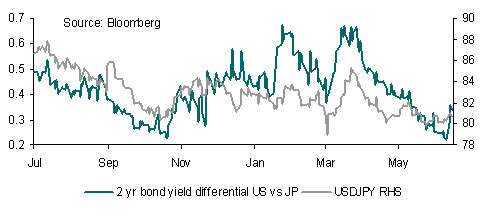
USD/JPY is the only major currency pair that is correlated with bond yield differentials at present (2-year yields) and therefore it should not come as a surprise that USD/JPY has moved higher as the yield differential between the US and Japan has widened by around 10bps over the past week. Indeed, yesterday’s move above 81.00 was spurred by the move in yield differentials although once again the currency pair failed to build sufficient momentum to close above this level.
Further gains will require US bond yields to move even higher relative to Japan but perhaps the end of QE2 today may mark a turning point for US bond markets and currencies. The end of QE2 taken together with a jump in bond supply over coming months, will see US Treasury yields will move sharply higher, implying much more upside for USD/JPY.

AUD has bounced back smartly over recent days, with the currency eyeing resistance around 1.0775 versus USD. A general improvement in risk appetite has given the currency some support but markets will be unwilling to push the currency much higher ahead of the Reserve Bank of Australia (RBA) meeting next week. On the plus side, there are no rate hikes priced in for Australia over the remainder of the year, suggesting an asymmetric risk to next week’s meeting.

In other words, unless the RBA openly discusses rate cuts in the statement, the AUD will likely remain supported. Conversely any indication that a rate hike may be in prospect will be AUD supportive. In any case we continue to believe the AUD offers better value especially relative to NZD and maintain our trade idea to buy AUD/NZD.

US dollar on the rise

Risk aversion is on the rise as uncertainties about Greece and worries about weaker economic data weigh on sentiment. A number of key events rather than data will be the main drivers this week. First and foremost amongst these is the vote in the Greek parliament on the country’s budget reform plan, which if passed will pave the way for the way for a disbursement of EUR 12 billion from the European Union / IMF and a new bailout package.

Meanwhile in the US talks on raising the debt ceiling are likely to resume in earnest, with the market likely to become increasingly nervous about the lack of resolution on the issue. Nonetheless, it is Europe that will dominate the headlines and on this front even if the reform plan is passed any market relief is likely to be limited given the ongoing uncertainty about private sector participation in any Greek debt roll over. This suggests that the EUR will remain under pressure over the week despite reassuring comments from Chinese Premier Wen.

Data releases will be relegated to background noise but what there is will not help sentiment. Signs of slowing activity remain evident as revealed in disappointing eurozone manufacturing surveys last week and this will be echoed in the US ISM manufacturing survey at the end of this week. Economic sentiment gauges in Europe are also set to reveal a decline. Given the lack of ammunition and/or unwillingness to risk using further stimulus from the Fed, the sensitivity of markets to weak data will be high, keeping risk aversion elevated.

Indeed, although well flagged the end of the Fed’s QE2 this week will mark a major shift in market dynamics, especially in currency markets where the USD will finally see a massive weight lifted from its shoulders. As indicated by Fed Chairman Bernanke following the FOMC meeting the Fed is not considering a further round of asset purchases, a fact that will help the USD to find firmer support.

Notably the USD index moved has above its 100-day moving average providing a positive technical signal given that it has failed on its last two attempts. The USD index now looks set to break its April high around 76.610.

Greece’s trials and tribulations

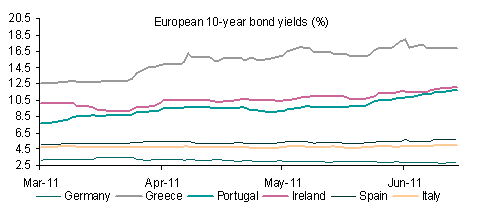
Two main influences on markets continue to weigh on sentiment. Firstly the trials and tribulations of the eurozone periphery remain centre of attention. The failure of Greek Prime Minister Papandreou to win cross party support for austerity measures at the end of last week highlights the problems Greece is facing both domestically and externally.

Reports that European officials are negotiating tough bailout conditions including major external intervention in terms of tax collection and privatisation suggest that gaining further aid will not be easy. The second weight on market sentiment is global growth concerns, with a string of disappointing data releases over recent weeks leading to an intensification of concerns about the pace of recovery.

Markets will likely remain nervous in this environment and it is difficult to see risk appetite improving to any major degree. This has proven bullish for bond markets, with the tone set to continue this week. Currencies remain in ranges and holidays today in the US and UK will likely result in thin trading. The resilience of the EUR to peripheral concerns has been impressive but at the same time Greek concerns will limit any gains. Meanwhile, gold and precious metals look to remain well supported, with gold’s safe haven bid remaining solid.

USD sentiment has improved sharply according to the latest CFTC IMM report which reveals that net USD short positions have been cut in half over the last two weeks with positioning well above the 3-month average. Conversely net EUR longs continue to shrink as speculative investors off load the currency. The fact that the EUR is not weaker than it is points to the influence of official demand for the currency, especially from Asia.

This week will likely be dominated by ongoing discussions about Greece and given the opposition to austerity measures and potentially strict bailout terms, forging an agreement will not be easy. Reports suggest that around half of Greece’s financing needs until the end of 2013 could be accounted for without new loans via privatisation and changes in terms for private bondholders, with Europe and the IMF needed to lend an additional EUR 30-35 billion on top of the EUR 110 already slated.

Data releases are likely to take a back seat but there will still be plenty of attention on the key release of the week, namely the May US jobs report. The market looks for a 185k increase in payrolls, with the unemployment rate edging lower to 8.9%. This would mark the lowest payrolls reading in 4 months. Clues to the jobs data will be garnered from the May ADP jobs report, ISM manufacturing survey and consumer confidence data earlier in the week.

Risk on, risk off

The USD has lost some upward momentum as risk appetite improved but FX markets remain skittish as sentiment gyrates between ‘risk on’ and ‘risk off’. The fact that US Q1 GDP was left unrevised whilst jobless claims surprisingly increased together with ongoing Greece concerns suggests that a risk off mood may filter into markets despite positive US earnings. Although the USD has not particularly benefitted from any rise in risk aversion lately, worries about the next IMF tranche being withheld from Greece will likely play more positively for the USD.

Nonetheless, lurking in the background and helping to keep the USD restrained is the Fed’s ongoing asset purchases as QE2 remains in place until the end of June. Moreover US data disappointments points to risks that the Fed will only slowly embark on its exit strategy. Additionally any agreement towards extending the US debt ceiling appears to be far off, and threatens to go down to the wire all the way to August 2. US debt markets and the USD appear to be downplaying this issue at present but it remains a clear threat to US markets.

Continuing to limit any upside in the EUR is the fact that officials and markets continue to gyrate on whether Greece will or will not restructure its debt. Apparent divisions between the view of some officials and the ECB are adding to the confusion whilst fresh worries about the IMF withholding funding for Greece will likely keep EUR/USD capped.

Peripheral worries as well as growth concerns are clearly weighing on confidence and a broad based decline in economic and business confidence in various eurozone May measures is expected to be revealed in data today . Weaker data taken together with ongoing concerns about the eurozone periphery will likely see the EUR struggle, with the currency set to settle into a range versus USD over the short-term, with technical support around 1.3968 and resistance at 1.4210.

The loss of USD momentum has also been exhibited in USD/JPY which has turned lower following its recent upward move hitting a low around 81.09. The big news was the fact that April nationwide core CPI recorded its first YoY increase since December 2008. At the margin may reduce the pressure on the Bank of Japan (BoJ) to enact more aggressive policy measures, which in turn is positive for the JPY. A big factor contributing to keeping the JPY supported over recent weeks is the ongoing inflow of foreign capital into Japan’s bond and equity markets, with Japan recording six straight weeks of net inflows.

USD/JPY is one currency pair where the correlation with US – Japan 2-year bond yield differentials is holding up well over the past 3-months. The fact that the yield differential has dropped to its lowest level since November 2010 at around 30bps reveals the declining US yield advantage, and plays for a lower USD/JPY. Against this background the JPY is likely to remain supported in the short-term, but will find it tough to break through technical support around USD/JPY 80.15.

Risk Aversion Creeps Higher

The USD index has dropped by around 17% since June 2010 high and despite a slight bounce this week it is unlikely to mark the beginning of a sustained turnaround. Nonetheless, I would caution about getting carried away with positioning for USD weakness. Whilst an imminent recovery looks unlikely the risk/reward of shorting the USD is becoming increasingly unfavourable.

Until then Federal Reserve comments will be watched closely for clues on policy and there are plenty of Fed speakers this week including a speech by Boston Fed’s Rosengren today and Fed Chairman Bernanke tomorrow. The USD will also gain some direction from jobs data and markets will be able to gauge more clues for Friday’s non-farm payrolls data , with the release of the April ADP employment report today.

The EUR is one currency that has suffered this week. News that Portugal’s caretaker government has reached an agreement with the European Union / International Monetary Fund on a bailout of as much as EUR 78 billion has so far been greeted with a muted response. EUR attention is still very much focussed on the ECB meeting tomorrow and prospects of a hawkish press statement suggest that EUR/USD downside will be limited, with support seen around 1.4755.

The JPY has strengthened by around 5% versus USD since its 6th April USD/JPY high around 85.53, confounding expectations that Japan’s FX intervention following the county’s devastating earthquake marked a major turning point in the currency. A combination of narrowing interest rate differentials with the US (2 year US/Japan yield differentials have narrowed by around 20bps in the past month), strong capital inflows to Japan (net bond and equity flows in the last four weeks have increased to their highest this year), and rising risk aversion have all played their part in driving the JPY higher.

As a result USD/JPY is fast approaching the psychologically important level of 80, a level that if breached will likely lead to FX intervention. Although Golden Week holidays in Japan this week suggest that JPY liquidity may be quite thin, Japanese authorities are likely to remain resistant to further gains in the JPY, likely using thinning liquidity to their advantage.

Despite the JPY’s recent strength speculative positioning over the past four weeks has remained net short JPY, whilst Japanese margin traders have also increased their long USD/JPY bets, suggesting that these classes of investors are not to blame for the JPY’s appreciation. This suggests that FX intervention may not be as successful given that the market is already short JPY.

Given the risk of intervention on USD/JPY, the CHF appears to be an easier choice for safe haven demand against the background of rising risk aversion. The currency has risen to a record high against the USD, gaining around 8.3% so far this year. Given the hints of higher interest rates by the Swiss National Bank (SNB) and resilience economic performance, downside risks for CHF are limited at present unless risk appetite improves sharply. Further gains are likely with USD/CHF likely to test the 0.8570 support level over the short-term.