Inflation Debate Rages On

Good morning, last week ended on a solid note for global equity markets, capped by strong gains in US stocks and in particular a surge towards the end of the session on Friday.  The S&P 500 is on track for its best month since November though in the next few days, month and quarter end rebalancing will continue to hold risks, which could result in increased volatility.  Another imponderable is potential follow through from huge equity sale block trades at the end of last week reportedly from Archegos Capital, which hit US media companies and Chinese tech stocks. All of this suggests risks of higher volatility in the days ahead.  

US interest rate markets came under renewed pressure, with yields backing up over the week, while the US dollar (USD) had a firmer week, with the USD index (DXY) ending above its 200-day moving average and technical indicators pointing to further gains this week.  CFTC IMM speculative positioning data (in the week to 23 March) shows that net aggregate USD short positions have been pared back further as USD sentiment continues to improve.  Positioning in most currencies vs. USD fell while Japanese yen (JPY) short positions increased further.  The oil market and container costs could be pressured higher by the continued delay in dislodging the stricken Ever from the Suez Canal, which seems to have made little progress over the weekend.

Attention this week will turn to a few key data and events.  Important among these will be President Biden’s speech in Pittsburgh (Wed) where he will likely give further details on his infrastructure plan and how it will be funded.  Key US data include the March ISM manufacturing survey (Thu) and March non-farm payrolls (Fri).  Solid outcomes for both are expected.  In Asia, focus will be on March purchasing managers indices (PMIs) across the region (Thu) including in China (Wed) where broadly positive readings are likely.  There will also be attention on the going malaise in Turkey’s markets since the sacking of the central bank (CBRT) governor while Europe continues to struggle with fresh virus waves, lockdowns, and vaccine reluctance as well as tensions over vaccine exports to the UK.

As President Biden gives his speech this week the debate about a potentially sharp rise in inflation rages on.  The Fed has tried to calm fears by highlighting that any rise in inflation over the coming months will likely be transitory.  However, with massive stimulus in the pipeline, economic recovery taking shape and the Fed set to keep policy very accommodative for years to come, market fears have risen as well as warnings from the likes of former Treasury Secretary Larry Summers.  Consumer inflation expectations remain largely subdued but the debate will not end quickly, and bond markets will be on tender hooks.  In the next few months inflation will turn up but this will largely be due to base effects as the collapse in activity in prices in Q1 last year falls out of the equation.  However, the jury is out on whether this will turn to more persistent inflation, something that could have a much more severe impact on markets and force central banks to belatedly tighten policy. 
Will the Fed Calm US Treasury Market Volatility?

The main market action on Friday was once again in US Treasuries, with another sharp sell off as the 10y yield spiked 8.8 basis points despite three large US debt auctions over the week that were received relatively well by the market.  The sell-off helped the US dollar (USD) to strengthen while oil prices slipped. USD sentiment is clearly becoming less negative as reflected in the latest CFTC IMM data (non-commercial speculative market positioning), which shows that USD (DXY) positions (as a % of open interest) are still short, but at their highest since the week of 8 Dec 2020. Tech stocks didn’t take well to higher yields, but the Dow and S&P 500 closed higher. The move in yields may pressure Asian currencies and bond markets after some consolidation/retracement towards the end of last week though equity markets look better placed. 

At the end of last week US University of Michigan consumer sentiment rose to 83.0 in the preliminary release for March from 76.8 in February and exceeded expectations at 78.5 (consensus). This week attention will turn to a plethora of central banks spearheaded by the Federal Reserve FOMC (Wed). Markets will be watching for any revisions to US growth forecasts amid a dovish tone, albeit with little sign of any push back on higher yields. US rates markets will also focus on the US 20y auction, which could keep the curve pressured steeper.  Nervousness over the Statutory Liquidity Ratio (SLR) exemption, which is set to expire at the end of the month, will also likely intensify.  A less dovish than hoped for Fed, will likely keep the USD on the front foot. 

Other central bank decisions this week will take place in the UK, Norway, Turkey, Russia, Indonesia, Taiwan, Brazil and Japan. None of these are likely change policy settings except Brazil, where the market is looking for a 1/2% hike. Developments to look out for include some push back from the Bank of England on higher yields, a move to bring forward the rate hike path in Norway, a potentially controversial no change decision in Turkey and the Bank of Japan’s announcement of the results of its policy tools and in particular clarification on the tolerated trading range for 10-year JGBs.

Data this week kicks off with Chinese activity data today including February industrial production and retail sales. Seasonal distortions and base effects will make this month’s data look particularly strong.  Other data this week includes US Feb retail sales (tomorrow) where a weak outcome is likely depressed by harsher-than-usual winter weather as well as a fading of the boost from stimulus payments. Australia February employment is also likely to be soft (Thursday).  

Overall, equity volatility has eased, especially in the equity market, suggesting some return of normal trading conditions there, but interest rate volatility remains high driven by the move in US Treasury yields.  The USD gave back some gains towards the end of last week, but will likely benefit from higher US yields and is set to start this week in firm form.  US interest rate gyrations will likely provide further direction for the USD over the rest of the week.   Much of course will depend on the Fed FOMC meeting, which will be the main event this week. 

Watching US Yields

Risk assets struggled to make headway last week, with technology stocks stumbling in particular.  Nonetheless, inflows into equities remain strong as more and more retail money is drawn in (perhaps signs of a near term peak).  Asian stocks started the week in positive mood despite last week’s nervousness, but equity investors will continue to keep one eye on the move in US yields.

US Treasuries continued to remain under pressure and the curve continued to bear steepen.  A combination of US fiscal stimulus hopes/expectations, vaccine progress and reduction in COVID cases, appear to be pressuring bonds. President Biden is likely to pass his $1.9 tn stimulus package in the weeks ahead, with a House vote likely this week, while the Fed continues to dampen down of any tapering talk, helping to push inflation expectations as reflected in break-evens, higher.  Indeed, this will likely be the message from a number of Fed speeches this week including Chair Powell testifying before Congress (Tue and Wed). 

Despite higher US nominal and real yields and visibly more nervous equities, the US dollar (USD) continues to struggle, failing to find a trigger to much covering of the massive short USD position still present.  We note that non-commercial FX futures positioning data (CFTC IMM) revealed only a limited reduction in aggregate USD short positions (as a % of open interest) in the latest week. Antipodean currencies led the way at the end of last week, but pound sterling (GBP) speculative positions have seen the biggest bounce over the last couple of weeks. 

Despite the USDs reluctance to rally lately, the short-term bias could shift to a firmer USD sooner rather than later, including against Asian emerging market currencies.  Indeed, several Asian currencies lost ground last week, with the Philippines peso (PHP) and Indonesian rupiah (IDR) leading the way lower.  The Asia USD index (ADXY) appears to have peaked and looks vulnerable to more short-term downside.

US economic data at the end of last week revealed that the flash estimates for the February purchasing managers indices (PMIs) stayed at fairly strong levels for both the manufacturing and services sectors.  Separately, US existing home sales posted stronger-than-expected numbers for January.

Attention this week will be on progress of passage on US fiscal stimulus as well as a number of central bank decisions beginning with China (today), New Zealand (Wed,) Hungary (Wed), and South Korea (Fri).  No policy changes from these central banks are likely.  Also of interest will be the UK’s announcement on exit plans from the current lockdown (today) and Germany’s Feb IFO survey, which is forecast to edge higher. 

Euro / dollar eyeing 1.40

EURIMM

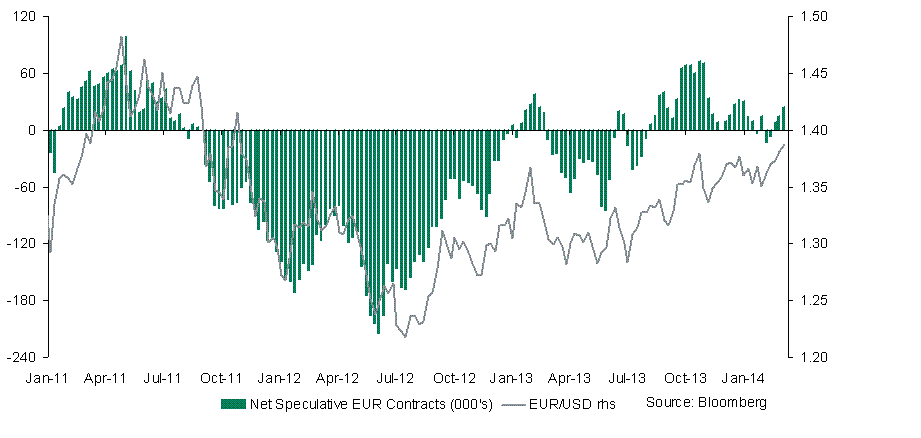
EUR has continued to push higher over recent weeks and looks well supported as inflows into European assets continues unabated. Although speculative EUR positioning continues to move higher above its 3-month average, suggesting that positioning is becoming a little more stretched, sentiment for the EUR remains firm. The ECB’s decision last week to refrain from any policy easing while not hinting at any easing in the pipeline, suggests that EUR/USD will remain a buy on dips on any decline to support around 1.3775. A test of strong psychological resistance around 1.4000 cannot be ruled out over coming sessions.

Posted in eurozone. Tags: , . Leave a Comment »

Gold breaches its 200 day moving average

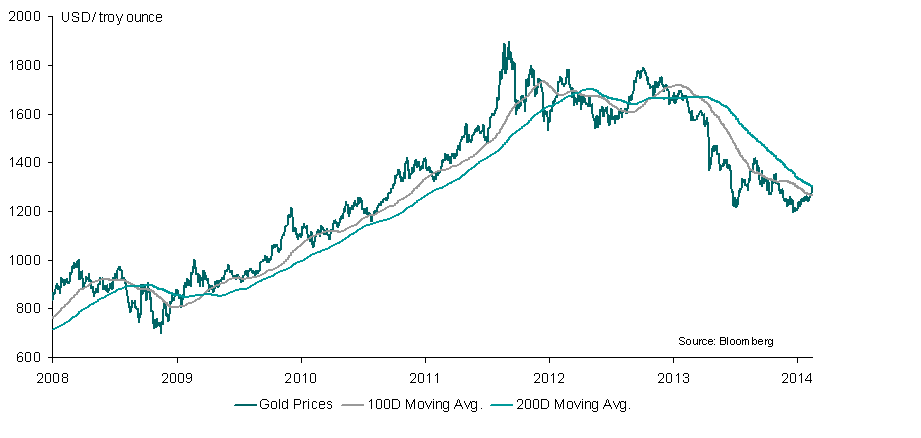
AUDjobsGold prices have risen sharply since the beginning of the year, up over 8% year to date. Higher risk aversion, lower US yields and a weaker USD have boosted gold. Consequently gold prices are trading around their 200 day moving average level around 1303.70. This could prove significant, with a close above the 200 day moving average important to sustain any short term uptrend,

Encouraging signs for gold bulls
ETF investor demand appears to have stabilised over recent weeks while CTFC IMM demand appears to be picking up. This data suggests that Investors are tentatively moving back into gold. The poor performance of equity markets since the start of the year has indeed made gold look more attractive as an investment while lower yields mean that the opportunity cost of holding gold has lessened.

Chinese demand for gold increases sharply
Additionally gold demand from China has picked up strongly. China Gold Association data showed that Chinese demand for gold jumped 41% to 1,176 tonnes last year. Chinese demand likely overtook India’s last year. Oddly Chinese import and production data were even stronger, making it possible that China bolstered its reserves with gold last year.

Indian restrictions hit demand
India restricts demand for gold via import restrictions. However, there is a lot of pressure domestically to remove these restrictions and a review is scheduled to take place at the end of the fiscal year at end March 2014. If these restrictions are removed or at the least weakened, Indian gold imports could increase sharply but it seems unlikely that imports will rise as strongly as previous years.

Moreover, the Indian government will want to avoid an adverse impact on India’s current account deficit, suggesting that a complete removal of gold import restrictions is unlikely. However, in the meantime the restrictions are having a major impact on Indian gold demand which dropped sharply last year.

Gold rally to fade
Risk appetite has already improved sharply over February and while I continue to expect bouts of volatility in the weeks and months ahead I do not expect to see sustained periods of elevated risk aversion. Therefore any boost to gold from rising risk aversion is set to prove temporary in the months ahead.

Secondly global inflation pressures remain well contained. Inflation for the major economies is likely to remain benign. Only in Japan is inflation expected to pick up but this is an aim of policy and is not expected to result in a bout of gold buying to hedge against such inflation risks. Therefore, gold demand as an inflation hedge will not take place.

Two major drivers of the gold price are US bond yields and the US dollar. Both are highly correlated with gold price gyrations, with gold falling as US yields and the USD rise and vice-versa. Both yields and the USD are set to rise over the coming months. Consequently any short term gold price gains are unlikely to hold, with the metal set to resume its decline.