Currencies At Pivotal Levels

Ahead of today’s highly anticipated Fed FOMC meeting markets are holding their breath to determine exactly what the Fed will deliver. The consensus view is for the Fed to announce a programme of $500 billion in asset purchases spread over a period of 6-months. The reaction in currency markets will depend on the risks around this figure. Should the Fed deliver a bigger outcome, say in the region of $1 trillion or above, the US dollar will likely come under renewed pressure. However, a more cautious amount of asset purchases will be US dollar positive.
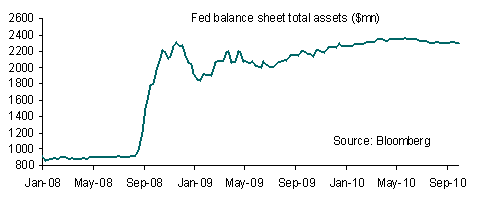
It has to be noted that the Fed will likely keep its options open and keep the program open ended depending on the evolution of economic data which it will use to calibrate its asset purchases. The USD will likely trade with a soft tone ahead of the Fed outcome, but with so much in the price, it may be wise to be wary of a sell on rumour, buy on fact outcome.

Whatever the outcome many currencies are at pivotal levels against the USD at present, with AUD/USD flirting around parity following yesterday’s surprise Australian rate hike, EUR/USD holding above 1.4000, GBP/USD resuming gains above 1.600 despite a knock back from weaker than forecast construction data, whilst USD/JPY continues to edge towards 80.00. Also, both AUD and CAD are trading close to parity with the USD. The Fed decision will be instrumental in determining whether the USD continues to remain on the weaker side of these important levels.

Going into the FOMC meeting the USD has remained under pressure especially against Asian currencies as noted by the renewed appreciation in the ADXY (a weighted index of Asian currencies) against the USD this week. Although it appears that the central banks in Asia have the green light to intervene at will following the recent G20 meeting the strength of capital inflows into the region is proving to be a growing headache for policy makers. One option is implementing measures to restrict “hot money” inflows but so far no central bank in the region has shown a willingness to implement measures that are deemed as particularly aggressive.

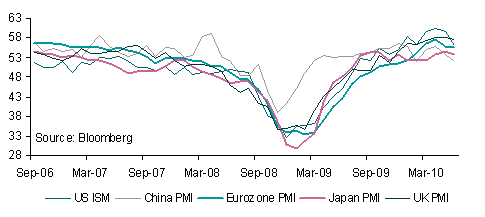
There has been some concern that Asia’s export momentum was beginning to fade as revealed in September exports and purchasing managers index (PMI) data in the region and this in turn could have acted as a disincentive to inflows of capital, resulting in renewed Asian currency weakness. The jury is still out on this front but its worth noting that Korean exports in October reversed a large part of the decline seen over previous months. Moreover, the export orders component of Korea’s PMI remained firm suggesting that exports will resume their recovery.

Nonetheless, manufacturing PMIs have registered some decline in October in much of Asia suggesting some loss of momentum, with weaker US and European growth likely to impact negatively. However, China’s robust PMI, suggests that this source of support for Asian trade will remain solid. Similarly a rise in India’s manufacturing PMI in October driven largely by domestic demand, highlights the resilience of its economy although with inflation peaking its unlikely that the Reserve Bank of India (RBI) will follow its rate hike on Tuesday with further tightening too quickly.
Resisting Asian FX Appreciation

The upward momentum in Asian currencies has continued unabated over recent weeks the gyrations in risk appetite. Most Asian currencies have registered gains against the USD over 2010 with the notable exception of one of last year’s star performers, KRW which after gaining by close to 9% last year has weakened slightly this year. Last year’s best performer the IDR which raked in close to 20% gains over 2009 versus USD has continued to strengthen this year, albeit to a smaller degree. Another currency that has extended gains this year has been the THB, which is on track to beat last year’s 4% appreciation against the USD.

The strength in Asian currencies has in part reflected robust inflows into Asian equity markets. For example Indonesia has been the recipient of around $1.7 billion in equity inflows so far this year. However, India and Korea have registered even larger inflows into their respective equity markets, at around $13 billion and $7.7, respectively, yet both the INR and KRW have underperformed other Asian currencies. The explanation for this is largely due to deteriorating current account positions in both countries. Further deterioration is likely.

The fact that equity flows have had only a small impact on the INR and KRW is reflected in their low correlations with their respective equity market performance. For most other Asian currencies the correlation with equity performance has been quite high, with the THB and MYR having the strongest correlations with their respective equity market indices over the past 3-months although the SGD, PHP and IDR have also maintained statistically significant correlations.

Clearly, for many but not all Asian currencies equity market gyrations are important drivers but at a time when growth is slowing more than many had expected in the US and governments in the eurozone are implementing austerity measures which will likely result in slowing growth and a worsening trade picture in the region, central banks in Asia will become increasingly wary of allowing their currencies from strengthening too quickly.

Increasingly Asian currency strength is being met with intervention by central banks in the region buying USDs against a host of Asian currencies. Over recent weeks this intervention appears to have become more aggressive. Nonetheless, any FX intervention led weakness in Asian FX is likely to prove short lived, with renewed appreciation likely over the coming months unless risk aversion increases dramatically. In other words a drop in Asian currencies will provide better opportunities to go long.

The CNY will play an important role on the pace and pattern of Asian currency movements. Investors in the region will also have one eye on developments on the visit of US National Economic Council director Larry Summers to Beijing. The CNY has firmed over recent days but this appears to be the usual pattern when a senior US official is in town and ahead of a G20 meeting. The fact is however, that the lack of CNY appreciation since the June CNY de-pegging remains a highly sensitive issue.

China is unlikely to yield to US pressure and is set to continue to act at its own pace and comments from officials in China over the past couple of days suggest no shift in FX stance. Although the CNY has not appreciated by as much as many had hoped for or expected since the June de-pegging the path is likely to be upwards, albeit at a gradual pace. For Asian currencies a slow pace of CNY appreciation implies further reluctance to allow a fast pace of appreciation so expect plenty of FX intervention in the weeks and months ahead.

Follow The Oracle

Many investors are probably wishing they had the psychic abilities of Paul the octopus. The mollusc once again gave the correct prediction, by picking Spain to beat the Netherlands to become the winner of the World Cup. This ability would have been particularly useful for currency forecasters, many of which have been wrong footed by the move higher in EUR/USD over recent weeks.

Confidence appeared to return to markets over the past week helped by a string of rate hikes in Asia from India, South Korea and Malaysia, and firm data including yet another consensus beating jobs report in Australia. An upward revision to global growth forecasts by the International Monetary Fund (IMF) also helped, with the net result being an easing in double-dip growth concerns.

The good news culminated in a much stronger than forecast June trade surplus in China. However, China’s trade numbers will likely keep the pressure on for further CNY appreciation, and notably US Senators are still pushing ahead with legislation on China’s FX policy despite the US Treasury decision not to name China as a currency manipulator.

Political uncertainty on the rise again in Japan following the loss of control of the upper house of parliament by the ruling DPJ party. The JPY has taken a softer tone following the election and will likely remain under pressure. CFTC IMM speculative JPY positioning has increased but this has been met with significant selling interest by Japanese margin accounts who hold their biggest net long USD/JPY position since October 2009 according to Tokyo Financial Exchange (TFX) data.

In the absence of the prodigious abilities of an “oracle octopus” data and events this week will continue to show slowing momentum in G3 country growth indicators but not enough to warrant renewed double-dip concerns. Direction will be largely driven by US Q2 earnings. S&P 500 company earnings are expected to have increased 27% from a year ago according to Thomson Reuters.

There are several data releases of interest in the US this week but the main release is the retail sales report for June which is likely to record another drop over the month. Data and events in Europe include the Eurogroup finance ministers meeting, with markets looking for further insight into bank stress tests across the region. Early indications are positive but the scope of the tests remains the main concern. The July German ZEW survey will garner some interest and is likely to show a further slight decline in economic sentiment.

EUR/USD gains looked increasingly stretched towards the end of last week, as it slipped back from a high of around 1.2722. Technical resistance around 1.2740 will prove to be tough level to crack over coming days, with a pullback to support around 1.2479 more likely. CFTC IMM data reveals that short covering in EUR has been particularly sharp in the last week, with net short positions cut by over half, highlighting that the scope for further short covering is becoming more limited.

Conversely aggregate net USD long positions have fallen by over half in the last week as USD sentiment has soured, with longs at close to a three-month low. The scope for a further reduction in USD positioning is less significant, suggesting that selling pressure may abate.

Q2 Economic Review: Double-Dip Recession or Prolonged Recovery?

I was recently interviewed by Sital Ruparelia for his website dedicated to “Career & Talent Management Solutions“, on my views on my view on the Q2 Economic Review: Double-Dip Recession or Prolonged Recovery?

Sital is a regular guest on BBC Radio offering career advice and job search tips to listeners. Being a regular contributor and specialist for several leading on line resources including eFinancial Careers and Career Hub (voted number 1 blog by ‘HR World’), Sital’s career advice has also been featured in BusinessWeek online.

Please see below to read my article

Since we last discussed the economic outlook at the end of quarter 1, much has happened and unfortunately there has not been a great deal of positive news. I retained a cautiously optimistic outlook for economic recovery for the Q1 Economic Review: elections, recovery and underemployment discussion article, but highlighted that recovery would be a long and drawn-out process, with western economies underperforming Asian economies.

The obstacles to recovery discussed then continue to apply now, including consumers paying down debt, high unemployment, tight credit conditions and weak confidence.

Click here to read the rest…

Double-dip fears pressure USD

Markets have found it hard to decide whether to sell the USD due to weaker economic data or buy it on higher risk aversion, but the moves overnight were clear; the USD sold off sharply in the wake of a run of soft data releases. Four separate US releases came in below consensus yesterday, with the June ISM, jobless claims, pending home sales and domestic vehicle sales, all disappointed to varying degrees, especially pending home sales, which dropped an astonishing 30% in June.

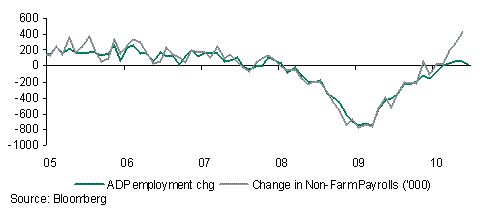
The news could have been much worse today, with the release of the US June jobs report. Following the 13k increase in the June ADP employment count the consensus forecast for nonfarm payrolls looked way too optimistic; consensus expectations were for a 130k drop in payrolls according to Bloomberg, with estimates ranging from 0 to -250k. In the event payrolls dropped by 125k and the unemployment dropped to 9.5%, an outcome that was not as bad as feared.

It was not just the US ISM that slipped, but a host of global purchasing managers indices (PMIs) weakened in June including China and India, supporting the view that economic activity will lose momentum in H2 2010. Before we all get too carried away it is worth noting that most manufacturing surveys are coming off a high level.

Nonetheless, for once it wasn’t European concerns that sparked an increase in risk aversion as eurozone banks borrowed less than feared from the ECB, and the Spanish bond tender passed off relatively well, factors that helped EUR/USD jump above 1.25000. Although I remain bearish on the prospects for the EUR over coming months, there may be some further near term upside, with EUR/USD 1.2675, the next resistance level in focus.

As a consequence of US double-dip fears, risk aversion remains at a high level, with US bond yields and commodity prices dropping sharply, leaving commodity currencies sharply lower. In the current environment the USD is likely to be sold on rallies.

On the commodity currency front, AUD/USD may find some relief from the news of a compromise on a proposed mining tax, but the weight of risk aversion will limit any rebound, with my preference to play AUD upside versus NZD. The main concession from Australian Prime Minister Gillard reduce was to reduce the tax to 30% for iron and coal, whilst retaining the 40% tax for oil and gas projects. The agreement likely increases the chance of an election in Australia in the next couple of months as Gillard capitalises on a popularity bounce. Fresh elections could be another factor that limits AUD upside over coming weeks.