EUR strength is overdone

The latest in a long line of disappointing US data was released on Friday. University of Michigan consumer confidence sent an alarming signal about the propensity of the US consumer to contribute to economic recovery. Confidence dropped much more than expected, to its lowest level since August 2009, fuelling yet more angst about a double-dip in growth.

The Fed’s relatively dovish FOMC minutes last week contributed to the malaise and undermined the USD in the process as attention switched from the timing of exit strategies to whether the Fed will expand quantitative easing. Friday’s benign June CPI report left no doubt that the Fed has plenty of room on its hands, with core inflation remaining below 1% and likely to decelerate further over the coming months. Against this background Fed Chairman Bernanke’s semi-annual testimony to the US Congress (Wed/Thu) will be a particular focus, especially if he hints at potential for further QE, a possibility that appears remote, but could harm the USD.

Arguably the biggest event of the week is the European bank stress test results on Friday. Although several European governments have suggested that the banks in their countries will pass the tests there is still a considerable event risk surrounding the announcement. 91 banks are being tested and much will depend on how rigorous the tests are perceived to be. Should they be seen not to be sufficiently thorough, for instance in determining a realistic haircut on sovereign debt holdings, the potential for pressure on the EUR to increase once again will be high. Similarly debt auctions across Europe this week will also garner interest but similar success to last week’s Spanish auction cannot be guaranteed.

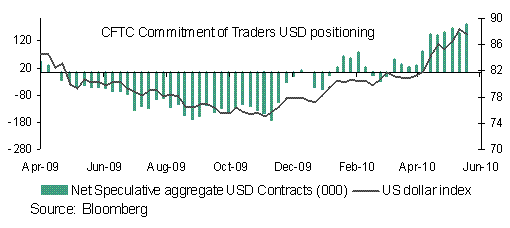
The big question in FX markets is whether the EUR can hold onto its recent gains and whether the USD will be punished further amidst growing double-dip worries. Interestingly the USD’s reaction on Friday to the soft consumer confidence data was not as negative as has been the case recently, with higher risk aversion once again outweighing negative cyclical influences. Various risk currencies actually came under pressure against the USD and this is likely to extend into this week. Despite a threat to the USD from any QE hints by Bernanke, speculative positioning has turned net short USD once again suggesting potential for less USD selling.

The bigger risk this week is to the EUR, which could face pressure on any disappointment from the bank stress test results. The EUR was strong against most major currencies last week, suggesting that the strengthening in EUR/USD is less to do with USD weakness, but more related to EUR strength. This strength in the EUR is hard to tally with the worsening economic outlook in the eurozone and the fact that a stronger EUR from an already overvalued level will crimp eurozone growth further. The latest CFTC IMM data has revealed a further covering of short positions, but this is likely to be close to running its course. Technically EUR/USD has broken above its ‘thick’ Ichimoku cloud, and the weekly MACD is turning above its signal line from oversold levels suggesting a period of further strength but its gains are set to be short-lived.
Unloved US Dollar

The USD index is now at its lowest level since May 3 and is showing little sign of turning around. The bulk of USD index weakness overnight came via the EUR and GBP, both of which rose sharply against the USD, with EUR/USD breaching its 90 day moving, hitting a high of 1.2955 and GBP/USD on its way to testing its 200 day moving average, reaching a high of 1.5472. Commodity currencies fared far less positively, perhaps feeling the after effects of the weaker Chinese data this week, with the NZD also dented by weaker than expected inflation data in Q2.

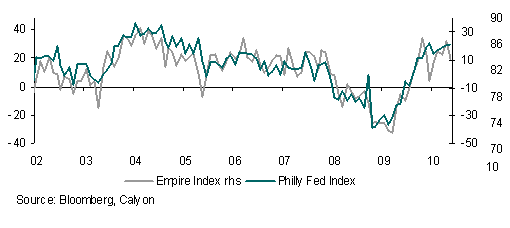
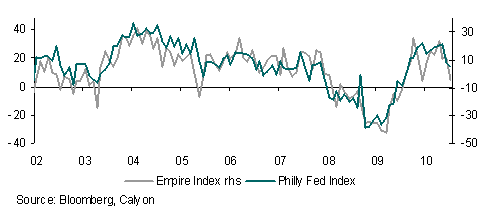
The USD was once again hit by US growth worries. To recap, the US data slate revealed a soft reading for PPI, whilst the July Empire manufacturing index dropped 14.5 points, a far bigger drop than forecast. The Philly Fed index also dropped further in July despite expectations of a small gain. In contrast, June industrial production edged higher, but manufacturing output actually fell. There was a bit of good news in the fact that weekly jobless claims fell more than forecast.

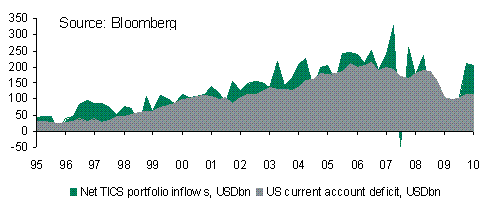
The releases extended the run of weak US data, keeping double-dip fears very much alive. The data have acted to validate the Fed’s cautious growth outlook expressed in the latest FOMC minutes but a double-dip is unlikely. Today’s releases include June CPI, May TIC securities flows, and July Michigan confidence. Another benign inflation report is expected. Consumer confidence is set to slip further against the background of soft data and volatility in equity markets whilst TICS data is forecast to reveal that long term securities flows declined in May compared to the $83 billion inflows registered in April.

The move in the EUR is a making a mockery out of forecasts including my own that had expected renewed downside. The relatively successful Spanish bond auction yesterday helped to ease eurozone sovereign debt concerns further, with a likely strong element of Asian participation. I have still not given up on my EUR negative view given the likelihood of a deteriorating economic outlook in the eurozone and outperfomance of the US economy, but over the short-term the EUR short squeeze may have further to go, with EUR/USD resistance seen at 1.3077.

Equity markets were saved from too much of a beating following the release of better than expected earnings from JP Morgan, a $550mn agreement between Goldman Sachs and the SEC to settle a regulatory case, and news from BP that it has temporarily stemmed the flow of oil from the leak from its Gulf well. Agreement on the US financial reform bill, passed by the Senate yesterday and likely to be signed into law by US President Obama next week, likely helped too.

The tone of the market is likely to be mixed today, with US growth concerns casting a shadow on risk trades. Earnings remain in focus and the big name releases today include BoA, GE and Citigroup but early direction could be negative following news after the US close that Google Inc. profits came in below analysts’ expectations. Data in the US today is unlikely to help sentiment given expectations of more weak outcomes, leaving the USD vulnerable to further selling pressure.

World Cup FX Positioning/Data Highlights

The market tone felt decidedly better over the course of the last week although it was difficult to tell if this was due to position squaring ahead of the World Cup football or a genuine improvement in sentiment. There was no particular event or data release that acted as a catalyst either, with the European Central Bank (ECB) and Bank of England (BoE) meetings passing with little fanfare.

US data ended the week mixed, with retail sales disappointing in May but in contrast June consumer confidence beating expectations. Although questions about the pace of recovery remain, other data such as the Fed’s Beige Book suggest that recovery remains on track, sentiment echoed, albeit cautiously by Fed Chairman Bernanke last week.

Attention this week will centre on inflation data. Expected benign CPI readings will support the view that the Fed will take its time to raise interest rates. Speeches by the Fed’s Bullard, Plosser and Bernanke this week will be eyed for further clues on Fed thinking.

Central banks in Brazil and New Zealand hiked rates last week but this is not likely to be echoed this week. No change is likely from both the Bank of Japan and Swiss National Bank although there will be plenty of attention on the SNB’s comments on the CHF following recent data showing a surge in FX reserves due to currency intervention. The BoJ is unlikely to announce anything new but perhaps some further detail on the loan support plan could be forthcoming.

Manufacturing data will also garner some attention, with the US June Empire and Philly Fed surveys and May industrial production on tap. All three reports will confirm the improving trend in manufacturing activity in the US. Housing data will look weaker, with starts set to pull back in starts in May following the expiry of government tax incentive programmes though permits are set to rise.

In Europe, the June German ZEW (econ sentiment) investor sentiment survey will likely slip slightly due to ongoing fiscal/debt worries but this will be countered by stronger domestic data. In any case the index remains at a high level and a slight drop is unlikely to derail markets.

GBP may find some support form upgrade of UK growth forecasts by the CBI to 1.3% for 2010 and relatively hawkish comments from the BoE’s Sentance in the weekend press warning that inflation is higher than expected, indicating that the Bank may need to hike rates sooner than expected.

Further GBP/USD direction will come from CPI and retail sales data this week as well as public borrowing figures and a report by the new Office of Budget Responsibility on the UK’s fiscal position ahead of the June 22 budget. A break above GBP/USD resistance around 1.4760 is unlikely to materialise.

Despite the many data releases this week, the overall tone is likely to be one of consolidation and reduced volatility in the days ahead. This may allow EUR/USD to gain some ground due to short covering, with the CFTC commitment of traders (IMM) report revealing a further increase in net short speculative positions last week, close to the record set a few weeks back, though we suspect that there will be strong resistance around 1.2227.

The fact that the IMM data revealed that net aggregate net USD long positions reached an all time high last week, highlights the potential for profit taking this week. USD/JPY will look to take out resistance around 92.55 but this looks unlikely unless the BoJ dishes up anything particularly dovish from its meeting.

Will the ECB intervene to support the Euro? (Part 2)

Click here to read Part 1

The last official intervention by the European Central Bank (ECB) in the currency markets took place in November 2000 and at the time the Bank stated that “the external value of the EUR does not reflect the favourable conditions of the euro area”. The ECB also noted the impact of a weaker EUR on price stability, with inflation at the time running above the ECB’s 2% threshold. This followed intervention a couple of months earlier in September 2000 when the ECB jointly intervened with the US Federal Reserve, Bank of Japan and other central banks in a concerted manner due to “shared concerns about the potential implications of recent movements in the euro exchange rate for the world economy”.

Conditions in the euro area could hardly be described as favourable at present, suggesting that this rationale would be very unlikely to be used to justify intervention. Conversely, a weaker EUR may actually contribute to making conditions in the eurozone more favourable. The rationale used for the September 2000 intervention holds more sway in the current environment. Nonetheless, the move in the EUR is very unlikely to do any serious damage to the world economy even if some Japanese exporters are suffering.

In the past the ECB has given various verbal warnings about the volatility of the EUR being too high, and this could potentially be utilized as rationale for FX intervention. However, implied volatility in EUR/USD is not particularly high when compared to the levels it reached during the recent financial crisis. Currently 3-month implied volatility is at its highest level since June 2009 but well below the peak in volatility recorded in December 2008. Clearly if EUR/USD volatility continues to rise there will be a greater cause for concern but at current levels the ECB is unlikely to even crank up verbal intervention let alone actual FX intervention.

One of the main benefits of the decline in the EUR is the support that it will provide to the eurozone economy. At a time when growth in Europe is slowing EUR weakness will be particularly welcome. Germany and other countries in Northern Europe will be major beneficiaries of EUR weakness given their export dependence. Given such benefits and the currently limited risks to inflation, the ECB is highly unlikely to intervene to strengthen the EUR.

Given the current very negative mood in the market, officials in Europe would do better to rectify some of the structural issues that markets are concerned about. This may provoke a more sustainable rally in the EUR but until there are concrete signs of progress on the fiscal front sentiment towards the EUR will remain negative. Against this background FX intervention to prop up the EUR would face more of a risk of failure, and in turn damage to the credibility of the ECB. This is perhaps as good a reason as any not to expect intervention.

Singapore revalues, Asian currencies jump

The positive tone to risk appetite is keeping the USD on the back foot and for once FX attention has turned away from events in Greece. Before elaborating further and staying with Greece, it’s worth highlighting that the outcome of Greece’s note auction was reasonably solid, with more debt than anticipated being sold. However, the cost of borrowing for Greece rose compared to the previous auction in January, which means that the Greece will still suffer higher funding costs to roll over debt.

The positive reception to the debt offering was not particularly surprising given that it followed so closely after the EU/IMF loan package announcement but it is difficult to see sentiment for Greece and the EUR for that matter, getting much of a lift. The main positive for the EUR is the fact that market positioning remains very short but EUR/USD is likely to struggle to make much headway above technical resistance around 1.3653.

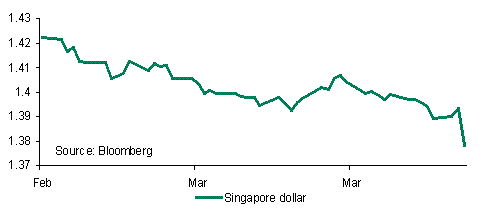
More interestingly Asian central banks are continuing on the track towards fighting rising inflation pressure and Asian currencies, in particular the SGD, were boosted by the Monetary Authority of Singapore (MAS) decision to revalue its currency. Singapore has moved back to a policy of a “modest and gradual appreciation” of the SGD from a policy of zero appreciation, which obviously implies openness to further FX appreciation in the weeks and months ahead.

The rationale for the decision was clear and as revealed in the strong first quarter Singapore GDP data which revealed a 13.1% annual rise. Stronger growth is fuelling growing inflationary concern and to combat this Singapore’s MAS will allow greater SGD appreciation. The reaction in other Asian currencies was also positive, with markets (quite rightly in my view) that other Asian central banks will be more tolerant of currency strength in their respective currencies.

Moreover, Singapore’s move was pre-emptive, perhaps with one eye on an imminent revaluation in China. The recent easing in tensions between the US and China has if anything increased the likelihood that China revalues its currency, the CNY, sooner rather than later, and most likely before the end of Q2 2010. Whatever the rationale, strengthening inflation pressure across the region, will mean a less FX interventionist stance in Asia, and likely stronger currencies over coming months.