Data releases in focus

For a change the markets may actually concentrate on data releases today rather than political events in the eurozone. The October US retail sales report and November Empire manufacturing survey are likely to paint a less negative economic picture of the US. The data will help to dampen expectations of more quantitative easing in the US but we will be able to hear more on the subject from the Fed’s Bullard and Williams in speeches today.

Overnight the Fed’s Fisher poured more cold water on the prospects of further QE by highlighting that the economy is “poised for growth”. While speculative data in the form of the CTFC IMM data shows a drop in USD sentiment to its lowest in several weeks we do not expect this to persist. The USD will likely benefit from the data today and we see the currency retaining a firmer tone over the short term especially as eurozone concerns creep back in.

The vote by German Chancellor Merkel’s party to approve a measure for a troubled country to leave the EUR opens up a can of worms and will hit EUR sentiment. But rather than politics there are several data releases on tap today that will provide some short term influence on the EUR, including Q3 GDP and the November German ZEW survey. FX markets will likely ignore a positive reading for GDP given that the outlook for Q4 is going to be much worse. The forward looking ZEW survey will record a further drop highlighting the risks to Europe’s biggest economy.

T-bill auctions in Spain and Greece may garner even more attention. Following on from yesterday’s Italian debt sale in which the yield on 5-year bond came in higher than the previous auction but with a stronger bid/cover ratio, markets will look for some encouragement from today’s auctions. Even if the auctions go well, on balance, relatively downbeat data releases will play negatively for the EUR.

When viewing the EUR against what is implied by interest rate differentials it is very evident that the currency is much stronger than it should be at least on this measure. Both short term (interest rate futures) and long term (2 year bond) yield differentials between the eurozone and the US reveal that EUR/USD is destined for a fall.

Europe’s yield advantage has narrowed sharply over recent months yet the EUR has not weakened. Some of this has been due to underlying demand for European portfolio assets and official buying of EUR from central banks but the reality is that the EUR is looking increasingly susceptible to a fall. EUR/USD is poised for a drop below the psychologically important level of 1.35, with support seen around 1.3484 (10 November low).
FX Winners and Losers

There has been a sense of mean reversion in FX markets so far this year as some of last year’s winners have become losers. Namely NZD, CHF, JPY and AUD have all lost ground whilst EUR and GBP have gained ground. The odd one out is the SEK which has strengthened over 2010 and in 2011 versus USD. I expect this pattern to change and the likely winners over the next 3- months are NZD, AUD and CAD, with CHF and JPY the likely losers.

EUR held up reasonably well in the wake of slightly disappointing growth data, with eurozone GDP rising less than expected in Q4, and a smaller than expected gain in the February German ZEW investor confidence survey (economic sentiment component). My sense is that the net long EUR speculative position has already been pared back somewhat over recent days reducing the potential selling pressure on the currency in the near term.

Given that EUR/USD is one of the only major currency pairs being influenced by interest rate differentials, its direction will hinge more on policy expectations but in the near the announcement by the German Finance Minister this morning of a restructuring plan for WestLB may give the currency some support.

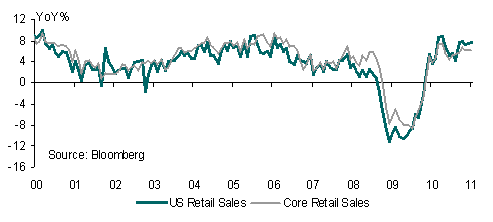
Perhaps one explanation for the stability of EUR/USD around the 1.3500 level is that US data was also disappointing yesterday. January retail sales rose less than forecast whilst revisions to back months suggest less momentum in Q4 consumer spending than previously envisaged. As with the eurozone data weather likely played a role in contributing to the outcome.

The net impact on currencies is that they are largely stuck within tight ranges. Further direction will come from the release of the Fed FOMC minutes for the January 26th meeting. The minutes may undermine the USD if a likely dovish slant continues to be expressed but given that the FOMC decision at that meeting to hold policy setting unchanged had no dissenters this should not come as a surprise.

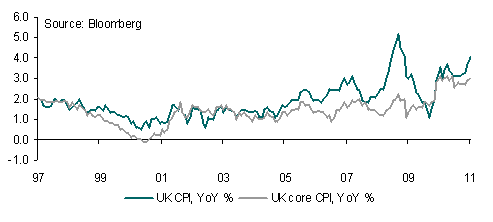
Whilst the battle between the USD and EUR ended in a stalemate GBP outperformed in the wake of the increase in UK January CPI inflation and in particular the letter from the BoE governor to the Chancellor keeping open the door to a rate hike. The Quarterly Inflation Report (QIR) today will be particularly important to determine whether the bounce in GBP is justified.

I remain hesitant to build on long GBP positions given the net long speculative overhang in the currency. The risks following yesterday’s jump in GBP are asymmetric, with a hawkish QIR likely to have less impact on the currency than the negative impact from a more dovish than expected report.

Econometer.org has been nominated in FXstreet.com’s Forex Best Awards 2011 in the “Best Fundamental Analysis” category. The survey is available at http://www.surveymonkey.com/s/fx_awards_2011

Interest rate and FX gyrations

Following a brief rally at the start of the year the USD has found itself under growing pressure in the wake of widening interest rate differentials versus many other currencies. In particular, the contrasting stance between the hawkish rhetoric (bias for tighter monetary conditions) from European Central Bank (ECB) President Trichet and the relatively dovish US Federal Reserve stance as highlighted in the 26th January FOMC statement has provided more fuel to the widening in interest rate expectations between the US and eurozone. Since the end of last year interest rate differentials have widened by around 31 basis points in favour of the EUR (second general interest rate futures contract).

The Fed remains committed to carrying out its full $600 billion of asset purchases by end Q2 2011 whilst the ECB appears to be priming the market for a scaling back of its liquidity operations. Whilst there may be more juice in EUR over the short term based on the move in interest rate differentials as well as improved sentiment towards the eurozone periphery the upside potential for EUR/USD is looking increasingly limited. Even European officials are beginning to inject a dose of caution, with the ECB’s Nowotny stating that markets are too euphoric over a potential enlargement of the European Financial Stability Facility (EFSF) bailout fund. Indeed, it is highly likely that the euphoria fades quickly once it becomes apparent that enlarging the bailout fund is by no means a panacea to the region’s ailments.

GBP is another currency that has undergone sharp gyrations over recent days in the wake of a shift in interest rate expectations. A surprise 0.5% quarterly drop in UK Q4 GDP (which could not all be blamed on poor weather) set the cat amongst the pigeons and gave a GBP a thrashing but much of this was reversed following the release of Bank of England Monetary Policy Committee (MPC) minutes which revealed a hawkish shift within the MPC, with two dissenters voting for a rate hike and most members agreeing that the risks to inflation has probably shifted higher.

Does this imply an imminent rate hike? No, a policy rate hike closer to the end of the year appears more likely. BoE Governor King provided support to this view, in a speech that was interpreted as dovish, with the governor once again highlighting the temporary nature of the current rise in inflation pressure. Consequently UK interest rate expectations have shifted back and forth over recent days, but still remain wider relative to the US since the start of the year. GBP/USD has of course benefitted, but given worries about growth and the dovish message from King, it is unlikely that rate differentials will widen much further. Consequently GBP/USD is unlikely to make much if any headway above 1.6000.

Euro Sentiment Jumps, USD Sentiment Dives

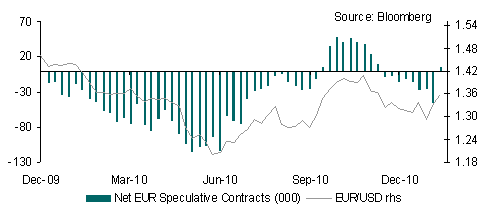
The bounce in the EUR against a broad range of currencies as well as a shift in speculative positioning highlights a sharp improvement in eurozone sentiment. Indeed, the CFTC IMM data reveals that net speculative positioning has turned positive for the first time since mid-November. A rise in the German IFO business confidence survey last week, reasonable success in peripheral bond auctions (albeit at unsustainable yields), hawkish ECB comments and talk of more German support for eurozone peripheral countries, have helped.

A big driver for EUR at present appears to be interest rate differentials. In the wake of recent commentary from Eurozone Central Bank (ECB) President Trichet following the last ECB meeting there has been a sharp move in interest rate differentials between the US and eurozone. This week’s European data releases are unlikely to reverse this move, with firm readings from the flash eurozone country purchasing managers indices (PMI) today and January eurozone economic sentiment gauges expected.

Two big events will dictate US market activity alongside more Q4 earnings reports. President Obama’s State of The Union address is likely to pay particular attention on the US budget outlook. Although the recent fiscal agreement to extend the Bush era tax cuts is positive for the path of the economy this year the lack of a medium to long term solution to an expanding budget deficit could come back to haunt the USD and US bonds.

The Fed FOMC meeting on Wednesday will likely keep markets treading water over the early part of the week. The Fed will maintain its commitment to its $600 billion asset purchase program. Although there is plenty of debate about the effectiveness of QE2 the program is set to be fully implemented by the end of Q2 2011. The FOMC statement will likely note some improvement in the economy whilst retaining a cautious tone. Markets will also be able to gauge the effects of the rotation of FOMC members, with new member Plosser possibly another dissenter.

These events will likely overshadow US data releases including Q4 real GDP, Jan consumer confidence, new home sales, and durable goods orders. GDP is likely to have accelerated in Q4, confidence is set to have improved, but at a low level, housing market activity will remain burdened by high inventories and durable goods orders will be boosted by transport orders. Overall, the encouraging tone of US data will likely continue but markets will also keep one eye on earnings. Unfortunately for the USD, firm US data are being overshadowed by rising inflation concerns elsewhere.

Against the background of intensifying inflation tensions several rate decisions this week will be of interest including the RBNZ in New Zealand, Norges Bank in Norway and the Bank of Japan. All three are likely to keep policy rates on hold. There will also be plenty of attention on the Bank of England (BoE) MPC minutes to determine their reaction to rising inflation pressures, with a slightly more hawkish voting pattern likely as MPC member Posen could have dropped his call for more quantitative easing (QE). There will also be more clues to RBA policy, with the release of Q4 inflation data tomorrow.

Both the EUR and GBP have benefitted from a widening in interest rate futures differentials. In contrast USD sentiment has clearly deteriorated over recent weeks as highlighted in the shift in IMM positioning, with net short positions increasing sharply. It is difficult to see this trend reversing over the short-term, especially as the Fed will likely maintain its dovish stance at its FOMC meeting this week. This suggests that the USD will remain on the back foot.

“Risk On”- Which Currencies Will Benefit?

It was a “risk on” beginning of the week as equity markets rallied, commodities prices rose, and G10 bonds and USD came under pressure. Stronger manufacturing PMIs helped to boost confidence in the global economic recovery, with solid PMIs revealed in China, and across the rest of Asia, UK, and the US. The US ISM manufacturing which rose to its highest since April 2006 also revealed a rise in the unemployment component, consistent with view of an unchanged reading for December payrolls.

In the Eurozone the PMI matched the flash release and remained in expansion territory though there was some slippage in Germany, Spain, and Italy, underscoring the likely underperformance of the Eurozone economy relative to expectations of faster recovery in the US. Nonetheless, the PMIs continued to show a picture of expansion, with the Eurozone PMI at its highest in 21-months.

The USD lost ground against the background of improved risk appetite and looks set to fall further abruptly ending its short covering rally. The USD appears to be finding little support from interest rate expectations, with the correlation between most currencies and relative interest rate differentials remaining relatively low for the most part (just -0.04 over the past 3-months between the USD index and US rate futures).  The correlation between the USD and US 10-year bond yields looks somewhat stronger however, and could offer some relief to the USD if yields continue to push higher.

Speculative (CFTC Commitment of Traders) data reveals just how massive the shift in USD positioning has been over recent weeks, with net aggregate USD positioning (vs EUR, JPY, GBP, AUD, NZD, CAD, CHF) registering its first net long USD position since May 2008. The swing in positioning has been dramatic, from -167k contracts on 15 September 2009 to +8.7k in the week ending 29th December 2009. The data also reveals the sharp deterioration in sentiment for the EUR to its lowest since September 2008. Likewise net JPY positions have shifted to their biggest net short since August 2008.

What does this imply? The market is very short EUR and JPY but the JPY has much further to go on the downside as it increasingly retakes the mantle of funding currency.  In any case compared to historical positioning JPY shorts are not so big suggesting more room to increase short positions.   

The EUR has moved into a short term uptrend, with the MACD (12,26,9) having crossed its signal line and positioning supports further upside. EUR/USD will need to take out strong resistance at 1.4459 (December 29) before it can embark on a more significant move higher. Asian currencies also look set to take more advantage of a resumption of USD weakness, especially in the wake of strong risk seeking capital flows into the region. KRW, TWD, IDR and PHP look bullish technically.