Global Themes

It’s definitely been a strange start to the year, with markets taking plenty of time to get their bearings. Some general themes have developed but none have provided clear direction. As a result, the path over coming weeks and months is likely to remain highly volatile and in this respect, currencies, equities and bonds will continue to see strong gyrations.

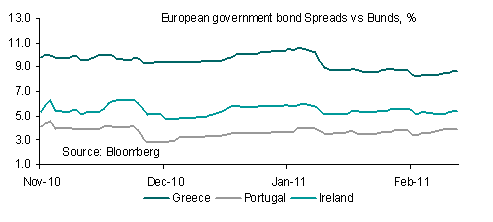
One theme that has been evident since the start of the year is an improvement in sentiment towards the eurozone periphery as hopes of an enlargement/extension of the European Union bailout fund (EFSF) have increased. This is a key reason why the EUR has strengthened this year although nervousness on this front appears to have returned over recent days (note the recent widening in peripheral bond spreads, drop in EUR and European Central Bank purchases of Portuguese debt). It seems that a lot of good news has already been discounted in relation to the eurozone periphery and now markets are in wait and see mode for the EU Council meeting on 24/25 March. There is a strong chance that eventually market expectations will prove overly optimistic and the EUR will drop but more on that later.
The second theme is global inflation concerns, driven by higher food and energy prices. Certainly this has had an impact on interest rate expectations and in some cases resulted in a hawkish shift in central bank language, notably in the eurozone and UK. Although European Central Bank (ECB) President Trichet has toned down his comments on tighter monetary policy compared to the more hawkish rhetoric following the last ECB council meeting, expectations for monetary tightening in the eurozone still look overly hawkish, with a policy rate hike currently being priced in for August/September this year, which looks way too early. The EUR has benefitted from the relative tightening in eurozone interest rate expectations compare to the US but will suffer if and when such expectations are wound down.

Elsewhere in many emerging markets the impact of higher food prices is finding its way even more quickly into higher inflation, forcing central banks to tighten policy. In Asia, the urgency for higher rates is even more significant given that real interest rates (taking into account inflation) are negative in many countries. China has accelerated the pace of its rate hikes over recent months and looks set to continue to tighten policy much further to combat inflation. In India, worries about inflation and the need for further monetary tightening have clearly weighed on equity markets, with more pain to come. Although not the sole cause by any means, in the Middle East and Africa higher food prices are feeding social tensions such as in Egypt.

Another clear theme that has developed is the improvement in US economic conditions. The run of US data over recent months has been encouraging, confirming that the economy is gaining momentum. Even the disappointing January non-farm payrolls report has not dashed hopes of recovery, with many other job market indicators pointing to strengthening job conditions such as the declining trend in weekly US jobless claims. Manufacturing, business and consumer confidence measures have strengthened whilst credit conditions are easing, albeit gradually. The US economy is set to outperform many other major economies this year, especially the eurozone, which will be beset with a diverging growth outlook between northern and southern Europe.

Although the US dollar has not yet benefitted from stronger US growth given the still dovish tone of the Fed and ongoing asset purchases in the form of quantitative easing, the rise in US bond yields relative to other countries, will likely propel the dollar higher over 2011 after a rocky start over Q1 2011. In contrast, the EUR at current levels looks too strong and as noted above, hopes of a resolution of eurozone peripheral problems look overdone. EUR/USD levels above 1.3500 provide attractive levels to short the currency. Other growth currencies that will likely continue to do well are commodity currencies such as AUD, NZD and CAD, whilst the outlook for Asian currencies remains positive even despite recent large scale capital outflows. The JPY however, will be one currency that suffers from an adverse yield differential with the US as US bond yields rise relative to Japan.

Econometer.org has been nominated in FXstreet.com’s Forex Best Awards 2011 in the “Best Fundamental Analysis” category. The survey is available at http://www.surveymonkey.com/s/fx_awards_2011

Interest rate and FX gyrations

Following a brief rally at the start of the year the USD has found itself under growing pressure in the wake of widening interest rate differentials versus many other currencies. In particular, the contrasting stance between the hawkish rhetoric (bias for tighter monetary conditions) from European Central Bank (ECB) President Trichet and the relatively dovish US Federal Reserve stance as highlighted in the 26th January FOMC statement has provided more fuel to the widening in interest rate expectations between the US and eurozone. Since the end of last year interest rate differentials have widened by around 31 basis points in favour of the EUR (second general interest rate futures contract).

The Fed remains committed to carrying out its full $600 billion of asset purchases by end Q2 2011 whilst the ECB appears to be priming the market for a scaling back of its liquidity operations. Whilst there may be more juice in EUR over the short term based on the move in interest rate differentials as well as improved sentiment towards the eurozone periphery the upside potential for EUR/USD is looking increasingly limited. Even European officials are beginning to inject a dose of caution, with the ECB’s Nowotny stating that markets are too euphoric over a potential enlargement of the European Financial Stability Facility (EFSF) bailout fund. Indeed, it is highly likely that the euphoria fades quickly once it becomes apparent that enlarging the bailout fund is by no means a panacea to the region’s ailments.

GBP is another currency that has undergone sharp gyrations over recent days in the wake of a shift in interest rate expectations. A surprise 0.5% quarterly drop in UK Q4 GDP (which could not all be blamed on poor weather) set the cat amongst the pigeons and gave a GBP a thrashing but much of this was reversed following the release of Bank of England Monetary Policy Committee (MPC) minutes which revealed a hawkish shift within the MPC, with two dissenters voting for a rate hike and most members agreeing that the risks to inflation has probably shifted higher.

Does this imply an imminent rate hike? No, a policy rate hike closer to the end of the year appears more likely. BoE Governor King provided support to this view, in a speech that was interpreted as dovish, with the governor once again highlighting the temporary nature of the current rise in inflation pressure. Consequently UK interest rate expectations have shifted back and forth over recent days, but still remain wider relative to the US since the start of the year. GBP/USD has of course benefitted, but given worries about growth and the dovish message from King, it is unlikely that rate differentials will widen much further. Consequently GBP/USD is unlikely to make much if any headway above 1.6000.

Japanese yen and FX sensitivity to interest rates

Interest rates have some way to go before they take over from risk aversion as the key driver of currency markets but as noted in my previous post, low US interest rates have played negatively for the dollar. As markets have continued to pare back US tightening expectations and US interest rate futures have rallied, interest rate differentials have moved against the dollar. 

The most sensitive currency pair in this respect has been USD/JPY which has been the most highly correlated G10 currency pair with relative interest rate differentials over the past month. It has had a high 0.93 correlation with US/Japan interest rate differentials and a narrowing in the rate differential (mainly due to a rally in US rate futures) has resulted in USD/JPY moving lower and the yen becoming one of the best performing currencies over recent weeks.

Going forward the strong FX / interest rate correlation will leave USD/JPY largely at the whim of US interest rate markets (as Japanese rate futures have hardly moved). Fed officials if anything, are adding to the pressure on the dollar as they continue to highlight that US interest rates will not go up quickly. San Francisco Fed President Yellen was the latest official to do so, warning that the prospects for a “tepid” recovery could fuel inflation risks on the downside.

This echoes the sentiments of other Fed officials over recent weeks and suggests that the Fed wants to prevent the market pricing in a premature reversal in US monetary policy.   It looks increasingly likely that the Fed will maintain interest rates at current levels throughout 2010 given the massive amount of excess capacity and benign inflation outlook, suggesting that interest rate differentials will play negatively for the dollar for several months to come.

As for the yen its path will not only depend on relative interest rates but also on the policies of the new DPJ led government. If Japanese press speculation proves correct the new Finance Minister may favour a stronger yen which will benefit domestic consumers rather than a weaker yen that would benefit exporters. Against this background, markets will largely ignore comments by outgoing Finance Minister Yosano who said that further yen strength would be detrimental for exporters.

The market certainly believes that the yen will strengthen further as reflected by the sharp increase in speculative positioning over recent weeks; net CFTC IMM long yen positions have reached their highest since 10 February 2009. Although USD/JPY has pushed higher since it’s low around 90.21 the upside is likely to be limited against this background and a re-test and likely break back below the key 90.00 psychological level is likely soon.

Why the Fed should be in no hurry to hike rates

Equity markets struggled to gain traction last week and finally lost ground registering their first weekly decline in month.  It finally looks as though markets are succumbing to the inevitable; the realisation that the recovery is going to be a rocky ride but neither will it be rapid or aggressive.  Markets look as though they have just about run out of fuel and after registering major relief that the global economy was not falling into an endless whole and that financial markets were not going to implode, the equity rally has finally come to a point where it will need more than just news about “green shoots” to keep it going. 

One question that has been raised in particular in bond markets and in interest rate futures pricing is whether these “green shoots” have accelerated the timing of the end of quantitative easing and/or higher interest rates.  Although the markets have retraced some of the tightening expectations that had built in following the May US jobs report there will be a lot of attention on whether the Fed will attempt to allay market concerns that current policy settings will result in inflation running out of control and necessitate a hike in interest rates. 

The Fed’s job shouldn’t be too difficult. In usual circumstances the expansion of the money supply undertaken by the Fed would have had major implications for inflation.  However, the circulation of money (money multiplier) in the economy has collapsed during the recession as consumers have been increasingly reluctant to borrow and lenders have become increasingly reluctant to lend.  The end result has been to blunt the impact of Fed policy.  Of course, once the multiplier picks up the Fed will need to be quick to remove its massive policy accommodation without fuelling a rise in inflation.  If it didn’t it would be bad both for long term interest rates as well as the dollar. 

Although the current policy of quantitative easing is untested and therefore has a strong element of risk attached to it the reality is that the Fed is unlikely to have too much of a problem on its hands.  The explanation for this is that there will be plenty of slack in the economy for months if not years to come.  The labour market continues to loosen and as the US unemployment rate increases most probably well in excess of 10%, wage pressures will continue to be driven down.  

In addition there is plenty of excess capacity in the manufacturing sector and as the May industrial production report revealed the capacity utilisation rate dropped to 68.3%, a hefty 12.6% below its average for 1972-2008.  Inflation data continues to remain subdued as revealed by last week’s release core inflation remains comfortable at a 1.8% annual rate.   Weaker corporate pricing power suggests that core inflation will remain subdued over coming months and will even fall further, so there will be little threat to Fed policy.  

The output gap (difference between real GDP and potential GDP) remains wide and according to CBO estimates of potential GDP the economy will end the year growing at around 8% below its full capacity.  Even if the economy grows above potential for the next few years it may only just close the output gap and subsequently begin fuelling inflation pressures.  The bigger risk is that the economy grows slowly over coming years and takes several years to close the output gap. 

Taking a perspective of past Fed rate hikes following the last two recessions, interest rate markets should take some solace.  In 2001 the Fed begin to hike rates until around 2 ½ years after the end of the recession whilst in the 1990-91 recession rates did not go up until close to 3 years following the end of recession.  Arguably this recession is worse in terms of depth and breadth suggesting that it will take a long time before the Fed even contemplates reversing policy.

Are currency market dynamics shifting?

There has been a major shift in market pricing for US interest rates following the US jobs report and comments from Fed officials including Atlanta Fed president Lockhart, suggesting that the Fed should not wait too long before tightening monetary policy.  As a result the implied yield on the December 09 3-month eurodollar futures contract has spiked by around 50bps since the middle of last week and markets have now moved to pricing in a US rate hike by year.  This looks wildly premature given the likely absence of inflation pressures for many months to come. 

The most interesting reaction to the shift in interest rate expectations was exhibited by the dollar which has managed to register solid gains over the last couple of days indicative of the past relationship between the dollar and interest rate expectations.  The odd thing about the strengthening in the dollar is that it has come at a time when risk appetite has continued to improve, suggesting that the strong risk appetite/dollar relationship that has been in place for much of the past year could be diminishing in strength.  For instance, the correlation between various dollar crosses and the VIX volatility index has been higher over the last few months than it has been in previous years.   

Admittedly its early days and the bounce in the dollar may just have reflected a market that was positioned very short dollars.  There was already signs of some short covering prior to the release of the US May jobs report as reflected in the CFTC IMM commitment of traders’ report which showed that net aggregate dollar speculative positioning (vs. EUR, JPY, GBP, AUD, NZD, CAD and CHF) improved for the first time in five weeks.  It is not inconceivable that investors have continued to cover short positions over the last few days.  

Nonetheless, it is difficult to ignore the possibility that currency market dynamics may be shifting back towards interest rate differentials as a key FX driver.  Over recent months the interest rate / FX relationship had all but broken down as reflected in very low and insignificant correlations between interest rate differentials and various currency pairs.  This could be changing and as interest rate markets begin to price in higher rates the relationship with currency markets may once again be strengthening.  

The risk for the dollar is that this tightening in US interest rate expectations looks premature.   It seems highly unlikely that the Fed will raise rates this year which points to the risk of a turnaround in rate expectations at some point over coming weeks and months.  In turn this suggests that the dollar could come under renewed pressure in the event of a dovish shift in US interest rate markets.  Even so, this is a factor to consider further out.  Over the next few days such a shift is unlikely and the dollar is likely to hold onto and even extend its gains as markets continue to ponder the probability that the Fed tightens policy sooner rather than later.