What QE2 means for currencies

The sweeping gains for the Republican party in the US mid term elections has sharply changed the political dynamic in the US, with the prospects of further fiscal stimulus looking even slimmer than before although the chances of the Bush tax cuts being extended have likely increased.

The onus is on monetary policy to do the heavy lifting and the Fed delivered on its end of the bargain, with the announcement of $600 billion of purchases of long-term securities over 8-months through June 2011.

Given the likelihood that the economic impact of the asset purchases is likely to be limited and with little help on the fiscal front the Fed has got a major job on its hands and $600 billion may end up being a minimum amount of purchases necessary for the Fed to fulfil its mandate.

The decline in the USD following the Fed decision is unlikely to mark the beginning of a more rapid pace of USD decline though further weakness over coming months remains likely. The USD remains a sell on rallies for now and an overshoot on the downside is highly probable as the Fed begins its asset purchases.

The bottom line is that the Fed’s program of asset purchases implies more USD supply and in simple economic terms more supply without an increase in demand implies a lower price. The USD will remain weak for some months to come and the Fed’s actions will prevent any USD recovery as the USD solidifies its position as the ultimate funding currency.

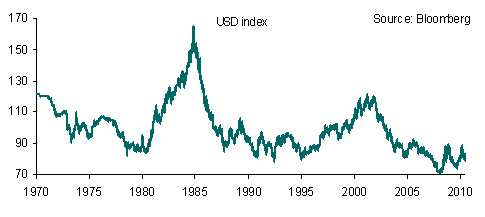
Nonetheless, with market positioning close to extreme levels, US bond yields unlikely to drop much further, and the USD already having sold off sharply in anticipation of QE2, (USD index has dropped by around 14% since June) those looking for a further sharp drop in the USD to be sustained are likely to be disappointed.

It is difficult however, to fight the likely further weakness in the USD even if turns out not to be a rapid decline. The path of least resistance to some likely USD weakness will be via the likes of the commodity currencies, scandies and emerging market currencies. There will be less marked appreciation in GBP, CHF and JPY against the USD.

The Fed’s actions will continue to fuel a rush of liquidity into emerging markets, particularly into Asia. This means more upward pressure on Asian currencies but will likely prompt a variety of responses including stronger FX intervention as well as measures to restrict and control such flows.

There have been various comments from central banks in the region warning about the Fed’s actions prompting further “hot money” flows into the region and even talk of a coordinated response to combat such flows.

This suggests more tensions ahead of the upcoming G20 meeting in Seoul. Assuming that at least some part of the additional USD liquidity flows into Asia, the implications of potentially greater FX intervention by Asian central banks to prevent Asian currencies from strengthening, will have a significant impact on major currencies.

Already it is apparent that central banks in Asia have been strongly using the accumulated USDs from FX intervention to diversify into EUR and other currencies including AUD and even JPY. Perversely this could end up exacerbating USD weakness against major currencies.
FX Tension

On September 22 1985 the governments of France, West Germany, Japan, US and UK signed the Plaza Accord which agreed to sharply weaken the USD. At this time it was widely agreed that the USD was overly strong and needed to fall sharply and consequently these countries engineered a significant depreciation of the USD.

It is ironic that 25 years later governments are once again intervening in various ways and that the USD is once again facing a precipitous decline as the Fed moves towards implementing further quantitative easing. This time central banks are acting unilaterally, however, and there is little agreement between countries. For instance Japan’s authorities found no help from the Fed or any other central bank in its recent actions to buy USD/JPY.

So far Japan’s FX interventions have been discreet after the initial USD/JPY buying on 15 September. The fact that Japan is less inclined to advertise its FX intervention comes as little surprise given the intensifying pressure from the US Congress on China for not allowing its currency, the CNY to strengthen. Tensions have deepened over recent weeks and the backing of a bill last week by an important Congressional committee to allow US companies to seek tariffs on Chinese imports suggests that the situation has taken a turn for the worse.

The softly softly approach to Japan’s FX intervention and US/China friction reflects the fact that unlike in 1985 we may be entering a period in which currency and in turn trade tensions are on the verge of intensifying sharply against the background of subdued global economic recovery.

The Fed’s revelation that it is moving closer to implementing further quantitative easing has shifted the debate to when QE2 occurs rather than if, with a November move moving into focus. Clearly the USD took the news negatively and will likely remain under pressure for a prolonged period as the simple fact of more USD supply weighs heavily on the currency. Markets will be able to garner more clues to the timing of QE2, with a plethora of Fed speakers on tap over coming days.

This week the US economic news will be downbeat, with September consumer and manufacturing confidence surveys likely to register declines, with consumer sentiment weighed down by the weakness in job market conditions. Personal income and spending will also be of interest and gains are expected for both. There will be plenty of attention on the core PCE deflator given that further declines could give clues to the timing of QE2.

Attention in Europe will centre on Wednesday’s recommendations for legislation on “economic governance” from the European Commission. Proposed penalties for fiscal indiscipline may include withholding of funding and/or voting restrictions but such measures would be politically contentious. Measures to enforce fiscal discipline ought to be positive for markets given the renewed tensions in peripheral bond markets in the eurozone.

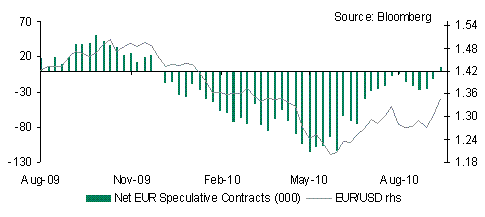
The EUR was a major outperformer last week benefiting from intensifying US QE speculation and will set its sights on technical resistance (20 April high) around 1.3523 in the short-term. Notably EUR speculative positioning has turned positive for the first time this year according to the CFTC IMM data, reflecting the sharp shift in speculative appetite for the currency over recent weeks. The EUR has been surprisingly resilient to renewed sovereign debt concerns and similarly softer data will not inflict much damage to the currency this week.

No Let Up in USD Pressure

At the end of a momentous week for currency markets it’s worth taking stock of how things stand. Much uncertainty remains about the global growth outlook, especially with regard to the US economy, potential for a double-dip and further Fed quantitative easing. Although there is little chance of QE2 being implemented at next week’s Fed FOMC meeting speculation will likely remain rife until there is clearer direction about the path of the US economy.

In Europe, sovereign debt concerns have eased as reflected in the positive reception to debt auctions this week. Nonetheless, after a strong H1 2010 in terms of eurozone economic growth the outlook over the rest of the year is clouded. Such uncertainty means that markets will also find it difficult to find a clear direction leaving asset markets at the whim of day to day data releases and official comments.

The added element of uncertainty has been provided by Japan following its FX intervention this week. Whilst Japanese officials continue to threaten more intervention this will not only keep the JPY on the back foot but will provide a much needed prop for the USD in general. Indeed Japan’s intervention has had the inadvertent effect of slowing but not quite stopping the decline in the USD, at least for the present.

The fact that Japanese officials continue to threaten more intervention suggests that markets will be wary of selling the USD aggressively in the short term. The headwinds on the USD are likely to persist for sometime however, regardless of intervention by Japan and/or other Asian central banks across Asia, until the uncertainty over the economy and QE2 clears.

Japan’s intervention has not gone down well with the US or European authorities judging by comments made by various officials. In particular, the FX intervention comes at a rather sensitive time just as the US is piling on pressure on China to allow its currency the CNY to strengthen further. Although US Treasury Secretary Geithner didn’t go as far as proposing trade and legal measures in his appearance before Congress yesterday there is plenty of pressure from US lawmakers for the administration to take a more aggressive stance, especially ahead of mid-term Congressional elections in November. Ironically, the pressure has intensified just as China has allowed a more rapid pace of CNY nominal appreciation over recent days although it is still weaker against its basket according to our calculations.

Another country that has seen its central bank intervening over many months is Switzerland, with the SNB having been aggressively intervening to prevent the CHF climbing too rapidly. However, in contrast to Japan the SNB is gradually stepping back from its intervention policy stating yesterday that it would only intervene if the risk of deflation increased. Even so, Japan may have lent the Swiss authorities a hand, with EUR/CHF climbing over recent days following Japan’s intervention.

The move in EUR/CHF accelerated following yesterday’s SNB policy meeting in which the Bank cut its inflation forecasts through 2013, whilst stating that the current policy stance in “appropriate”. Moreover, forecasts of “marked” slowdown in growth over the rest of the year highlight the now slim chance of policy rates rising anytime soon. Markets will eye technical resistance around 1.3459 as a near term target but eventually the CHF will likely resume its appreciation trend, with a move back below EUR/CHF 1.3000 on the cards.

Japanese FX Intervention

The Bank of Japan acting on the behest of the Ministry of Finance intervened to weaken the JPY, the first such action since 2004. The intervention came as the USD was under broad based pressure, with the USD index dropping below its 200-day moving average. USD/JPY dropped to a low of around 82.88 before Japan intervened to weaken the JPY. The move follows weeks of verbal intervention by the Japanese authorities and came on the heels of the DPJ leadership election in which Prime Minister Kan retained his leadership.

One thing is for certain that Japanese exporters had become increasingly concerned, pained and vocal about JPY strength at a time when export momentum was waning. However, the move in USD/JPY may simply provide many local corporates with better levels to hedge their exposures.

Time will tell whether the intervention succeeds in engineering a sustainable weakening in the JPY but more likely it will only result in smoothing the drop in USD/JPY over coming months along the lines of what has happened with the SNB interventions in EUR/CHF. As many central banks have seen in the past successful intervention is usually helped if the market is turning and in this case USD/JPY remains on a downward trajectory.

Although the BoJ Governor Shirakawa said that the action should “contribute to a stable foreign exchange-rate formation” it is far from clear that the BoJ favoured FX intervention. Indeed, the view from the BoJ is that the move in USD/JPY is related less to Japanese fundamentals but more to US problems.

Now that the door is open, further intervention is likely over coming days and weeks but for it to be effective it will require 1) doubts about US growth to recede, 2) speculation of Fed QE 2 to dissipate, 3) and consequently interest rate differentials, in particular bond yields between the US and Japan to widen in favour of the USD. This is unlikely to happen quickly, especially given continued speculation of further US quantitative easing. A final prerequisite to a higher USD/JPY which is related to the easing of some of the above concerns is for there to be an improvement in risk appetite as any increase in risk aversion continues to result in JPY buying.

When viewed from the perspective of Asian currencies the Japanese intervention has put Japan in line with other Asian central banks which have been intervening to weaken their currencies. However, Asian central bank intervention has merely slowed the appreciation in regional currencies, and Japan may have to be satisfied with a similar result. Japan’s intervention may however, give impetus to Asian central banks to intervene more aggressively but the result will be the same, i.e. slowing rather then stemming appreciation.

As for the JPY a further strengthening, with a move to around 80.00 is likely by year end despite the more aggressive intervention stance. Over the short term there will at least be much greater two-way risk, which will keep market nervous, especially if as is likely Japan follows up with further interventions. USD/JPY could test resistance around 85.23, and then 85.92 soon but eventually markets may call Japan’s bluff and the intervention may just end up putting a red flag in front of currency markets to challenge.

Resisting Asian FX Appreciation

The upward momentum in Asian currencies has continued unabated over recent weeks the gyrations in risk appetite. Most Asian currencies have registered gains against the USD over 2010 with the notable exception of one of last year’s star performers, KRW which after gaining by close to 9% last year has weakened slightly this year. Last year’s best performer the IDR which raked in close to 20% gains over 2009 versus USD has continued to strengthen this year, albeit to a smaller degree. Another currency that has extended gains this year has been the THB, which is on track to beat last year’s 4% appreciation against the USD.

The strength in Asian currencies has in part reflected robust inflows into Asian equity markets. For example Indonesia has been the recipient of around $1.7 billion in equity inflows so far this year. However, India and Korea have registered even larger inflows into their respective equity markets, at around $13 billion and $7.7, respectively, yet both the INR and KRW have underperformed other Asian currencies. The explanation for this is largely due to deteriorating current account positions in both countries. Further deterioration is likely.

The fact that equity flows have had only a small impact on the INR and KRW is reflected in their low correlations with their respective equity market performance. For most other Asian currencies the correlation with equity performance has been quite high, with the THB and MYR having the strongest correlations with their respective equity market indices over the past 3-months although the SGD, PHP and IDR have also maintained statistically significant correlations.

Clearly, for many but not all Asian currencies equity market gyrations are important drivers but at a time when growth is slowing more than many had expected in the US and governments in the eurozone are implementing austerity measures which will likely result in slowing growth and a worsening trade picture in the region, central banks in Asia will become increasingly wary of allowing their currencies from strengthening too quickly.

Increasingly Asian currency strength is being met with intervention by central banks in the region buying USDs against a host of Asian currencies. Over recent weeks this intervention appears to have become more aggressive. Nonetheless, any FX intervention led weakness in Asian FX is likely to prove short lived, with renewed appreciation likely over the coming months unless risk aversion increases dramatically. In other words a drop in Asian currencies will provide better opportunities to go long.

The CNY will play an important role on the pace and pattern of Asian currency movements. Investors in the region will also have one eye on developments on the visit of US National Economic Council director Larry Summers to Beijing. The CNY has firmed over recent days but this appears to be the usual pattern when a senior US official is in town and ahead of a G20 meeting. The fact is however, that the lack of CNY appreciation since the June CNY de-pegging remains a highly sensitive issue.

China is unlikely to yield to US pressure and is set to continue to act at its own pace and comments from officials in China over the past couple of days suggest no shift in FX stance. Although the CNY has not appreciated by as much as many had hoped for or expected since the June de-pegging the path is likely to be upwards, albeit at a gradual pace. For Asian currencies a slow pace of CNY appreciation implies further reluctance to allow a fast pace of appreciation so expect plenty of FX intervention in the weeks and months ahead.