Egypt Unrest Hits Risk Trades

Recent weeks have seen a real contrast in policy and growth across various economies. A case in point was the surprise drop in UK GDP in Q4 contrasting sharply with the solid (albeit less than forecast) rise in US Q4 2010 GDP. The resilience of the US consumer was particularly evident in the data. The European Central Bank’s (ECB) hawkish slant as reflected in comments from President Trichet compared to the dovish pitch of the Fed FOMC is another clear contrast for markets to ponder.

The ECB’s hawkish tone gave the EUR a lift but expectations of an early Eurozone rate hike looks premature. Although Eurozone inflation data (Monday) will reveal a further rise in CPI above the ECB’s target, to around 2.4% in January, this will not equate to a policy rate hike anytime soon. This message is likely to be echoed at this week’s ECB meeting where policy will be characterised as “appropriate”.

Whilst monetary tightening expectations look overdone in the Eurozone the same can be said for hopes of an expansion in the EU bailout fund (EFSF). Indeed, the fact that EU Commissioner Rehn appeared to pour cold water over an expansion in the size of the fund could hit the EUR and the currency may find itself struggling to extend gains over coming weeks especially if interest rate expectations return to reality too, with a move to EUR/USD 1.4000 looking far harder to achieve than it did only a few days ago.

It’s worth noting that a renewed widening in peripheral debt spreads will also send an ominous signal for the EUR. Against this background the EU Council meeting on February 4 will be in focus but any expectation of a unified policy resolution will be disappointed.

However, markets perhaps should not solely focus on peripheral Europe as the downgrading of Japan’s credit ratings last week highlights. Warnings about US credit ratings also demonstrate that the US authorities will need to get their act together to find a solution to reversing the unsustainable path of the US fiscal deficit, something that was not particularly apparent in last week’s State of the Union Address.

Last week ended with a risk off tone filtering through markets as unrest in Egypt provoked a sell-off in risk assets whilst worries about oil supplies saw oil prices spike. Gold surged on safe haven demand too. This week, markets will focus on events in the Middle East but there will be thinner trading conditions as Chinese New Year holidays result in a shortened trading week in various countries in Asia.

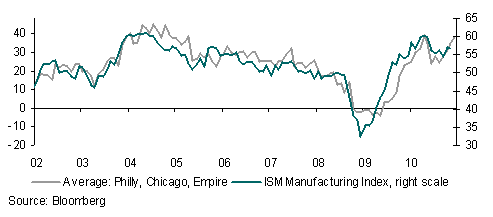
The main release of the week is the US January jobs report at the end of the week. Regional job market indicators and the trend in jobless claims point to a 160k gain in January although the unemployment rate will likely edge higher. Final clues to the payrolls outcome will be deemed from the ISM manufacturing confidence survey and ADP private sector jobs report this week. Whilst the January jobs report is unlikely to alter expectations for Fed policy (given the elevated unemployment rate) the USD may continue to benefit from rising risk aversion.
All Eyes On US Jobs Data

Happy New Year!

2010 ended on a sour note especially for eurozone equity markets (and the Australian cricket team) where there has yet to be a resolution to ongoing growth/fiscal/debt tensions.  The EUR strengthened into year end but this looked more like position adjustment than a shift in sentiment and EUR/USD is likely to face stiff resistance around the 1.3500 level this week, with a drop back towards 1.3000 more likely.  In the US there was some disappointment in the form of a surprise drop in December consumer confidence data but pending home sales and the Chicago PMI beat expectations, with the overall tone of US data remaining positive.

There will be plenty to chew on this week in terms of data and events which will provide some much needed direction at the beginning of the year.  The main event is the December US jobs report at the end of the week.   Ahead of this there will be clues from various other job market indicators including the Challenger jobs survey, ADP employment report, and the ISM manufacturing and non-manufacturing surveys.  The data will reflect a modest improvement in job market conditions and the preliminary forecast for December payrolls is for a 135k increase, with private payrolls set to rise by 145k and the unemployment rate likely to fall slightly to 9.7%.

The minutes of the 14 December Fed FOMC meeting (Tue) will also come under scrutiny against the background of rising US bond yields.  In addition, Fed Chairman Bernanke will speak on the monetary and fiscal outlook as well as the US economy to the Senate Budget Panel.   Bernanke will once again defend the use of quantitative easing whilst keeping his options open to extend it if needed.  However, the changing composition of the FOMC with four new members added in 2011 suggests a more hawkish tinge, which will likely make it more difficult to agree on further QE.   In any case, the tax/payroll holiday package agreed by the US administration means that more QE will not be necessary. 

It’s probably not the most auspicious time for new member Estonia to be joining the eurozone especially as much of the speculation last year focussed on a potential break up.  The beginning of the year will likely see ongoing attention on the tribulations of Ireland after its bailout, with looming elections in the country.  Portugal and Spain will also remain in focus as the “two-speed” recovery in 2011 takes shape.  Data releases this week include monetary data in the form of the eurozone December CPI estimate and M3 money supply.  Inflation will tick up to 2% but this ought to be of little concern for the ECB.  Final PMI data and confidence indices will likely paint a picture of slight moderation.   

The USD ended the year on a soft note, with year lows against the CHF and multi year lows vs. AUD registered, but its weakness is unlikely to extend much further.  The key driver will remain relative bond yields and on this front given the prospects for relative US yields to move higher, the USD will likely gain support.  There maybe a soft spot for the USD in Q1 2011 but for most of the rest of the year the USD is set to strengthen especially against the EUR which will increasingly comer under pressure as peripheral tensions and growth divergence weigh on the currency.

Gold / FX correlations

There is no shortage of cash rich investors in Asia even amidst the current troubles in Dubai. Indeed, sentiment in the gemstones market is particularly upbeat, with a rare five-carat pink diamond selling for a record HK$84.24 million in Hong Kong. Perhaps this is a good reflection of abundant liquidity and of course wealth in Asia and in particular China, with talk that mainland Chinese investors were strong participants in the diamond auction.

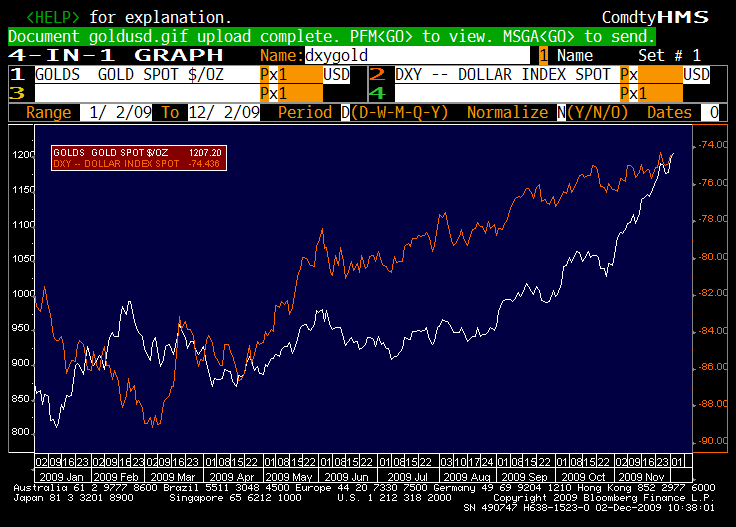
It’s not just diamonds that are selling for record prices; gold hit a fresh high above $1,200 and once again at least part of this is attributable to the appetite of Asian central banks as well as demand from China as the country tries to increase its gold reserves. The rise in gold prices has coincided with a bullish announcement from the world’s top gold producer that it has completely eliminated its market hedges earlier than forecast due to the positive outlook on prices and waning supply.

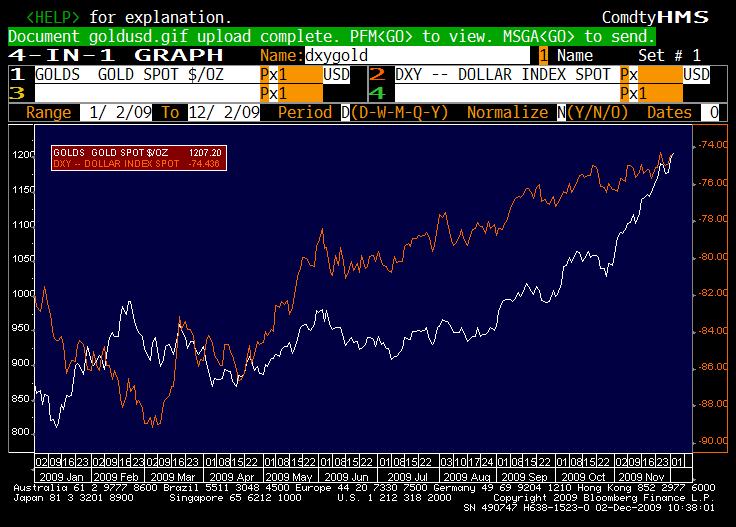
The correlation between gold prices and the USD remains very strong at -0.88 over the last 3-months, with firmer gold prices, implying further USD weakness. In fact, the gold / USD correlation has been consistently strong over the past few months and is showing little sign of diminishing.

Over the past 6-months the correlation has been -0.91 and over the past 1-month it was -0.75.  Assuming that anything above 0.70 can be considered statistically significant, the relationship shows that USD weakness has been well correlated with gold strength and that despite talk of a breakdown in the relationship it appears to remain solid. 

As long as the bullish trend in gold continues, the pressure on the USD will remain in place.  Adding to this pressure is the fact that risk is back on for now. Markets took the news of a fall in the ISM manufacturing index and in particular the drop in the employment component in its stride even though it supports the view of a weaker than consensus drop in payrolls in November when it is published on Friday.

There are still plenty of reasons to be cautious in the weeks ahead and although we appear to be back in a “risk on” environment markets are likely to gyrate between “risk on” and “risk off” over coming weeks. At least for now, the USD looks to remain under pressure but if risk aversion creeps back up as I suspect it may then the USD will see a bit more resilience into year end. 

Moreover, central banks globally are reaching the limits of their tolerance of USD weakness and will be tested once again, with EUR/USD back above 1.5000, EUR/CHF moving back below 1.5100 and the USD/JPY set to re-test 85.00 following the relatively benign measures announced by the BoJ in which the Bank did little to stem deflationary pressure or weaken the JPY.

A Better Start To The Week

The start of this week looks somewhat better compared to the end of last week. Although nervousness will remain amidst thinning liquidity, news that the UAE central bank “stands behind” local and foreign banks and will lend, albeit at a rate of 0.5% above the 3-month benchmark rate, will reassure investors that banks have sufficient liquidity in the wake of any losses suffered due to the Dubai Holdings debacle. This will see some improvement in risk appetite.

The news will unlikely prevent stock markets in the UAE, which open today following Eid holidays, from sliding, however. Attention will turn to the suspended Sukuk bonds and also to the extent of support (and any strings attached) provided by Abu Dhabi to Dubai. The support from the central bank will help markets outside of the UAE regain a little composure and limit demand for safe haven assets but the rally may prove limited until there is greater transparency.

Nonetheless, even if there is some relief at the beginning of this week due to some containment of the problems in Dubai nerves are likely to fray going into the end of the year, with the multi-month trend of improving risk appetite faltering. There have been plenty of reasons for markets to worry lately including concerns about the shape of economic recovery in the months to come as well as renewed banking sector concerns and these will not be allayed quickly.

Data this week in the US is unlikely to help to dampen growth concerns. The main event is the US November jobs report and although the magnitude of job losses is set to decrease the unemployment rate is set to remain stubbornly high around 10.2%. In addition to an expected decline in the November ISM manufacturing index suggests that growth concerns will intensify rather than lessen. This in turn highlights that any improvement in risk appetite this week will prove limited.

The other key events this week include interest rate decisions in Europe and Australia. Although the ECB is widely expected to leave rates on hold on Thursday, there will be plenty of attention on any details of the Bank’s “gradual” exit strategy. Whether the ECB offers new loans to banks at a variable interest relative to the current fixed rate will be taken as an important sign on the path of liquidity withdrawal. We believe the Bank will stick with a fixed rate. The RBA will take a step further and announce a 25bps interest rate hike tomorrow.

FX markets are likely to be buffeted by the gyrations in risk appetite but at least at the beginning of the week the USD is set to give up its recent gains, with EUR/USD likely to try and hold above 1.5000 as markets digest the better news coming from the UAE. The JPY will be a particular focus given the growing attention of the authorities in Japan. Finance Minister Fujii is quoted in the Japanese press that they won’t intervene in the FX market, which appears to give the green light to further JPY strength though I suspect that if USD/JPY drops below 85.00 again there will plenty of FX intervention speculation and in any case these comments have since been denied.