US payrolls clues

Most investors will be glad to see the back of August, a month that marked the biggest monthly decline in US stocks in nine years. The main imponderable is whether September will be any better. A series of manufacturing surveys globally today will do little to restore confidence although there was some good news in a slight increase in China’s official August purchasing managers index (PMI) as well a stronger than forecast increase in Australian Q2 GDP, which will likely provide some short-term relief for risk trades.

There was also some slight solace for markets in terms of US data at least from the point of view that the data was not as disappointing as many recent releases. Although the August Chicago PMI slipped (to 56.7) consumer confidence increased (to 53.5) though admittedly confidence remains at a relatively low level. The job market situation detailed within the consumer confidence report was more pessimistic in August than the previous month, however, with those reporting jobs hard to get moving higher. This sends a negative signal for Friday’s payrolls data.

There will be more clues to Friday’s US jobs report today which will enable any fine tuning of forecasts to take place in the wake of the August ADP employment report and ISM manufacturing survey. Consensus forecasts centre on a 15k increase in private jobs. Despite the slight increase in the Empire manufacturing survey in August, the falls in other manufacturing surveys point to some downside risks to the ISM today, with a simple average of the three pointing to the ISM closer to the 50 mark, which will highlight a loss in US manufacturing momentum.
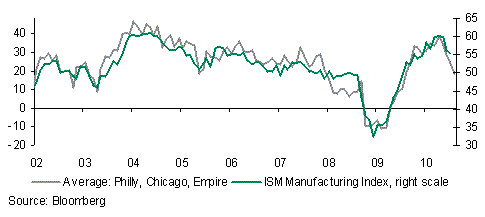
Manufacturing surveys elsewhere will also be in focus, with the final PMI readings scheduled to be released for the eurozone and UK. There is likely to be confirmation of the slight drop in the eurozone PMI to 55.0 in August while the UK PMI is likely to drop to around 57.0 over the month. Both surveys remain at a relatively high level but it is clear that activity is moderating in H2 2010 from a healthy level in H2. The data will give little support to the EUR but the currency has found a degree of stability over the last couple of days. Nonetheless, a further downward move is in prospect.

The Fed FOMC minutes provided little for markets to get excited about. The minutes noted concerns about large scale asset purchases from some Fed officials, indicating resilience to increasing quantitative easing despite acknowledging increased downside risks to the growth and inflation outlook. It is unclear exactly what will be the trigger for further QE as acknowledged by Fed Chairman Bernanke last week.

The minutes will do little to help market confidence given the hesitancy to pursue further QE and provide further stimulus to the economy but the USD is likely to benefit from the fact that the Fed may not be as eager to expand its balance sheet further. Other currencies that remain beneficiaries in the current risk averse environment are the JPY and CHF. The JPY may find further upside more difficult given ongoing intervention fears but the trend remains for a lower USD/JPY in the coming weeks.

Renewed concerns

Despite some positive US data, with both the May ISM manufacturing index and April construction spending coming in stronger than forecast, market sentiment soured. The relative calm that was exhibited at the end of May is giving way to renewed fears as equity markets weaken, volatility increases and risk aversion intensifies. Risk trades are set to remain on the back foot, with the EUR likely to remain the weakest link. After testing support close to 1.2110 EUR/USD bounced but remains vulnerable to a fresh test of this level in the short-term.

A combination of concerns including rumours of ratings downgrades, with France the new target, Middle East tensions, weaker Chinese manufacturing activity and worries about increasing bank writedowns in Europe, have conspired to drag markets lower. The failure to stem the hue oil-leak in the US contributed to the malaise as the US government announced a criminal probe.

For the most part, data releases were unhelpful to risk appetite as the majority of global purchasing managers indices (PMIs) slipped in May, led by China. Only a few increased, including India and notably Ireland, whilst the Spanish and Greek PMIs fell. Although the US ISM index slipped the components looked positive, especially the employment component which moved higher, suggesting some upside potential for Friday’s May payrolls data for which we look for a 500k increase.

A picture of divergence appears to be growing in the eurozone, which will act as another source of pressure on the EUR. Germany’s outperformance is widening as reflected by the fact the German unemployment dropped to 7.7% in May in contrast to a rise in eurozone unemployment, to 10.1%. Moreover, Germany was the only country where its PMI was actually revised higher relative to the flash reading. There are also growing divisions within the European Central Bank (ECB), in particular towards the purchase of government bonds, with German ECB members particularly critical.

Greece In The Spotlight (again)

Once again Greek worries are hogging the limelight and although the Greek saga has become a rather tedious affair for markets, concerns are well founded.  The latest issue is whether Greece is willing to adhere to potentially tough measures that would be associated with IMF assistance for the country.  Latest speculation suggests that Greece may side step the IMF to avoid such measures though this was belatedly denied by the Greek authorities. 

Given the huge amount of bonds Greece needs to sell over the coming weeks renewed nervousness does not bode well for a good reception to this issuance. As it is financing costs are rising once again in the wake of a renewed widening in Greek sovereign bond spreads and servicing this debt will add to the economic misery.  Greece has little by way of upside over coming months and years.  Tough and necessary austerity measures mean that sharp growth deterioration is inevitable, deepening recession.

The lack of flexibility for Greece to devalue its way out of its quagmire means much more economic pain with no release valve.   The same applies to the likes of Spain and Portugal.  The overall loser will be the EUR which looks likely to succumb to further weakness in the months ahead; the parity trade remains a prospect. Perversely a weaker EUR may be exactly what is necessary to alleviate some of the pain for Southern European economies though the EUR would need to weaken by much more than we forecast to be of much help.   

Aside from Greek gyrations the overall market tone looks somewhat positive.  The Fed’s dovish minutes of its March 16 meeting in which it marginally downgraded growth and inflation forecasts, highlights that interest rates are unlikely to be raised by the Fed this year. This will keep in place an accommodative policy stance conducive to further improvements in risk appetite.     Moreover, data releases such as the US ISM manufacturing and non-manufacturing surveys, have been generally supportive to recovery,

Easing tensions on China/US exchange rate policy have also helped sentiment as the issue has been put to one side after the US administration delayed the decision whether to officially label China as a currency manipulator.  Pressure from the US Congress suggests that the issue will not be on the back burner for long and the issue of CNY revaluation will likely be a topic at the during the various meetings between US and Chinese officials over coming weeks. 

Nonetheless, the delay in the US Treasury report will work in favour of a Chinese currency revaluation sooner rather than later as China will likely react more favourable to less international pressure to revalue.

The Ball Is In the EU’s Court

A run of data and events have continued this week’s theme of improving risk appetite. Greece lived up to expectations, with the government announcing a EUR 4.8 billion package of austerity measures amounting to around 2% of GDP. The US ADP jobs data was in line with expectations, with employment dropping by 20k in February, whilst ISM non-manufacturing index delivered an upside surprise to 53.0 in February, contrasting with a weaker eurozone Purchasing Managers Index (PMI).

Greece now believes it has lived up to its part of the bargain and the ball is now in the court of EU countries. However the issue of aid from the EU remains highly sensitive with little sign of any aid forthcoming from EU partners. Moreover, Germany dealt a blow to Greek hopes by stating that financial aid would not be discussed when the Greek Prime Minister visits tomorrow. Failure to provide such assistance could see Greece turn to the IMF. The key test will be the roll over of around EUR 22 billion of debt in April/May.

Markets have reacted positively to recent events, with Greek debt rallying and the EUR strengthening to a high of 1.3727 overnight amidst reports that regulators are investigating hedge fund trades shorting the EUR. The 17 February high of 1.3789 will provide strong resistance to further EUR/USD upside but the currency looks vulnerable to selling on rallies above its 20-day moving average around 1.3631. The EUR will be driven by news about any aid to Greece rather than data whilst the medium term outlook remains bearish.

In the US the steady but gradual recovery in the economy is continuing to take shape. The Fed’s Beige Book revealed that economic activity “continued to expand” but severe snowstorms restrained activity in several districts. Overall, the report revealed little new information following so soon after Fed Chairman Bernanke’s testimony. Today’s US releases are second tier, with a likely upward revision to Q4 non-farm productivity to around 6.5% and a 1.5% increase in January factory orders.

As has been the case recently the weekly jobless claims data will garner more attention than usual given that it has recently signaled deterioration in job conditions. One factor that could have distorted the claims as well as the payrolls data is harsh weather conditions in parts of the US. Indeed, this has led us to cuts in forecasts for February non-farm payrolls scheduled to be released tomorrow, with the real consensus likely to be much weaker than the -65k shown in the Bloomberg survey.

There are four central bank decisions of interest today no change is likely from all of them. Indonesia and Malaysia are both edging towards raising interest rates but are likely to wait until Q2 2010 before hiking. There will be no surprises if the Bank of England (BoE) and European Central Bank (ECB) leave policy unchanged too, but there will be particular interest in the ECB’s announcement on changes in liquidity provision and the BoE’s signals on the potential for further expansion in quantitative easing. A dovish signal from the BoE will deliver GBP a blow, leaving GBP/USD vulnerable to a drop back below 1.50.

Selling Risk Trades On Rallies

Disappointing earnings as well as a weaker than expected outcome for data on the health of the US service sector (the ISM non-manufacturing index failed to match expectations, coming in at 50.5 in January versus consensus of 51.0) has weighed on markets, undoing the boost received from the generally positive manufacturing purchasing managers (PMIs) indices earlier in the week. It was not all bad news however, as earnings from Cisco Systems beat expectations Meanwhile US ADP jobs data fell less than expected, dropping 22k whilst data for December was upwardly revised. These are consistent with a flat outcome for January non-farm payrolls.

Various concerns are still weighing on confidence. Sovereign ratings/fiscal concerns remain high amongst these and although much has been made of the narrowing in Greek debt spreads, attention now seems to be turning towards Portugal. Greece is also far from being out of the woods, and whilst the European Commission accepted Greece’s economic plans the country would be placed under much greater scrutiny by the EC.

The US has not escaped either, with Moody’s warning that the US AAA credit rating would come under pressure unless more stringent actions were taken to reduce the country’s burgeoning budget deficit. The move follows the US administration’s forecast of a $1.565 billion budget deficit for 2010, the highest as a proportion of GDP since the second world war, with the overall debt to GDP ratio also forecast to rise further.

The current environment remains negative for risk trades and the pullback in high beta currencies has been particularly sharp over recent weeks. Sentiment for the NZD was dealt a further blow from a surprisingly weak Q4 jobs report in New Zealand. Unemployment rose to a decade high of 7.3% over the quarter whilst employment growth contracted by 0.1%. The pull back in wage pressures will also be noted by interest rate markets, as it takes some of the pressure off the RBNZ to raise rates anytime soon.

Data in Australia will not help sentiment for the AUD too. Australian retail sales dropped by 0.7% in December, a worse than expected outcome. The data will only serve to reinforce market expectations that the RBA will no hike interest rates as quickly as previously expected. Nonetheless, I would caution reading too much into the data, with real retail sales volumes rising by a solid 1.1% over Q4 whilst other data showed a strong 2.2% jump in building approvals.

The overall strategy against this background is to sell risk trades on rallies. There are still too many concerns to point to a sustained improve in risk appetite. Moreover, the market is still long in many major risk currencies. Asian currencies have so far proven more resilient to the recent rise in risk aversion however, a reflection of the fact that a lot of concerns are emanating from the US and Europe. However, Asian currencies will continue to remain susceptible to events in China, especially to any further measures to tighten policy.

Further USD strength against this background is likely, which could see EUR/USD testing support around 1.3748, AUD/USD support around 0.8735, and NZD/USD support around 0.6916.