Risk Aversion to remain elevated

It remains a tumultuous time for markets, gripped by a cacophony of concerns ranging from the lack of resolution to the Eurozone debt crisis to the failure to reach agreement on raising the US debt ceiling and associated deficit reduction plans. Mingled among these is the growing evidence that economic growth is turning out weaker than expected. Meanwhile Europe’s crisis appears to be shifting from bad to worse, as reflected in a shift in attention towards the hitherto untouched Italy although Italian concerns have eased lately.

The release of the EU bank stress test results at the end of last week have not helped, with plenty of criticism about their severity and rigour following the failure of only 8 banks out of the 90 tested. Expectations centred on several more banks failing, with much more capital required than the EUR 2.5 billion shortfall revealed in the tests. Answering to this criticism officials note that there has already been a significant amount of capital raised over recent months by banks, but this will be insufficient to stem the growing disbelief over the results.

Attention is still very much focussed on Greece and reaching agreement on a second bailout for the country, with further discussions at the special EU summit on July 21. The contentious issue remains the extent of private sector participation in any debt restructuring. The decision to enhance the flexibility of the EFSF bailout fund to embark on debt buybacks has not helped. Consequently contagion risks to other countries in the Eurozone periphery are at a heightened state. Despite all of this the EUR has shown a degree of resilience, having failed to sustain its recent drop below 1.40 versus USD.

One explanation for the EUR’s ability to avoid a steeper decline is that the situation on the other side of the pond does not look much better. Hints of QE3 in the US and the impasse between Republicans and Democrats on budget deficit cutting measures tied to any increase in the debt ceiling are limiting the USD’s ability to benefit from Europe’s woes. Moreover, more weak data including a drop in the Empire manufacturing survey and a drop in the Michigan consumer sentiment index to a two-year low, have added to the worries about US recovery prospects.

Against this background risk aversion will remain elevated, supporting the likes of the CHF and JPY while the EUR and USD will continue to fight it out for the winner of the ugliest currency contest. Assuming that a deal will eventually be cobbled together to raise the US debt ceiling (albeit with less ambitious deficit cutting measures than initially hoped for) and that the Fed does not embark on QE3, the EUR will emerge as the most ugly currency, but there will be plenty of volatility in the meantime.

Data and events this week include more US Q2 earnings, June housing starts and existing home sales. While housing data are set to increase, the overall shape of the housing market remains very weak. In Europe, July business and investor surveys will be in focus, with a sharp fall in the German ZEW investor confidence survey likely and a further softening in July purchasing managers indices across the eurozone. The German IFO business confidence survey is also likely to decline in July but will still point to healthy growth in the country. In the UK Bank of England MPC minutes will confirm no bias for policy rate changes with a 7-2 vote likely, while June retail sales are likely to bounce back.
Which is the ugliest currency?

The contest of the uglies has once again been set in motion in FX markets as last Friday’s weak US jobs report, which revealed a paltry 18k increase in June payrolls, downward revisions to past months and a rise in the unemployment rate, actually left the USD unperturbed. Europe’s problems outweighed the negative impact of more signs of a weak US economy, leaving the EUR as a bigger loser.

The USD’s resilience was even more impressive considering the drop in US bond yields in the wake of the data. However, news over the weekend that talks over the US budget deficit and debt ceiling broke down as Republicans pulled out of discussions, will leave USD bulls with a sour taste in their mouth.

Should weak jobs recovery dent enthusiasm for the USD? To the extent that it may raise expectations of the need for more Fed asset purchases, it may prove to be an obstacle for the USD. However, there is sufficient reason to look for a rebound in growth in H2 2011 while in any case the Fed has set the hurdle at a high level for more quantitative easing (QE).

Fed Chairman Bernanke’s reaction and outlook will be gleaned from his semi-annual testimony before the House (Wed) although he will likely stick to the script in terms of US recovery hopes for H2. This ought to leave the USD with little to worry about. There will be plenty of other data releases this week to chew on including trade data, retail sales, CPI and PPI inflation and consumer confidence as well as the kick off to the Q2 earnings season.

Fresh concerns in Europe, this time with contagion spreading to Italy left the EUR in bad shape and unable to capitalise on the soft US jobs report. In Italy high debt levels, weak growth, political friction and banking concerns are acting in unison. The fact that there is unlikely to be a final agreement on second Greek bailout package at today’s Eurogroup meeting will act as a further weight on the EUR.

Discussions over debt roll over plans, the role of the private sector and the stance of ratings agencies will likely drag on, suggesting that the EUR will not find any support over coming days and will more likely lose more ground as the week progresses. If these issues were not sufficiently worrisome, the release of EU wide bank stress tests on Friday will fuel more nervousness. Against this background EUR/USD looks vulnerable to a drop to technical support around 1.4102.

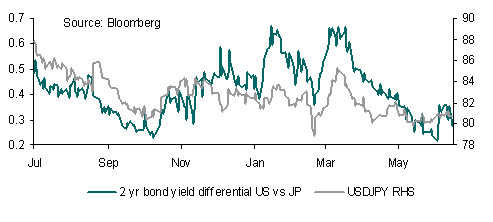
The Bank of Japan is the only major central bank to decide on interest rates this week but an expected unchanged policy decision tomorrow is unlikely to lead to any JPY reaction. In fact there appears to be little to move the JPY out of its current tight range at present. USD/JPY continues to be the most correlated currency pair with 2-year bond yield differentials and the fact that the US yield advantage has dropped relative to Japan has led to USD/JPY once again losing the 81.0 handle.

However, as reflected in the CFTC IMM data the speculative market is still holding a sizeable long position in JPY, which could result in a sharp drop in the currency should US yields shift relatively higher, as we expect over coming months. In the short-term USD/JPY is likely to be well supported around 80.01.

Risk off mood

A ‘risk off’ tone is quickly permeating its way through the market psyche as tensions surrounding the eurozone periphery reach fever pitch. This is reflected in the sharp jump in equity volatility as indicated by the VIX ‘fear’ gauge. Equity markets and risk trades in general look set to remain under pressure in the current climate.

Moreover, the EUR which is finally succumbing to bad news about the periphery will continue to face pressure over the short-term. Against this background economic data will likely be relegated to the background this week but it worth noting that what data there is on tap, is likely to send a weaker message, with data such as durable goods orders in the US as well as various purchasing managers indices (PMI) data in the eurozone today likely to show some slippage.

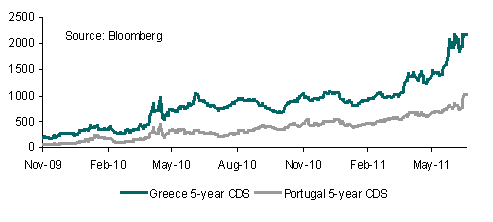
The Greek saga remains at the forefront of market attention, with restructuring speculation remaining high despite various denials over the weekend by Greek and European Central Bank (ECB) officials. News that Norway has frozen payments to Greece, whilst Fitch ratings agency’s downgrades of Greece’s ratings by 3 notches and S&P’s downgrade of Italy’s ratings outlook to negative, have all contributed to the malaise afflicting the periphery.

This weekend’s local election in Spain in which Prime Minister Zapatero and his Socialist Party suffered its worst defeat in more than 30 years leading to a transfer of power in the Spanish regions, will lead to concerns about the ability of the government to carry out much needed legislative changes.

It is difficult to see any improvement in sentiment towards the peripheral Europe and consequently the EUR over the short-term. In Greece, Prime Minister Papandreou will attempt to push through further unpopular austerity measures through parliament this week in advance of a 5th bailout tranche of EUR 12 billion scheduled for next month. This comes at a time when opinion polls show the government losing more support and 80% of those surveyed saying they would not accept more austerity measures.

The deterioration in sentiment for the EUR has been rapid as reflected in the CFTC IMM data, with net long speculative positions now at their lowest since 15 February and heading further downhill. Conversely, USD short covering has been significant though there is still a hefty USD short overhang, which points to more USD short covering as EUR sentiment sours.

Nonetheless, the USD still has plenty of risks hanging over it including the fact that it still suffers from an adverse yield differential (note that 2-year Treasury yields have fallen to the lowest since 6 December 2010). Safe haven currencies in particular CHF are the key beneficiaries and notably EUR/CHF touched a record low around 1.2354 and is showing little sign of any rebound.

Temporary Euro Relief

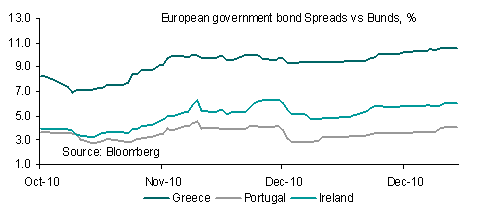
Eurozone peripheral country travails continue to garner most market attention. There was at least a semblance of improvement on this front as peripheral bond spreads with German bunds narrowed on Tuesday but this was largely due to European Central Bank (ECB) bond buying than any improvement in sentiment. The fact that German bund yields also rose helped to narrow bund-peripheral spreads further.

A clearer test of sentiment will be today’s debt sales by Portugal followed by actions by Spain and Italy tomorrow. ECB buying of Portuguese bonds has given some relief to other debt, with Spanish and Italian debt spreads narrowing too. Even Greece managed to sell short term debt (EUR 1.95 bn of 26 week T-bills) but at a higher cost than the previous sale.

Perhaps a stronger boost to sentiment will come from the news that European Union (EU) governments are discussing an increase in the EUR 440 billion bailout fund in recognition of the fact that the fund may prove too small to cope if the crisis spreads to Spain. However, don’t expect a decision anytime soon, with next week’s meeting of EU finance ministers unlikely to agree to such a move. Support (or lack) of from Germany may prove to be a sticking point against the background of domestic political pressure.

Other options being considered include the possibility of the EFSF (European Financial Stability Facility) purchasing bonds in the secondary market and lowering interest rates on EFSF bailout loans. News that Japan will buy 20% of EFSF bonds this month as well as recent supportive comments from China suggest that an increase in the size of the EFSF may be easily funded by such investors. The EUR will gain some support against the background of such speculation but its upside may be restrained around its 200-day moving average at EUR/USD 1.3071.

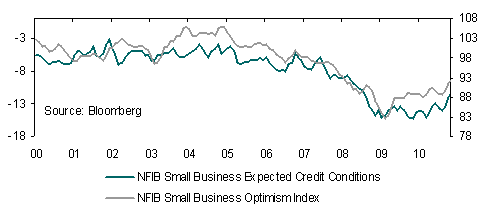
In the US the economic news was not so positive for a change as the National Federation of Independent Business (NFIB) small business optimism survey came in weaker than expected in December, an outcome that will come as a blow given that it suggests some stuttering in the recovery process as well as hiring.

There is only secondary data scheduled today, with most attention on the Fed’s Beige Book later tonight. The survey of Federal Reserve districts will likely reveal a broad based but moderate improvement in economic conditions with the exception of housing activity. A speech by the Fed’s Fisher on Monetary policy will also be in focus. Like the Fed’s Plosser overnight he may highlight some caution about the impact of Fed quantitative easing (QE).

The AUD is increasingly feeling the impact of the flooding in Queensland Australia as the extent of economic damage is revealed. Reserve Bank of Australia (RBA) board member McKibbin estimated that it could knock off at least 1% from economic growth. This may prove too negative and although the flooding will result in a significantly negative impact on growth in Q1 rebuilding and reconstruction will mean that overall growth for 2011 will not be as significantly impacted. Nonetheless, a paring back in RBA policy tightening expectations will see the AUD come under further pressure, with a move down to around AUD/USD 0.9634 on the cards over the short-term.

Euro Problems Intensify

Following the bullish build up and increasingly lofty expectations for the US December jobs report the actual outcome was disappointing, at least on the headline reading. Non farm payrolls rose 103k which in reality was not that much less than initial forecasts but the real consensus was somewhat higher following the robust ADP private sector jobs report earlier in the week. There was some mitigation in the 70k upward revisions to October and November and surprisingly large decline in the unemployment rate to 9.4%. Consequently the market impact was less severe than it could have been and even the USD ended higher on the day.

Nonetheless, the data provided a dose of reality to markets’ optimistic expectations and this was reinforced by Fed Chairman Bernanke in testimony on Friday. He highlighted that it will take “considerable time” before the unemployment rate drops to a normal level, which could threaten recovery. Even the drop in the unemployment rate revealed in the December is report is vulnerable to a reversal given it was in part due to a drop in the labour force. This reality provided support to bond markets which may undermine the USD given the drop in bond yields. However, the USD’s anti-EUR credentials suggest that it will remain resilient.

Eurozone’s woes continued to heat up last week as the holiday season relief proved temporary. Stress in peripheral debt markets increased despite buying from the ECB last week and faced with debt sales in Italy, Portugal and Spain this week the pressure is likely to continue over coming days. Whether its worries about a resolution to funding issues and investor haircuts and/or the growing divergence in growth across the eurozone, the EUR continues to look vulnerable in the absence of any resolution to these issues. Having easily slipped below its 200-day moving average EUR/USD will eye support around 1.2767.

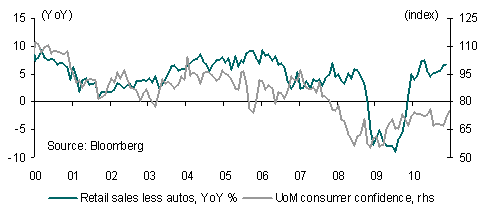
US data this week will look upbeat and provide more support for the USD, with December retail sales likely to record a healthy increase both on the headline and ex-autos readings as indicated by strong holiday sales. Similarly industrial production will reveal a solid gain whilst the Beige Book will highlight that economic conditions across the Federal Reserve districts, have continued to improve. The weak spot will remain housing but despite this consumer spending and sentiment are likely to be reported as resilient. The Beige Book is unlikely to reveal much of an inflation threat despite higher commodity prices. This will be echoed in the core CPI reading this week.

Although headline inflation in the eurozone breached the 2.0% threshold in December the ECB is unlikely to use it as an excuse to move towards tighter monetary conditions any time soon. The ECB meeting this week will nonetheless likely note the increase in various inflation gauges in President Trichet’s press statement. Most attention will be focused on any comments that Trichet makes regarding peripheral bond strains. In reality there is little that he can say that will alter market sentiment. Whilst an ongoing commitment to buy debt will help on the margin it will do little to stem the growing tide of negative sentiment towards eurozone assets.