Week Ahead

The market mood can be characterised as uncertain and somewhat downbeat, as reflected by the downdraft in US equity markets which posted their second weekly loss last week. Conversely, there has been a bullish run in government bonds, with the notable exception of peripheral debt. Over the last week markets had to contend with more data disappointment, in the wake of soft Japanese Q2 GDP, and a plunge in the August Philly Fed into negative territory, its first contraction since July 2009. Additionally a jump in jobless claims, which hit 500k highlighted the slow improvement in US job market conditions currently underway.

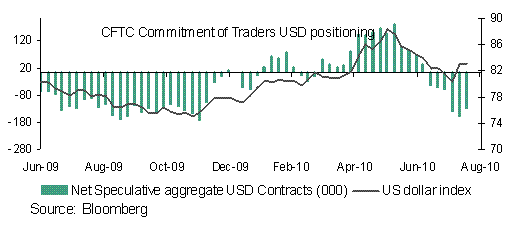
Despite all of this, the USD proved resilient and instead of the usual sell-off in the wake of soft data it benefited instead from increased risk aversion. The USD is set to retain some of this resilience though range-trading is likely to dominate over much of the weak. Reflecting the USD’s firmer stance, speculative positioning in the form of the CFTC IMM data revealed a reduction in aggregate USD short positioning in the latest week and although positioning is well below the three-month average, the improvement over the latest week and current magnitude of short positioning, highlights the potential and scope for further short-covering.
Negative data surprises have forced many to downgrade their forecasts for growth and policy implications, especially in the US. Markets will look for further clarity on the economic outlook this week but it is not clear that anything conclusive will be delivered. At the end of the week Q2 GDP will be revised sharply lower and whilst the data is backward looking it will reveal the weaker momentum of growth going into the second half of the year.

US Housing data will be mixed, with existing home sales set to drop in July as the impact of the expiration of home buyers tax credits continues to sink in whilst new home sales will likely increase but only marginally and will remain well below the April levels. Overall the picture of housing market activity remains bleak and this week’s data will do little to shake this off. On a more positive note July durable goods orders and August Michigan confidence will rise, the latter only marginally though. There will be plenty of attention on Fed Chairman Bernanke’s speech at the Jackson Hole Fed conference at the end of the week, especially given speculation of more quantitative easing in the pipeline.

The European data slate kicks off today with the release of manufacturing and service sector PMIs. Both are likely to register small declines, albeit from high levels. Nonetheless, taken together with a likely drop in the August German IFO survey on Wednesday and weaker June industrial orders tomorrow, the data will highlight that the momentum of growth in the region is coming off the boil, with the robust GDP outcome registered in Q2 2010 highly unlikely to be repeated. Against this background EUR/USD will find it difficult to make any headway. Technically further donwnside is likely over the short-term, with a test of 1.2605 support on the cards

Japan releases its slate of month end releases including jobs data, household spending and CPI. A slight improvement in job market conditions and increased spending will be insufficient to allay growth and deflation concerns, especially with CPI remaining firmly in negative territory. The onus will remain on the authorities to try to engineer a weaker JPY, which remains stubbornly around the 85.00 level versus USD. Talk of a BoJ / MoF meeting today has been dismissed, suggesting the prospect of imminent action is small. Meanwhile, speculative JPY positioning has dropped slightly in the last week but remain close to historical highs.

Aside from various data releases this week markets will digest the outcome of Australia’s federal elections. From the point of view of markets the outcome was the worst possible, with no clear winner as both the incumbent Prime Minister of the ruling Labour Party and opposition Liberal-National Party leader Tony Abbot failed to gain an outright majority. The outcome of a hung parliament will likely keep the AUD on the back foot, with trading in the currency likely be somewhat volatile until a clear outcome is established as both candidates try to garner the support of a handful of independents. However, it is notable that apart from an initial drop the AUD has managed to hold its ground. Nonetheless, the given the fluidity of the political situation there will be few investors wanted to take long positions at current levels around 0.8900 versus USD.
Pandemonium and Panic

Pandemonium and panic has spread through markets as Greek and related sovereign fears have intensified. The fears have turned a localized crisis in a small European country into a European and increasingly a global crisis.  This is reminiscent of past crises that started in one country or sector and spread to encompass a wide swathe of the global economy and financial markets such as the Asian crisis in 1997 and the recent financial crisis emanating from US sub-prime mortgages.  

The global financial crisis has morphed from a credit related catastrophe to a sovereign related crisis. The fact that many G20 countries will have to carry out substantial and unprecedented adjustments in their fiscal positions over the coming years means the risks are enormous as Greece is finding out. The IMF estimate that Japan, UK, Ireland, Spain, Greece, and the US have to adjust their primary balances from between 8.8 in the US to 13.4% in Japan. Such a dramatic adjustment never been achieved in modern history.

Equity markets went through some major gyrations on Thursday in the US, leading to a review of “unusual trading activity” by the US Securities and Exchange Commission in the wake of hundreds of billions of USDs of share value wiped off in the market decline at one point with the Dow Jones index recording its biggest ever points fall before recouping some of its losses. Safe haven assets including US Treasuries, USD and gold have jumped following the turmoil in markets whilst risk assets including high equities, high beta currencies including most emerging market currencies, have weakened. Playing safe is the way to go for now, which means long USDs, gold and Treasuries.

There is plenty of expectation that the G7 teleconference call will offer some solace to markets but this line of thought is destined for disappointment. Other than some words of comfort and support for Greece’s austerity measures approved by the Greek government yesterday, other forms of support are unlikely, including intervention to prop up the EUR. The ECB also disappointed and did not live up to market talk that the Bank could embark on buying of European debt and it is highly unlikely that the G7 will do so either. Into next week it looks like another case of sell on rallies for the EUR.   Remember the parity trade, well it’s coming back into play. 

Aside from the turmoil in the market there has been plenty of attention on UK elections. At the time of writing it looks as though the Conservatives will win most seats but fall short of a an overall majority. A hung parliament is not good news for GBP and the currency is likely to suffer after an already sharp fall over the last few days. GBP/USD may find itself back towards the 1.40 level over the short-term as concerns about the ability of the UK to cut its fiscal deficit grow. A warnings by Moody’s on Friday that the “UK can’t postpone fiscal adjustments any longer” highlights the risk to the UK’s credit ratings and to GBP.

Risk Aversion Back With A Vengeance

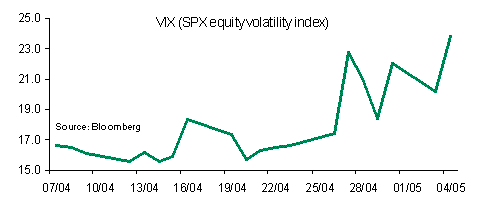
Risk aversion is back with a vengeance as reflected in the rise in equity volatility (VIX), drop in equity markets and rally in US Treasuries.  European peripheral debt markets sold off despite the EU/IMF aid package for Greece, whilst EUR/USD slid below 1.3000.  Various rumours dealt a blow to markets including talk of a sovereign ratings downgrade and a EUR 280 billion bailout for Spain.   The message is clear.  This situation is becoming increasingly dire by the day.  Europe is in big trouble and the whole euro project is under threat of unravelling.  

Concerns about parliamentary approvals, implementation/execution risk, prospects for relatively weaker growth in Europe, as well as contagion to Spain and Portugal, has tempered any enthusiasm towards the EU/IMF bailout package.  In addition, despite the large size of the EUR 110 billion loan package there are growing worries that it will be insufficient to cover Greece’s funding requirements over the next three years.  All of this implies that the EUR will remain under pressure for some time yet.  I have previously spoken about a drop to around EUR/USD 1.25 but the risk is for a much sharper decline is growing.

The USD is the clear winner, spiking to its highest level since May 2009 and is looking well set to consolidate its gains over the short-term despite the fact that net aggregate USD speculative positioning has already reached its highest level since September 2008 (according to the CFTC Commitment of Traders IMM data) in contrast to EUR positioning, which is at a record low.  This is unlikely to stand in the way of further downside for EUR/USD, with the next technical support level seen at 1.2885, which would match the previous lows see in April 2009.

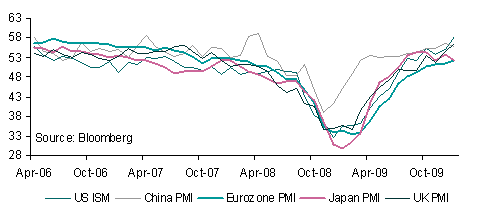
A combination of worries including contagion to Spain and Portugal, policy tightening in China, debt concerns in the UK and Japan, all threaten to undo the positive message from recent positive economic data including further strengthening in Purchasing Managers Indices globally.   The immediate attention remains on Greece and growing scepticism about the ability of Greece to carry out austerity measures in the face of rising domestic opposition, including a nationwide strike today. 

The rout in US and European markets will spill over to Asia, putting equity markets and Asian currencies under pressure.  Another risk currency to suffer is the AUD, which has dropped sharply following the Reserve Bank of Australia (RBA) meeting, in which the Bank indicated that rates were close to peaking.  Speculative positioning has dropped for the past two weeks as longs are taken off but AUD/USD weakness is set to be temporary, with buyers likely to emerge around near term support seen around 0.9001.

Q1 Economic Review: Elections, Recovery and Underemployment

I was recently interview by Sital Ruparelia for his website dedicated to “Career & Talent Management Solutions“, on my views on Q1 Economic Review: Elections, Recovery and Underemployment.

Sital is a regular guest on BBC Radio offering career advice and job search tips to listeners. Being a regular contributor and specialist for several leading on line resources including eFinancial Careers and Career Hub (voted number 1 blog by ‘HR World’), Sital’s career advice has also been featured in BusinessWeek online.

As you’ll see from the transcript of the interview below, I’m still cautiously optimistic about the prospects for 2010 and predicts a slow drawn out recovery with plenty of hiccups along the way.

Sital: Mitul, when we spoke in December to look at your predictions for 2010, you were cautiously optimistic about economic recovery in 2010. What’s your take on things after the first quarter?

Click here to read the rest…

Why Buy Asian FX (Part 2)

The strength of portfolio capital inflows into Asia reflects the outperformance of Asian economies relative to Western economies. Whilst the US, Europe, Japan and UK have struggled to recover from recession and are likely to register only sub-par recovery over the coming months, Asian economies led by China are recovering quickly and strongly. This pattern is set to continue, leading to a widening divergence between Asian and G7 economic growth.

As growth strengthens inflationary pressures are set to build up and Asian central banks will likely raise interest rates more quickly than their G7 counterparts. Already some central banks have moved in this direction, with India, Malaysia, Philippines and Vietnam, having tightened policy. This will be followed by many other central banks in Asia over Q2 2010 including China. Even countries with close trade links to Asia, in particular Australia will rate hikes further over coming months, with Australian interest rates likely to rise to a peak of 5% by year-end.

Given that the US is unlikely to raise interest rates in 2010 higher interest rates across Asia will result in a widening in the interest rate differential with the US leading to more upside potential for Asian currencies as their ‘carry’ attraction increases relative to the USD. The most sensitive Asian currencies to interest rate differentials at present are the Malaysian ringgit (MYR), Thai baht (THB) and Philippines peso (PHP) but I believe that as rates rise in Asia, the sensitivity will increase further for many more Asian currencies.

Most Asian currencies have registered positive performances versus the USD in 2010 led by the MYR and Indonesian rupiah (IDR) and closely followed by the Indian rupee (INR), THB and South Korean won (KRW). The notable exception is China which has been unyielding to pressure to allow the CNY to strengthen. Even China is set to allow some FX appreciation although if the US labels China as a “currency manipulator” it could prove counterproductive and even result in a delay in CNY appreciation.

Looking ahead, the trend of strengthening Asian FX will continue likely led by the likes of the KRW and INR but with the MYR, TWD and IDR not far behind. Stronger growth, higher interest rates, strengthening capital inflows and higher equity markets will contribute to appreciation in Asian currencies over the remainder of the year.