All eyes on G20

Although we move from feast to famine this week in terms of data there are still a few events that are noteworthy. In the US the September trade balance (Wed) will be of interest with a narrowing expected. Net exports negatively impacted GDP in Q3 but this is likely to reverse in Q4. Michigan confidence at the end of week is also likely to reveal better news with a rebound expected in October in the wake of firming equities, whilst the October budget statement is likely to reveal a sharp narrowing compared to October last year. Several Fed speakers over the week will be also be in focus as markets try to gauge the level of support within the FOMC for the QE2 announced last week.

There are a few data releases of interest in the eurozone including the preliminary estimate of Q3 GDP. Worryingly the divergence across the eurozone between healthier northern Europe and weaker performing in Southern Europe is becoming increasingly stark, a big headache for the Eurozone Central Bank with its one size fits all policy. Elsewhere, in the UK the Bank of England Quarterly Inflation Report will be scrutinized to determine whether recently firmer data and sticky inflation has pushed the BoE away from following the Fed into QE2. Japan’s volatile machinery orders data marks the highlight of its calendar, with a sharp drop expected in September following two strong months.

The main event of the week is the G20 leaders meeting in Seoul at the tail end of the week. Rhetoric going into the meeting suggests little support for the US plan to limit current account surpluses to 4% of GDP and even US officials appear to have cooled on the idea. Moreover the G20 meeting will probably elicit further reaction to the Fed’s QE2 announcement. Reaction was highly critical initially but seems to have softened lately. Currencies will nonetheless, remain the major topic of discussion although expectations of a global agreement are likely to be disappointed.

The Fed’s QE2 announcement helped provide a prop to risk assets and weighed on the USD last week despite the amount of asset purchases being within expectations. The USD will remain a sell on rallies this week and once again the best way to play USD weakness is likely via the higher yielding commodity currencies, especially AUD and NZD. Scandinavian currencies also offer a good way to capitalize on USD weakness.

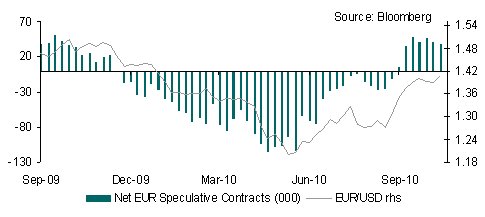
The EUR may also struggle this week given worries about peripheral Europe and widening in peripheral bond spreads. Ireland’s budget cuts announced last week have so far failed to shore up confidence whilst political uncertainties are also rising. Greece’s regional elections revealed that the ruling socialist party narrowly retained control allowing the government to continue with reforms suggesting a modicum of support for its debt. Nonetheless, with Irish and Portuguese sovereign worries continuing, the EUR will continue to lag. Notably the CFTC IMM data revealed that speculative EUR sentiment deteriorated in the latest week to its lowest in over a month. EUR/USD is likely to target 1.3864 after dropping swiftly below the 1.4000 level.
Perhaps best way to play EUR vulnerability is versus the AUD, with a further decline through 1.3800 likely to pave the way for a drop below the 13 September low around 1.3660. AUD/JPY may also be another cross worth exploring especially as Japan’s new fund begins buying JGBs today, which could limit JPY upside. A test of AUD/JPY 83.65 is on the cards shortly. If Australia’s October employment report on Thursday reveals another strong reading it will likely give the currency further support into the end of the week.
Two-way FX risk returns

It appears that there is a bit of a sea change taking place in currency markets. Since early June the trend in currency markets would have looked like a one way bet to most casual observers. For instance, the USD index was declining fairly steadily and predictability as US growth worries intensified and markets anticipated a resumption of quantitative easing by the Fed. This changed quite dramatically over recent days, with a significant degree of two-way risk re-entering the market as the USD shook off worries about Fed quantitative easing and instead rallied in the wake of higher risk aversion.

The introduction of two-way risk into the market will cause a rethink of the increasingly fashionable view that the USD was about to embark on a renewed negative trend. This change in market perspective has coincided with renewed concerns about European sovereign risks, even as European growth has come in much stronger than expected over Q2. Other currencies have also lost ground against the USD more recently, with the notable exception of the JPY which remains close to the psychological level of 85.00.

Until recently the move in FX markets since early June contrasted with my view that Q3 would be a period of uncertainty and volatility. Improved risk appetite reflected a decline in uncertainty but whilst I now believe that Q3 will see less of an increase in risk aversion than previously anticipated, my core views remain unchanged. I see the USD resuming an appreciation trend against the EUR and funding currencies (JPY and CHF) whilst weakening against higher yielding risk currencies (AUD, NZD and CAD) over the medium term.

Although FX markets will likely gyrate between the influences of risk aversion on the one hand and growth/interest rates on the other, risk is likely to take the upper hand over the coming weeks. The influence of risk aversion has jumped sharply over the last few weeks for almost all currencies. As risk appetite was improving as it has done for much of the period since early June, it played negatively for the USD but the recent increase in risk aversion – brought about by renewed growth concerns, sovereign worries in the eurozone, with Ireland in particular coming under scrutiny – has managed to reverse this trend. The one-way bet for investors now appears to be over.

Only time will tell if the EUR’s recent bull run has come to an end but there is sufficient evidence to suggest that plenty of good news has now been priced in and that further upside will be much more difficult to achieve. Even the recently strong growth data in the eurozone has thrown up potential problems including growing divergence as well as the potential for a slowdown over coming quarters. Further strengthening of the EUR will be a particular problem for eurozone growth, especially for exporting countries such as Germany. In any case, even the recent drop in the EUR leaves the currency at an overvalued level and susceptible to further falls. Over the coming weeks a period of consolidation is likely, with the EUR set to take a weaker tone.

The JPY in contrast has shown little sign of weakening and continues to flirt with the key psychological level of 85.00 much to the detriment of the Japanese economy, leading to growing frustration from Japanese officials. Much weaker than expected Q2 GDP data has given even more reason to engineer a weaker JPY but as yet the only intervention has come verbally and even this has not been particularly strong. In the absence of FX intervention, the Japanese authorities may be forced to consider other options such as increasing outright JGB purchases.

Like the EUR and JPY, GBP will find it tough to extend gains against the USD especially given that the doves at the Bank of England will likely remain in the ascendancy as growth moderates. GBP is also less undervalued than it was just a few weeks back suggesting that the argument for GBP strength has weakened. Nonetheless, GBP is likely to outperform against a generally weaker EUR ending 2010 around 0.78.

Similarly, CHF will likely maintain its strength against the EUR in the short term but unlike GBP this will likely give way to weakness and a gradual move higher in EUR/CHF to around 1.37 by year end. An eventual improvement in risk appetite and some relative economic underperformance will undermine the case for holding CHF.

Scandinavian currencies are likely to struggle in the short term due to market nervousness about a US double dip in an environment of elevated risk aversion. Interest rates will also play an important role in driving NOK and SEK as will be the case for most currencies eventually. Divergence in rate views for Norway and Sweden suggests holding a short SEK long NOK position. Overall, with two-way risk now much more evident as many investors return from their summer break the FX market will look far less predictable than it did before they left.

US Dollar Back On Top As Yields Rise

Two issues are driving markets and both are playing negatively for sentiment; the rise in G7 bond yields and the outcome of the EU summit. At a time when G7 bond yields have been pushing higher the poor response to the US $32 billion 7-year note sale contributed to a further increase in yield. The sale resulted in a yield of 3.374%, which was higher than expected, and a bid/cover ratio of 2.61. A combination of large US Treasury supply, medium term funding issues and signs of improving growth suggest no let up for US Treasuries.

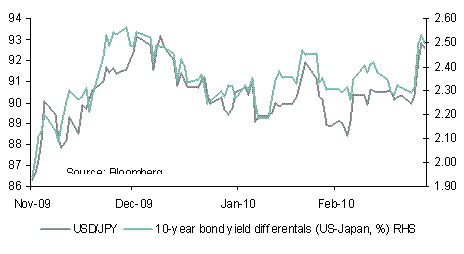
The most reactive currency to yield differentials is currently USD/JPY. The 1-month correlation between USD/JPY and US/Japan bond yield differentials is a high 0.85. The spike in US 10-year Treasury yields especially relative to JGB yields (by around 21 basis points this week) is the main contributor to the jump in USD/JPY over recent days. Given the bearish outlook for US bonds in the near term, it suggests more upside for USD/JPY but also increasingly for other currencies against the USD as the importance of yield increases. Immediate USD/JPY technical resistance is seen around 93.21, with support at 91.87.

The other event of note yesterday was developments surrounding Greece in the European Union summit though in truth it was probably the strong comments by ECB President Trichet that had the bigger impact on EUR sentiment. The final EU communiqué noted the readiness for bilateral loans to Greece and substantial International Monetary Fund (IMF) financing in a Greek aid mechanism. Importantly and a likely sop to Germany, any aid will not contain a subsidy for Greece. Aid by the EU and IMF will only be provided in the event of “very serious difficulties”.

The EU agreement means that no money will be forthcoming immediately, but at least there will be a back stop should Greece have financing difficulties over coming weeks, which will act as an important safety net ahead of substantial Greek debt rollovers. This news was supplemented by the fact that ECB will not raise its minimum collateral requirements at the end of the year, which means that Greek debt will not be excluded in the event of a ratings downgrade. This is good news for Greece.

The combination of the fact that Greece will have to borrow money only at market rates, ongoing worries about other EU countries fiscal problems and European Central Bank (ECB) President Trichet putting somewhat of a dampener on sentiment by criticizing IMF involvement in the deal, will keep the EUR under pressure. Although Trichet later reversed his comments, the damage was already done and any relief to EUR/USD will be short-lived. The currency pair is increasingly poised for a further downside move, with the next target at 1.3213 on the path towards an eventual test of 1.3000.

What To Watch This Week

As usual the G7 meeting will leave markets with little to chew on. G7 officials maintained their commitment to stimulus measures and timely exit strategies but there was little of note for FX markets aside from the usual comments about wanting to avoid excess FX volatility. There was certainly know step up in pressure on China to strengthen though a report prepared for the meeting did push for countries with inflexible currencies to make adjustments. Meanwhile US officials mouthed the usual “strong dollar” mantra.

Where does this leave markets this week? Well I must admit my bullish view on risk currencies is clearly suffering after a positive start to the year. The pullback in high beta currencies (those with the highest sensitivity to risk aversion) has been dramatic. I have highlighted many of the factors weighing on sentiment in previous posts and whilst I still think the US dollar will find itself under renewed pressure over coming months the current environment remains conducive to more USD and JPY buying and selling of currencies such as the AUD, NZD, CAD, GBP, NOK, SEK, ZAR etc.

Ironically the US and Japan have arguably more severe deficit/debt concerns than some of the European countries under pressure but as most of Japan’s debt is held domestically there is little worry of a collapse in JGBs. Unlike Japan foreign investors hold over half of US debt but are not yet losing confidence with US Treasuries though this may not last unless there is some tangible sign that the burgeoning US budget deficit is being reduced. For now, attention remains firmly focussed on Greece, Spain, Portugal and to a lesser extent Italy.

Like the G7 meeting the US January jobs report released at the end of last week will give little direction for markets. Although the 20k drop in payrolls and revisions to past months were slightly disappointing the surprise drop in the unemployment rate was better news. This week’s data highlights include the January US retail sales report and December trade balance. The sales data is likely to help allay some concerns about faltering economic recovery, with retail sales forecast to rise over the month despite a likely pull back in autos spending.

How will this play out for currencies this week? Overall, the risk off tone is set to continue though the moves are looking increasingly stretched. The USD, JPY and CHF will remain on the front foot whilst risk currencies will remain under pressure. The EUR is set to continue to struggle against the background of eurozone deficit concerns and after its dive through 1.40 last week 1.35 now looms large. Meanwhile, the AUD may also struggle following the recent reassessment of interest rate expectations after the recent Reserve Bank of Australia (RBA) meeting in which interest rates were left unchanged.

UK markets will focus on the Quarterly Inflation Report from the Bank of England though the political situation may hold some interesting implications for GBP if polls continue to show that the gap between the governing Labour party and Conservative opposition continues to narrow. Prospects of a hung parliament will hardly hold any positive implications for GBP, a prospect which could limit any potential for GBP to recover ahead of May elections. The drop below 1.60 for Cable (GBP/USD) could extend further, especially as the BoE has kept the door open to further asset purchases if needed.