Edging Towards A European Deal For Greece

The momentum towards some form of agreement at the Special EU Summit today is growing, with French and German leaders reaching a “joint position on Greece’s debt situation”. Details of this position are still unknown, however. EUR has found support as expectations of a positive outcome intensify.

However, given that positive news is increasingly being priced in, and the market is becoming increasingly long, upside EUR potential will be limited even in the wake of a comprehensive agreement. A break above EUR/USD resistance around 1.4282 would bring in sight the next key resistance level around 1.4375 but this where the rally in EUR/USD is set to be capped.

Prospects of a major US debt default or at the least a government shutdown appear to be receding as the US administration has indicated some willingness to opt for a short term increase in the US borrowing limit to give more time for a bigger deficit reduction deal to be passed by Congress. Meanwhile, there will be further news on the deficit reduction plans put forward by the “gang of six” US senators, with a press conference scheduled for later today.

Debt ceiling negotiations are likely to be the main focus of market attention, with the Philly Fed manufacturing survey and weekly jobless claims relegated to the background. A speech by Fed Chairman Bernanke is unlikely to deliver anything new today. The USD is likely to be on the back foot given expectations of a deal in Europe and improved risk appetite but we expect losses to be limited.

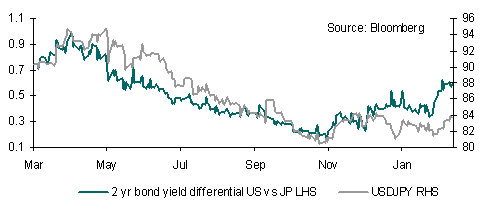
The JPY continues to defy my bearish expectations. Over recent days the US yield advantage over Japan in terms of 2Y bonds dropped to multi-year lows below 20bps. Given the high correlation between USD/JPY and yield differentials, this has corresponded with the fall below 80.00.

Expectations of JPY weakness versus USD is highly dependent on the US – Japan yield gap widening over coming months. For this to happen it will need concerns about the US economy and expectations of more Fed asset purchases to dissipate, something that may not happen quickly given the rash of disappointing US data releases lately.

GBP found itself on the front foot following the release of the Bank of England Monetary Policy Committee minutes, which were less dovish than anticipated. They also revealed that the BoE expects inflation to peak higher and sooner than previously expected. However, the fact that the overall tone was similar to the last set of minutes meant there was little follow through in terms of GBP.

Further direction will come from June retail sales data today and forecasts of a bounce in sales will likely help allay concerns about a downturn in consumer spending. Nonetheless, GBP is still likely to struggle to break through resistance around 1.6230 versus USD.
Asia Helps The Euro Again

Following the pressure on markets over recent days there is some relief filtering through markets today although sentiment remains fickle. Weaker than expected US April durable goods orders data failed to dent confidence with equity markets ending in positive territory overnight even though the data added to a plethora of global data disappointments over recent weeks.

Once again the EUR has been saved by Asian demand, this time not directly for the EUR itself but by reports that China and other Asian investors will purchases EFSF bailout bonds, with China apparently reported to be “clearly interested” in the mid June sales of Portuguese bailout bonds, with Asian investors representing a “strong proportion” of the buyers.

Despite the reassuring news about Asian official interest in eurozone debt, problems in the periphery remain a major drag on the EUR. Developments at the two day G8 heads of governments meeting in Deauville and various speeches by officials from the European Financial Stability Facility (EFSF), European Union (EU) and European Central Bank (ECB) regarding Greece’s travails will be particularly important for EUR direction.

The various speakers are likely to maintain the pressure on peripheral countries to continue their austerity programmes in order to gain external support. Nonetheless, there still appears to be conflicting comments about what Greece will do with regard to its debt burden. Whilst some EU officials have espoused the benefits of extending Greek debt maturities on a voluntary basis, the ECB has steadfastly stood against any form of restructuring.

Other than the events above, in the US the second reading of Q1 GDP will be released. The consensus looks for an upward revision to a 2.1% annual rate from an initial estimate of 1.8% due mainly to an upward revision to inventories. US weekly jobless claims will also be of interest especially as the recent increase in the 4-week average for jobless claims has provoked renewed fears about the jobs market recovery.

Another Day, Another Drop In The US Dollar.

The USD index is now close to breaching its November 2009 low around 74.17, with little sign of any turnaround in prospect. A surprise jump in weekly jobless claims to 412k (380k expected) did little to help the USD’s cause whilst higher commodity prices, and in particular energy prices played negatively.

Indeed, many USD crosses have experienced an increase in sensitivity to oil price movements over recent weeks, with the USD on the losing side when oil prices move higher. Commodity currencies including CAD and NOK are the key beneficiaries but EUR/USD is also highly correlated with the price of oil.

Various Fed comments overnight including supportive comments on the USD’s role as a reserve currency have done little to boost USD sentiment despite the generally hawkish slant to comments. A host of US data releases will keep markets busy.

The data are unlikely to deliver any strong surprises but given the growing FX attention on Fed policy, CPI data may take on more importance than usual. Our expectation of a trend like 0.2% increase in core CPI, which is unlikely to cause any consternation within the Fed, suggests that the USD will garner little support.

The ability of the EUR to withstand a torrent of bad news regarding the eurozone periphery is impressive. In particular, peripheral bond yields continue to rise especially Greek yields as expectations of debt restructuring grow. Comments from Germany’s finance minister have added to such expectations. News that the Bank of Spain approved the recapitalisation of 13 bank and that Spanish banks borrowed only EUR 44 billion last month, the lowest since Jan 2008, may have provided some relief.

However, given that markets are already relative hawkish about eurozone interest rates and given growing peripheral worries as well as overly long EUR market positioning, the upside for EUR/USD is looking increasingly restrained, with a break above technical support around 1.4580 likely to be difficult to achieve over the short-term.

AUD and NZD have registered stellar performances over recent weeks as yield attraction has come back to the fore and risk appetite has strengthened. The gains since their post Japan earthquake lows have been in the region of 7.3% and 10.5%, respectively for AUD and NZD.

The additional element of support, especially for AUD has come from central bank diversification, an increasingly important factor for both currencies. The gains in both currencies have been impressive and neither is showing signs of reversing but there are clear risks on the horizon.

One indication of such risks is the fact that market positioning is stretched especially in terms of AUD positioning, with CFTC IMM contracts registering an all time high. The move in AUD especially has been well in excess of what interest rate / yield differentials imply. Whilst I would not suggest entering into short AUD and NZD positions yet, the risks to the downside are clearly intensifying.

USD Pressured As Yields Dip

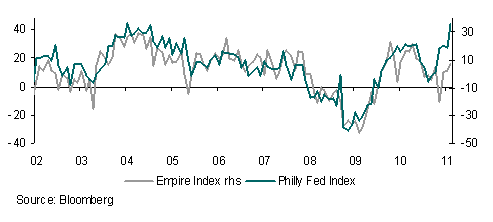
The USD came under pressure despite a higher than forecast reading for January US CPI and a strong jump in the February Philly Fed manufacturing survey. On the flip side, an increase in weekly jobless claims dented sentiment. The overnight rally in US Treasury yields was a factor likely weighing on the USD. The US calendar is light today leaving markets to focus on the G20 meeting and to ponder next week’s releases including durable goods orders, existing and new home sales.

The jump in the European Central Bank (ECB) marginal facility borrowing to EUR 15 billion, its highest since June 2009, provoked some jitters about potential problems in one or more eurozone banks. At a time when there are already plenty of nerves surrounding the fate of WestLB and news that Moody’s is reviewing another German bank for possible downgrade, this adds to an already nervous environment for the EUR.

Nonetheless, EUR/USD appears to be fighting off such concerns, with strong buying interest on dips around 1.3550. The G20 meeting under France’s presidency is unlikely to have any direct impact on the EUR or other currencies for that matter, with a G20 source stating that the usual statement about “excess volatility and disorderly movements in FX” will be omitted.

Although USD/JPY has been a highly sensitive currency pair to differentials between 2-year US and Japanese bonds (JGBs), this sensitivity has all but collapsed over recent weeks. USD/JPY failed to break the 84.00 level, coming close this week. There appears to be little scope to break the current range ahead of next week’s trade data and CPI.

Given the recent loss in momentum of Japan’s exports the data will be instructive on how damaging the strength of the JPY on the economy. In the near term, escalating tensions in the Middle East will likely keep the JPY supported, with support around USD/JPY 83.09 on the cards.

It seems that the jump in UK CPI this week (to 4.0%) provoked even more hawkish comments than usual from the Bank of England BoE’s Sentance, with the MPC member stating that the Quarterly Inflation Report understates the upside risks to inflation indicating that interest rates need to rise more quickly and by more than expected. Specifically on GBP he warned that the Bank should not be relaxed about its value.

Although these comments should not be particularly surprising from a known hawk, they may just help to underpin GBP ahead of the January retail sales report. Expectations for a rebound in sales following a weather related drop in the previous month will likely help prop up GBP, with GBP/USD resistance seen around 1.6279.

GBP troubles, KRW too weak

The Fed FOMC minutes for the January meeting revealed that behind the unanimous vote to leave policy settings unchanged there was some unease about the completion of QE2. Nonetheless, the USD was left weaker given the Fed’s sanguine view on inflation and worries about unemployment. Inflation data will garner most market attention today but the fact that the core rate of CPI inflation is expected to remain well below the Fed’s preferred level could undermine the USD and add a further barrier to the USD’s recovery so far in February. Jobless claims data will also be of interest given the sharp drop last week. Another firm outcome will help to dispel worries about job market recovery.

As warned in my last post, downside risks to GBP were high given the long GBP speculative positioning overhang and hawkish expectations for the BoE Quarterly Inflation Report. In the event the Report revealed a downward growth forecast revision and an upward inflation forecast revision but importantly showed some reluctance to play into market expectations of an early UK policy rate hike. Following on from a weaker than expected UK January jobs report in which unemployment increased, GBP was hit on both counts. GBP/USD is unlikely to veer far from the 1.6000 level, but with markets reassessing interest rate expectations downside risks are beginning to open up.

News yesterday that Moody’s ratings agency has placed Australia and New Zealand’s major banks on review for possible downgrades went down like a lead balloon but once again AUD and NZD showed their usual resilience and acted as if little has happened. AUD and NZD have weakened since the turn of the year. Weaker data and a paring back in policy tightening expectations have contributed to the weaker performance of the AUD and NZD, but markets have gone too far in scaling back the timing and magnitude of interest rate hikes, suggesting that both currencies may bounce back as interest rate expectations become more hawkish.

Asian currencies continue to register mixed performances largely influenced by capital flows. Most equity markets in the region have registered outflows so far in 2011, with the exception of Taiwan and Vietnam. This has been reflected in Asian FX performance, with the strongest performer being the IDR, but its gains have only been around 0.72% versus USD, coinciding with the fact that it has registered some of the least capital outflows this year. Interestingly the worst performing currency has been the THB, one of last year’s star performers. Korea has also registered strong equity capital outflows but this will not persist and a resumption of inflows taken together with positive fundamentals and higher interest rates will boost the KRW this year.