EUR falls, JPY retraces after intervention

Risk aversion has come back in full force, with various concerns weighing on markets. Once again attention is firmly fixed on the eurozone and worryingly last week’s European Union (EU) rescue agreement has failed to prevent a further widening in eurozone peripheral bond spreads. This will come as a blow to eurozone officials as the agreement was aimed to prevent exactly this.

A lack of detail in the plans announced last week has come back to haunt markets. Moreover, given the event risk of the RBA, ECB and Fed central bank meetings this week plus the US October jobs report at the end of the week, nerves will likely remain frayed over coming days. Overall, the tone will likely be on of selling risk assets on rallies over the short term.

The EUR has unwound a significant part of its gains from last week as various doubts about the eurozone rescue package have surfaced. The measures announced by EU officials have failed to prevent a jump in Italian and Spanish bond yields. News that MF Global has filed for bankruptcy while the Greek Prime Minister has called for a referendum on the EU’s debt deal dealt markets a blow overnight.

As it was doubts had been creeping in due to the lack of detail in the rescue package including but not limited to the lack of specifics on the leveraging of the EFSF bailout fund. The pattern appears to have followed the reaction to previous EU announcements to stem the crisis, namely short lived euphoria followed by a sell off in risk assets. The EUR is likely to struggle further over the near term, with the current pull back likely to extend to around the 21 October low of 1.3705.

Japanese officials had blamed the strength of the JPY on speculative flows and have threatened more FX intervention following yesterday’s Judging by the price action this morning the threat has been followed up by action. In order for USD/JPY to sustain a move higher it will require both a widening in yield differentials and easing risk aversion. Neither are guaranteed to happen any time soon as was evident overnight with risk aversion rising. US data has improved but it is insufficient to provoke a sharp back up in US bond yields.

Consequently in the coming weeks USD/JPY topside momentum will be limited. A break above USD/JPY’s 200 day moving average level of 79.89 could prove decisive in terms of JPY long capitulation and once above this level USD/JPY will target the 11 July high of 80.83. However, this will require further intervention otherwise the underlying trend in JPY will continue to remain positive.
No QE3 but Bernanke gives some hope

Not only did Federal Reserve Chairman Bernanke not discuss the potential for more quantitatiive easing QE3 but he also did not discuss many other options for Fed policy at Jackson Hole last Friday. The onus has now shifted to the 2-day Fed FOMC meeting on September 21 where markets are looking (hoping) for fresh policy measures. Such hopes helped US equity markets bounce back after initially reacting negatively to Bernanke’s speech.

Bernanke provided some hope to markets that the US economy wasn’t sliding into the abyss while offering the potential for further Fed stimulus even if QE3 wasn’t quite on the cards. This hope was sufficient to spur markets higher. However, importantly Bernanke noted the limitations of monetary policy in stimulating growth over the medium term.

In this respect there will be plenty of attention on President Obama’s speech on September 5 in which markets will be looking for a response from the administration at a time when the economy is becoming an increasingly important issue for the electorate.

In the meantime there are plenty of data releases to contend with this week including the August US jobs report, ISM manufacturing survey, US consumer confidence and various confidence surveys in Europe. Unfortunately the news will not be positive as the data releases are set to reinforce concerns of economic slowdown. The US jobs report is likely to reveal a limited, around 75k increase in non-farm payrolls according to consensus while the ISM manufacturing survey is set to drop into contraction territory.

Consequently markets may start the week in risk on mood but this is unlikely to last given renewed economic worries. Moreover, Eurozone peripheral country travails continue to exasperate markets, with concerns that some members of German Chancellor Merkel’s coalition plan to vote against the revamped EFSF bailout fund and news that two German banks have yet to commit on Greece’s bailout plan. Against this background the EUR continues to defy gravity around the 1.45 level versus USD but may yet come down to earth with a bang.

RBA on hold, RBI hikes rates

News of the death of Osama Bin Laden gave the USD a lift and its gains have extended for a second day. Extreme short market positioning as well as increasing risk aversion (perhaps due to worries about retaliation following Bin Laden’s death) have helped the USD.

However, the boost to the USD could be short-lived in the current environment in which it remains the preferred global funding currency. Indeed, the fact that US bond yields have dropped sharply over recent weeks continues to undermine the USD against various currencies.

The USD firmed despite the US ISM manufacturing index dropping slightly, albeit from a high level. The survey provided some useful clues to Friday’s US jobs report, with the slight decline in the employment component of the ISM survey to 62.7 consistent with a 200k forecast for April payrolls.

Ahead of the European Central Bank (ECB) meeting on Thursday hawkish rhetoric from new Council member and Bundesbank chief Weidmann (replacing Weber) and more reassurances from Greek and EU officials that there will be no debt restructuring or haircut on the country’s debt has helped the EUR although it is notable that it could not sustain a foot hold above 1.49. Eurozone bond yields have risen by around 20bps compared to US yields over the past month, a fact that suggests that the EUR may not fall far in the short-term.

USD/JPY is trading dangerously close to levels that may provoke FX intervention by the Japanese authorities. General USD weakness fuelled a drop in USD/JPY which has been exacerbated by a rise in risk aversion over recent days (higher risk aversion usually plays in favour of a stronger JPY). The biggest determinant of the drop in USD/JPY appears to a narrowing in bond yields (2-year bond yields have narrowed by around 20bps over the past month) largely due to a rally in US bonds.

Unsurprisingly the Reserve Bank of Australia (RBA) left its cash rate on hold at 4.75%. The accompanying statement showed little inclination to hike rates anytime soon, with credit growth noted as modest, pressure from a stronger exchange rate on the traded sector and temporary prices shocks which are expected to dissipate. The only indication that rates will eventually increase is the view that longer term inflation is expected to move higher.

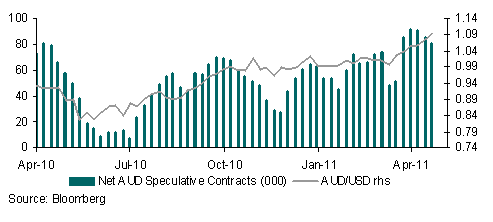
I look for further rate hikes over coming months even with the AUD at such a high level. AUD has lost a bit of ground after hitting a high just above 1.10 against the USD and on the margin the statement is slightly negative for AUD. A slightly firmer USD overall and stretched speculative positioning, with IMM AUD positions close to their all time high, points to some downside risks in the short-term.

In contrast India’s central bank the RBI hiked interest rates by more than many expected. Both the repo and reverse repo rates were raised by 50bps, with the central bank governor highlighting renewed inflation risks in his statement. The decision reveals a shift in RBI rhetoric to an even more hawkish bias in the wake of rising inflation pressures, which should be beneficial to the rupee.

Central bank decisions and US payrolls in focus

The USD’s troubles are far from over. Data and events this week will do little to stop the rot. As US Federal Reserve Chairman Bernanke made clear last week the Fed is committed to completing its asset purchase programme by the end of June though there is plenty of debate about what comes after. Reduced growth forecasts and the Fed’s view that price pressures are “transitory” have been sufficient to keep the USD on its knees.

The weaker than expected reading for Q1 US GDP growth at 1.8% QoQ clearly did nothing to alleviate pressure on the USD even though it is widely believed that the soft growth outcome will prove fleeting, with recovery set to pick up pace over the coming months. In truth much will depend on the trajectory for oil prices, especially as petrol prices in the US verge on the psychologically important $4 per gallon mark. Even higher energy prices could dent growth further but lower or stable prices will keep the recovery on track.

The highlight in this holiday shortened week for many countries this week is the US April jobs report at the tail end of the week. Estimates centre on around a 200k gain in payrolls but forecasts will be refined with the release of the ADP private sector jobs report and ISM manufacturing survey earlier in the week. The unemployment rate may prove sticky and will likely remain at 8.8%, a disappointment to those looking for a quicker recovery. The elevated unemployment rate will only reinforce expectations that the Fed will not be quick to reverse policy, with the USD continuing to suffer as a result.

Central bank meetings will be plentiful this week, with the European Central Bank (ECB) and Bank of England (BoE) likely to garner most attention. Recent data in the Eurozone has provided further evidence of growth divergence between North and South, but the EUR has remained resilient to this as well as to increased concerns about the periphery. This make the ECB’s job even tougher than usual when it meets this week and it is unlikely that the Bank will hike rates again so soon, especially given the strength of the EUR. Nonetheless, Trichet will continue to sound hawkish, limiting any damage to the EUR (if any) of no move in policy rates.

Similarly the Bank of England will also remain on the sidelines though this should come as little surprise in the wake of disappointing data recently and a surprise drop in inflation, albeit to still well above the BoE’s target. GBP has made up ground against a generally weak USD but judged against other currencies it has been an underperformer as expectations of monetary tightening have been pared back. Finally, the Reserve Bank of Australia (RBA) is set to remain on hold, but a hike over coming months remains likely even with the AUD at such a high level. Quite frankly although the USD is looking increasingly oversold there is nothing this week that would suggest it will recover quickly.

Losing Your Addiction

An interesting thing happened to me last week. On a business trip to Europe my blackberry broke and failed to work for the rest of the week. I felt like an addict coming off an addiction. The first couple of days were very tough; my usual instinct to constantly check for messages resulted in constant fidgeting and major withdrawal symptoms.

Once this had worn off I must admit I felt liberated. My addiction gone, it felt great to be weaned off my crackberry. The message here is that life goes on without access to mail. It’s an experience I would recommend to all users of such devices.

Back to reality and my view from Hong Kong this week is as follows. The risk-off tone as reflected in related to the turmoil in Libya and the increase in oil prices (as supply concerns intensify), may help to limit the pressure on the USD this week, but the overall tone is set to remain weak.

Much will depend on this week’s key US data releases and a testimony by Fed Chairman Bernanke to the US Senate, to determine whether the USD will find a more stable footing. Clearly the more hawkish tone of the European Central Bank (ECB) and Bank of England (BoE) in contrast to the lack of inclination by the Fed towards a tighter monetary policy stance could undermine the USD.

In this respect, it is doubtful that Bernanke will change his stance of the Fed failing to meet its dual mandate due to too low inflation. The main event is the February US jobs report at the tail end of the week. The consensus expectation of a 190k increase in payrolls will be finalised after gaining more clues from the US February ISM surveys and ADP jobs report earlier in the week. The week’s releases will likely reveal further improvements in US economic data, but given that this will do little to budge the Fed’s stance, the USD may be left somewhat underwhelmed.

The intensification in risk aversion over recent days has also been felt in the Eurozone periphery where bond market pressures have resumed. Nonetheless, the fallout on the EUR has been limited by hawkish ECB jawboning. Thursday’s ECB meeting will surely maintain this stance, and following the release of data on Tuesday likely to show a further increase in inflation in February, upside inflation risks are likely to be highlighted by ECB President Trichet in the press conference.

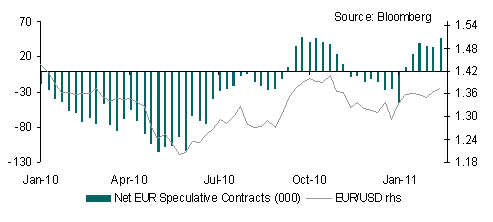
A likely pre-emptive strike from the ECB cannot be ruled out. Two rate hikes in H2 2011 are now likely even as the Bank maintains liquidity support for weaker peripherals. No change in policy but a hawkish press statement on Thursday will on the face of it play for a firmer EUR but i) the fact that the market has already discounted the possibility of early rate hikes and ii) the proximity of the US payrolls data on Friday and iii) uncertainty over the impact of the Irish election outcome in which the Fine Gael party won a clear victory, suggest that EUR risks are asymmetric. The net long positioning overhang also points to some downside risks to EUR.

There are plenty of other events and data on the calendar this week including Japan’s slate of month end releases, interest rate decisions by the Reserve Bank of Australia and Bank of Canada, UK PMI manufacturing survey data and Swedish Q4 GDP data.

The bottom line is that currencies will be driven by the conflicting influences of improving economic data on the one hand and elevated risk aversion on the other. The main beneficiaries of higher risk aversion will be the CHF and JPY though both have risen far whilst the USD will be restrained by a dovish Fed.

In contrast the EUR and GBP may yet extend gains but in both cases, markets have already shifted policy tightening expectations sharply over recent weeks and we suspect EUR/USD will be capped at resistance around 1.3860, whilst GBP/USD will similarly struggle to break its year high around 1.6279.