Beyond Expectations

Egypt worries continue to reverberate across markets, yet there appears to be growing resilience or at least some perspective being placed on problems there. Encouraging economic data, particularly in the US has helped to shield markets to some extent, with equity market rallying and US bond yields rising last week. The main impact of Egypt and worries about Middle East contagion continues to be felt on oil prices.

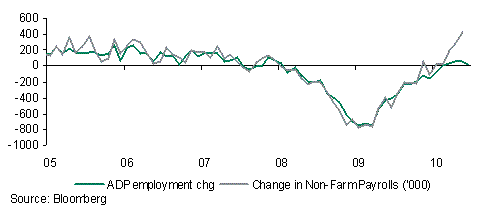
Even the mixed US January jobs report has failed to dent market sentiment; the smaller than expected 36k increase in payrolls was largely attributed to severe weather. A further surprising drop in the unemployment rate to 9.0% due mainly to a significant drop in the labor force was also well received by the market.

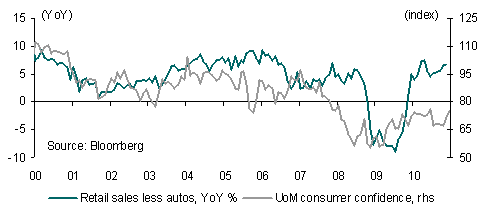
There will be less market moving releases on tap this week and the data are unlikely to dent recovery hopes. Michigan confidence is set to record an improvement in February whilst the December trade deficit is set to widen to around $41.0 billion. There are also plenty of Federal Reserve speakers this week including a testimony by Chairman Bernanke.

One central bank that has softened its hawkish rhetoric is the European Central Bank (ECB), with President Trichet dampening speculation of an early rate hike last week and alleviating some of the pressure on eurozone interest rate markets. Consequently the EUR fell as the interest rate differential with the USD became somewhat less attractive. The EUR was also undermined by the opposition from some member states to French and German ideas for greater fiscal policy coordination, an aim apparently not shared across euro members.

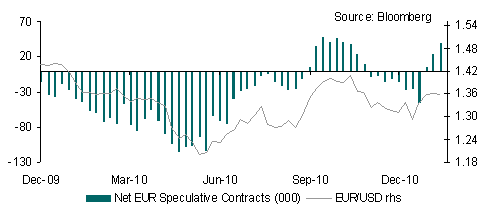
Data in Europe will be largely second tier. The EUR will look increasingly vulnerable to a further drop this week especially given the increase in net positioning over the past week to (1st February) according to the CFTC IMM data. The potential for position squaring looms large as positioning is now well above the three-month average. Stops are seen just below EUR/USD 1.3540.
In the UK the Bank of England policy meeting will take centre stage but there is unlikely to be any change in policy settings. Clues to policy thinking will be available in the monetary policy committee meeting minutes in two weeks times but it seems unlikely that any more members have joined the two voting for a hike at the last meeting.

Recent data have been a little more encouraging helping to wash off the disappointment of the surprise drop in Q4 GDP. The UK industrial production report is likely to be similarly firm on Thursday, with the annual pace accelerating. GBP/USD may however, struggle to make much headway against the background of a firmer USD and the weigh of long positioning, with GBP/USD 1.6279 seen as strong resistance.

There are plenty of releases in Australia this week to focus including the January employment data, consumer confidence, and a testimony by RBA governor Stevens in front of the House of Representatives on Friday. The data slate started off somewhat poorly this week, with December retail sales coming in softer than expected, up 0.2% MoM. AUD/USD is likely to be another currency that may struggle to sustain gains this week but much will depend on data over coming days. Resistance is seen around 1.0255.

On a final note, the weekend’s sporting events highlight how it’s not just economic data or moves in currencies that don’t always go as expected. After a solid run in the Ashes cricket England slumped to a 6-1 series loss to Australia in the one-day series, putting the Ashes win into distant memory. A similarly solid performance by Man United was dented with their unbeaten record broken by bottom of the table Wolves.

Econometer.org has been nominated in FXstreet.com’s Forex Best Awards 2011 in the “Best Fundamental Analysis” category. The survey is available at http://www.surveymonkey.com/s/fx_awards_2011

Your support in the survey is highly appreciated
Egypt Unrest Hits Risk Trades

Recent weeks have seen a real contrast in policy and growth across various economies. A case in point was the surprise drop in UK GDP in Q4 contrasting sharply with the solid (albeit less than forecast) rise in US Q4 2010 GDP. The resilience of the US consumer was particularly evident in the data. The European Central Bank’s (ECB) hawkish slant as reflected in comments from President Trichet compared to the dovish pitch of the Fed FOMC is another clear contrast for markets to ponder.

The ECB’s hawkish tone gave the EUR a lift but expectations of an early Eurozone rate hike looks premature. Although Eurozone inflation data (Monday) will reveal a further rise in CPI above the ECB’s target, to around 2.4% in January, this will not equate to a policy rate hike anytime soon. This message is likely to be echoed at this week’s ECB meeting where policy will be characterised as “appropriate”.

Whilst monetary tightening expectations look overdone in the Eurozone the same can be said for hopes of an expansion in the EU bailout fund (EFSF). Indeed, the fact that EU Commissioner Rehn appeared to pour cold water over an expansion in the size of the fund could hit the EUR and the currency may find itself struggling to extend gains over coming weeks especially if interest rate expectations return to reality too, with a move to EUR/USD 1.4000 looking far harder to achieve than it did only a few days ago.

It’s worth noting that a renewed widening in peripheral debt spreads will also send an ominous signal for the EUR. Against this background the EU Council meeting on February 4 will be in focus but any expectation of a unified policy resolution will be disappointed.

However, markets perhaps should not solely focus on peripheral Europe as the downgrading of Japan’s credit ratings last week highlights. Warnings about US credit ratings also demonstrate that the US authorities will need to get their act together to find a solution to reversing the unsustainable path of the US fiscal deficit, something that was not particularly apparent in last week’s State of the Union Address.

Last week ended with a risk off tone filtering through markets as unrest in Egypt provoked a sell-off in risk assets whilst worries about oil supplies saw oil prices spike. Gold surged on safe haven demand too. This week, markets will focus on events in the Middle East but there will be thinner trading conditions as Chinese New Year holidays result in a shortened trading week in various countries in Asia.

The main release of the week is the US January jobs report at the end of the week. Regional job market indicators and the trend in jobless claims point to a 160k gain in January although the unemployment rate will likely edge higher. Final clues to the payrolls outcome will be deemed from the ISM manufacturing confidence survey and ADP private sector jobs report this week. Whilst the January jobs report is unlikely to alter expectations for Fed policy (given the elevated unemployment rate) the USD may continue to benefit from rising risk aversion.

Euro Problems Intensify

Following the bullish build up and increasingly lofty expectations for the US December jobs report the actual outcome was disappointing, at least on the headline reading. Non farm payrolls rose 103k which in reality was not that much less than initial forecasts but the real consensus was somewhat higher following the robust ADP private sector jobs report earlier in the week. There was some mitigation in the 70k upward revisions to October and November and surprisingly large decline in the unemployment rate to 9.4%. Consequently the market impact was less severe than it could have been and even the USD ended higher on the day.

Nonetheless, the data provided a dose of reality to markets’ optimistic expectations and this was reinforced by Fed Chairman Bernanke in testimony on Friday. He highlighted that it will take “considerable time” before the unemployment rate drops to a normal level, which could threaten recovery. Even the drop in the unemployment rate revealed in the December is report is vulnerable to a reversal given it was in part due to a drop in the labour force. This reality provided support to bond markets which may undermine the USD given the drop in bond yields. However, the USD’s anti-EUR credentials suggest that it will remain resilient.

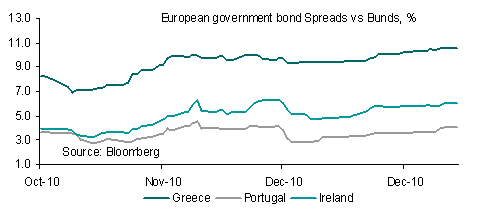
Eurozone’s woes continued to heat up last week as the holiday season relief proved temporary. Stress in peripheral debt markets increased despite buying from the ECB last week and faced with debt sales in Italy, Portugal and Spain this week the pressure is likely to continue over coming days. Whether its worries about a resolution to funding issues and investor haircuts and/or the growing divergence in growth across the eurozone, the EUR continues to look vulnerable in the absence of any resolution to these issues. Having easily slipped below its 200-day moving average EUR/USD will eye support around 1.2767.

US data this week will look upbeat and provide more support for the USD, with December retail sales likely to record a healthy increase both on the headline and ex-autos readings as indicated by strong holiday sales. Similarly industrial production will reveal a solid gain whilst the Beige Book will highlight that economic conditions across the Federal Reserve districts, have continued to improve. The weak spot will remain housing but despite this consumer spending and sentiment are likely to be reported as resilient. The Beige Book is unlikely to reveal much of an inflation threat despite higher commodity prices. This will be echoed in the core CPI reading this week.

Although headline inflation in the eurozone breached the 2.0% threshold in December the ECB is unlikely to use it as an excuse to move towards tighter monetary conditions any time soon. The ECB meeting this week will nonetheless likely note the increase in various inflation gauges in President Trichet’s press statement. Most attention will be focused on any comments that Trichet makes regarding peripheral bond strains. In reality there is little that he can say that will alter market sentiment. Whilst an ongoing commitment to buy debt will help on the margin it will do little to stem the growing tide of negative sentiment towards eurozone assets.

Double-dip fears pressure USD

Markets have found it hard to decide whether to sell the USD due to weaker economic data or buy it on higher risk aversion, but the moves overnight were clear; the USD sold off sharply in the wake of a run of soft data releases. Four separate US releases came in below consensus yesterday, with the June ISM, jobless claims, pending home sales and domestic vehicle sales, all disappointed to varying degrees, especially pending home sales, which dropped an astonishing 30% in June.

The news could have been much worse today, with the release of the US June jobs report. Following the 13k increase in the June ADP employment count the consensus forecast for nonfarm payrolls looked way too optimistic; consensus expectations were for a 130k drop in payrolls according to Bloomberg, with estimates ranging from 0 to -250k. In the event payrolls dropped by 125k and the unemployment dropped to 9.5%, an outcome that was not as bad as feared.

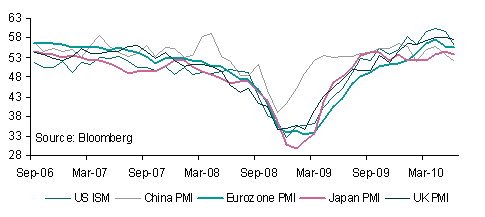
It was not just the US ISM that slipped, but a host of global purchasing managers indices (PMIs) weakened in June including China and India, supporting the view that economic activity will lose momentum in H2 2010. Before we all get too carried away it is worth noting that most manufacturing surveys are coming off a high level.

Nonetheless, for once it wasn’t European concerns that sparked an increase in risk aversion as eurozone banks borrowed less than feared from the ECB, and the Spanish bond tender passed off relatively well, factors that helped EUR/USD jump above 1.25000. Although I remain bearish on the prospects for the EUR over coming months, there may be some further near term upside, with EUR/USD 1.2675, the next resistance level in focus.

As a consequence of US double-dip fears, risk aversion remains at a high level, with US bond yields and commodity prices dropping sharply, leaving commodity currencies sharply lower. In the current environment the USD is likely to be sold on rallies.

On the commodity currency front, AUD/USD may find some relief from the news of a compromise on a proposed mining tax, but the weight of risk aversion will limit any rebound, with my preference to play AUD upside versus NZD. The main concession from Australian Prime Minister Gillard reduce was to reduce the tax to 30% for iron and coal, whilst retaining the 40% tax for oil and gas projects. The agreement likely increases the chance of an election in Australia in the next couple of months as Gillard capitalises on a popularity bounce. Fresh elections could be another factor that limits AUD upside over coming weeks.

What A Disappointment!

Ok so after talking up US data releases over recent weeks the big one namely the May jobs report, came as a disappointment. To recap, payrolls rose 431k, which was less than market consensus. Hiring due to the census which by its nature will be transitory was however, in line with expectations, at 411k, leaving ex-census hiring at a measly +20k.

Believe it or not, the trend in payrolls is one of improvement but the May outcome came as a blow to a market with bullish expectations, especially following earlier comments from the US administration hinting at a robust outcome. The disappointment was compounded by talk of a +700k payrolls outcome, which proved widely off the mark. The unemployment rate did drop more than expected, by two ticks to 9.7%, but this was due to disaffected workers dropping out of the labor force rather than an inherent pick up in job conditions.

Combined with worries about a new target in the sovereign debt crisis in Europe, this time Hungary, markets quickly tanked and risk aversion jumped. So much for relative stability! The concerns were sparked by Hungarian officials themselves, with a spokesman for the Prime Minister warning about the fiscal mess inherited from the previous government. The real blow came when the spokesman compared Hungary to Greece and reportedly said that talk of a default was “not an exaggeration”.

Suffice to say, markets are set up for tense and nervous week in which risk trades are set to suffer further. EUR/USD once again proved to be the weak link dropping below the psychologically important level of 1.20 and the EUR introduction rate around 1.1830 has moved sharply into focus.