AUD hit by weak jobs data

AUD has been one of the best performing major currencies so far in February. Better than expected Chinese trade data released yesterday was a boon for the AUD given Australia’s strong trade links with China. Moreover, as markets have backed away from RBA policy easing expectations AUD has gained a sound footing.

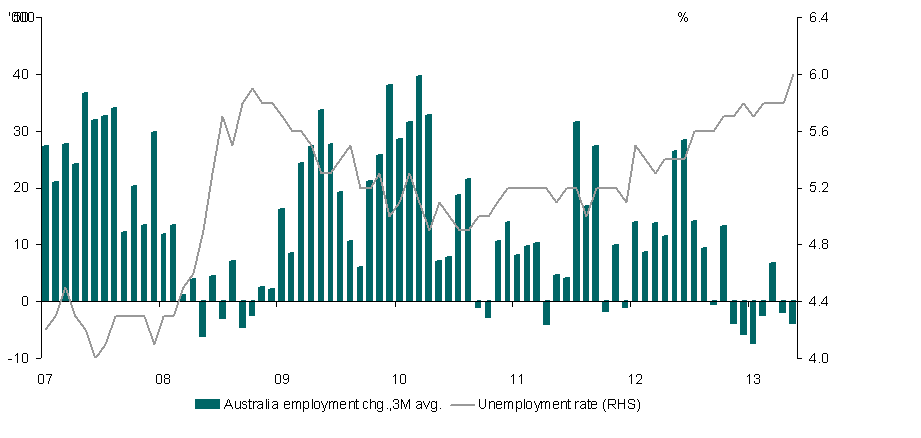
Positive sentiment for the AUD was dashed today however, following the release of January jobs data which came in worse than expected at -3.7k versus +15k consensus. The details were weak too, with the unemployment rate rising to a 10 year high of 6% and participation rate dropping to 64.5%.

The data will clearly restrain AUD in the short term, but is unlikely to spark renewed risks of further policy easing given a rise in inflation pressures. In this respect, AUD is set to continue to show some resilience over coming weeks. Near term AUD/USD support is seen around 0.8915.

AUDjobs

Posted in Australia. Tags: , , . Leave a Comment »

Euphoria fades, risk currencies weaker

The euphoria emanating from last week’s eurozone agreement will likely fade into this week as renewed doubts creep in. Details of how the EFSF bailout fund will be leveraged or how the special purpose vehicle will be utilised have yet to emerge while the firewall to protect countries such as Italy and Spain may still be insufficient given that the use of the European Central Bank (ECB) to provide unlimited support has been ruled out.

With more questions than answers markets will be hungry for further details over coming weeks and until then it is difficult to see risk appetite stretching too far. One indication of such concern was the fact that Italy’s borrowing costs climbed to euro-era highs the day after the European Union (EU) plan was agreed. The G20 meeting on 3-4 November will be eyed for further developments as well as further reaction to the EU agreement.

There are plenty of events to digest this week that could add to any market nervousness. In terms of central banks we do not expect to see any change in policy stance from the ECB, Federal Reserve or Reserve Bank of Australia (RBA) this week but the decisions may be close calls. The ECB under the helm of new President Draghi will be under pressure to ease policy as growth momentum has clearly weakened but the Bank will likely hold off for the December meeting when new growth and inflation forecasts will be released.

The RBA may also take some solace from a better global economic and market climate but the market disagrees having priced in a cut this week. The Fed will look to see how ‘Operation Twist” is faring before moving again but recent indications from some Fed officials suggest growing support for purchases of mortgage backed securities.

On the data front eurozone inflation today will be the key number in Europe while the US jobs report at the end of the week will be the main release in the US. Ahead of the payrolls data, clues will be garnered from the ISM manufacturing data and ADP jobs report. The consensus is for a 95k increase in non-farm payrolls and the unemployment to remain at 9.1% maintaining the trend of only gradual improvement in the US jobs market.

Recent data releases have turned less negative, however, and at the least have helped to alleviate renewed recessionary concerns. Overall, I suspect that markets will come back down to the reality of slow growth and unanswered questions this week, with risk assets likely to lose steam over coming days.

Ecofin, ECB, US jobs report in focus

The USD index remains close to its recent highs, maintaining a positive tone amid elevated risk aversion. Data releases have tended to take a back seat to events over recent weeks, but this week the all important US September jobs report may provide the bigger focus for US markets. The consensus expectation is for a 50k increase in payrolls and the unemployment rate remaining at 9.1% an outcome that would do nothing to assuage US growth worries. As usual markets will gauge clues to the jobs data from the ADP jobs data and employment components of the ISM data but an outcome in line with consensus expectations will likely keep risk aversion elevated and the USD supported unless the data is so bad that it results in an increase in expectations for Fed QE3.

There will be plenty of attention on the Ecofin meeting of European finance ministers today especially given that much of the reason for the stability in markets recently is the hope of concrete measures to resolve the crisis in the region. In this respect the scope for disappointment is high, suggesting that the EUR is vulnerable to a further drop if no progress is made at today’s meeting. While the extent of short market positioning has left open some scope for EUR short covering the absence of any good news will mean the impetus for short covering will diminish.

While attention in Europe will predominately remain on finding a resolution to the debt crisis and the saga of Greece’s next loan tranche, the European Central Bank (ECB) meeting will also be in focus this week especially given expectations that the ECB will cut interest rates. While hopes of a 50 basis points rate cut may have taken a knock from the firmer than expected reading for September flash CPI released at the end of last week the EUR could actually react positively to an easing in policy given that it may at least help to allay some of the growing growth concerns about the eurozone economy. However, any EUR will be limited unless officials in the eurozone get their act together and deliver on expectations of some form of resolution to the crisis in the region.

Strong words from Japan’s Finance Minister Azumi failed to have any lasting impact on USD/JPY. Japan will bolster funds to intervene in currency markets by JPY 15 trillion and extend the monitoring of FX positions until the end of December. Japan did not intervene during September but spent around JPY 4.5 trillion in FX intervention in August to little effect. For markets to be convinced about Japan’s conviction to weaken the JPY it will require putting intervention funds to active use, something that doesn’t seem to be forthcoming at present. A factor that may give some potential upside momentum for USD/JPY is the slight widening of US versus Japan bond yield differentials over recent days, which could finally result in a sustained move above 77.00 if it continues into this week.

Payrolls sour mood, Eurozone concerns intensify

The market mood has soured further and risk aversion has increased following disappointing August US jobs report in which the change in payrolls was zero and downward revisions to previous months has reinforced the negative mood on the US and global economy while raising expectations of more Federal Reserve action. Moreover, the report has put additional pressure on US President Obama to deliver fresh jobs measures in his speech on Thursday though Republican opposition may leave Obama with little actual leeway for further stimulus.

There is plenty of event risk over coming days, with a heavy slate central bank meetings including in Europe, UK, Japan, Australia, Canada and Sweden. The European Central Bank will offer no support to a EUR that is coming under growing pressure, with the Bank set to take a more neutral tone to policy compared its previously hawkish stance. In the UK, GBP could also trade cautiously given recent comments by Bank of England Monetary Policy Committee members about potential for more UK quantitative easing.

The EUR has been unable to capitalise on the bad economic news in the US as news there has been even worse. The negative news includes the weekend defeat of German Chancellor Merkel’s centre-right bloc in regional elections, which comes ahead of a vote in Germany’s constitutional court on changes to the EFSF bailout fund.

The withdrawal of the Troika (ECB, IMF and EU) from Greece has also put renewed emphasis on the country at a time when protests are escalating. If all of this is not enough there is growing concern about Italy’s apparent backtracking on austerity measures, with the Italian parliament set to discuss measures this week. Separately Germany, Holland and Finland will hold a meeting tomorrow on the Greek collateral issue. On top of all of this is the growing evidence of deteriorating growth in the euro area.

Data releases are unlikely to garner a great deal of attention amidst the events noted above, with mainly service sector purchasing managers indices on tap and at least threw will look somewhat better than their manufacturing counterparts. In the US the Beige Book and trade data will be in focus but all eyes will be on Obama’s speech later in the week. The USD has maintained a firm tone despite the jobs report but its resilience may be better explained by eurozone negativity rather than US positivity. Even so, the USD is looking less uglier than the EUR in the current environment.

USD weaker, EUR resilient, JPY supported, CHF pressure

Why has the USD come under pressure even after Fed Chairman Bernanke failed to signal more QE? The answer is that Bernanke offered hope of more stimulus and gave a shot in the arm to risk trades even if QE3 was not on the cards. Consequently the USD has looked vulnerable at the turn of this week but we suspect that a likely batch of soft US data releases over coming days including the August jobs report at the end of the week, ISM manufacturing survey on Thursday and consumer confidence today, will erase some of the market’s optimism and leave the USD in better position. The FOMC minutes today may also give some further guidance to the USD as more details emerge on the potential tools the Fed has up its sleeve.

The EUR’s ability to retain a firm tone despite the intensification of bad news in the eurozone has been impressive. Uncertainty on various fronts in Germany including but not limited to concerns about the outcome of the German Bundestag vote on the revamped EFSF on September 30, German commitment to Greece’s bailout plan and German opposition party proposals for changes to bailout terms including the possibility of exiting the eurozone, have so far gone unnoticed by EUR/USD as it easily broke above 1.4500. EUR was given some support from news of a merger between Greece’s second and third largest banks. Likely weak economic data today in the form of August eurozone sentiment surveys may bring a dose of reality back to FX markets, however.

The lack of reaction of the JPY to the news that Japan’s former Finance Minister Noda won the DPJ leadership and will become the country’s new Prime Minister came as no surprise. The JPY has become somewhat used to Japan’s many political gyrations over recent years and while Noda is seen as somewhat of a fiscal hawk his victory is unlikely to have any implications for JPY policy. Instead the JPY‘s direction against both the USD and EUR continues to be driven by relative yield and in this respect the JPY is likely to remain firmly supported. Both US and European 2-year differentials versus Japan are at historic lows, with the US yield advantage close to disappearing completely. Until this picture changes USD/JPY is set to languish around current levels below 77.00.

EUR/CHF has rebounded smartly over recent weeks, the latest bounce following speculation of a fee on CHF cash balances, with the currency pair reaching a high of 1.1972 overnight. The pressure to weaken the CHF has become all the more acute following the much bigger than anticipated drop in the August KOF Swiss leading indicator last week and its implications for weaker Swiss growth ahead. The ‘risk on’ tone to markets following Bernanke’s speech has provided a helping hand to the Swiss authorities as safe haven demand for CHF lessens but given the likely weak slate of economic releases this week his speech may be soon forgotten. Nonetheless, the momentum remains for more EUR/CHF upside in the short term, at least until risk aversion rears its head again.