Strengthening risk appetite hitting the dollar

Strengthening risk appetite is taking its toll on the USD, with the USD index now down around 3.5% from its 4 October peak. Although equity markets probably liked the news the USD was dealt another blow from the FOMC minutes which revealed that some Fed officials were keen on embarking on further large-scale asset purchases after recognizing that the impact of Operation Twist will not be so potent.

Earnings will have some impact on risk and in turn the USD, with Q3 earnings from JP Morgan and Google on tap today. However, risk appetite looks well supported and in a market that became long USDs very quickly, this suggests some scope for squaring long positions in the short term.

What comes next for the EUR? The currency has bounced from its lows and has made considerable ground against the USD over recent sessions. Markets quickly got over Slovakia’s initial rejection of the EFSF’s enhancement as agreement was reached by officials in the country to approve the mechanism in a second vote. However, there is not much news on the progress on issues such as European banking sector recapitalisation, ‘leveraging’ the EFSF or the any change in creditor participation in any Greek debt restructuring.

Although European Commission President Barroso gave some broad outlines of what should be done to recapitalise banks disagreement among officials meant that there was little detail. Perhaps no news is good news and in any case markets will have to wait for the delayed EU Summit for further news, but the longer the wait the greater the scepticism and attendant downside risks to EUR.

The Swiss National Bank must be content with their stance on the CHF. Since the imposition of a ceiling for CHF versus EUR at 1.2000, and after an initial sharp jump higher the currency pair has continued to edge upwards. Meanwhile, speculation that the SNB may even raise the ceiling to 1.30 has grown as domestic complaints such as those from the country’s largest telecoms operator yesterday about the ongoing strength in the currency, continue.

The SNB has not indicated that it favors such a move and may be content with a gradual decline in the CHF as is taking place now, but should the fragile market calm at present disintegrate the SNB may have another battle on their hands as appetite for the currency strengthens anew. On the top side resistance is seen around 1.2469 for EUR/CHF.

Like many other high beta currencies AUD is being influenced less by domestic factors and more by risk aversion. Even more influential to the direction of AUD/USD is the movement in commodity prices and like risk aversion this had a negative influence on AUD as commodity prices dropped sharply over September.

Due to a bounce in both risk and commodities AUD has bounced sharply from its recent lows back above parity with the USD. AUD will have found further support from the firm September jobs report today. It is difficult to go against rising risk appetite at present but there is still a significant risk that hopes of a solution to the eurozone’s woes do not materialise while growth expectations are pared back further. Against this background the AUD will remain susceptible to sharp
Unloved US Dollar

The USD index is now at its lowest level since May 3 and is showing little sign of turning around. The bulk of USD index weakness overnight came via the EUR and GBP, both of which rose sharply against the USD, with EUR/USD breaching its 90 day moving, hitting a high of 1.2955 and GBP/USD on its way to testing its 200 day moving average, reaching a high of 1.5472. Commodity currencies fared far less positively, perhaps feeling the after effects of the weaker Chinese data this week, with the NZD also dented by weaker than expected inflation data in Q2.

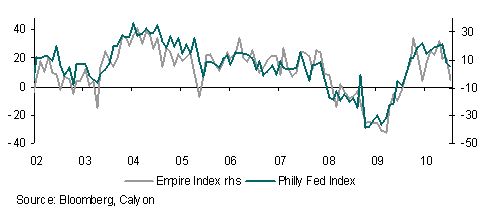
The USD was once again hit by US growth worries. To recap, the US data slate revealed a soft reading for PPI, whilst the July Empire manufacturing index dropped 14.5 points, a far bigger drop than forecast. The Philly Fed index also dropped further in July despite expectations of a small gain. In contrast, June industrial production edged higher, but manufacturing output actually fell. There was a bit of good news in the fact that weekly jobless claims fell more than forecast.

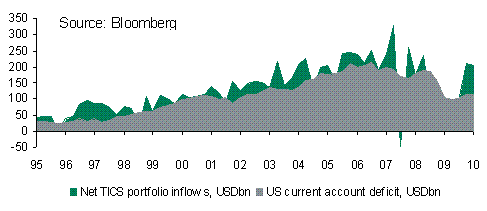
The releases extended the run of weak US data, keeping double-dip fears very much alive. The data have acted to validate the Fed’s cautious growth outlook expressed in the latest FOMC minutes but a double-dip is unlikely. Today’s releases include June CPI, May TIC securities flows, and July Michigan confidence. Another benign inflation report is expected. Consumer confidence is set to slip further against the background of soft data and volatility in equity markets whilst TICS data is forecast to reveal that long term securities flows declined in May compared to the $83 billion inflows registered in April.

The move in the EUR is a making a mockery out of forecasts including my own that had expected renewed downside. The relatively successful Spanish bond auction yesterday helped to ease eurozone sovereign debt concerns further, with a likely strong element of Asian participation. I have still not given up on my EUR negative view given the likelihood of a deteriorating economic outlook in the eurozone and outperfomance of the US economy, but over the short-term the EUR short squeeze may have further to go, with EUR/USD resistance seen at 1.3077.

Equity markets were saved from too much of a beating following the release of better than expected earnings from JP Morgan, a $550mn agreement between Goldman Sachs and the SEC to settle a regulatory case, and news from BP that it has temporarily stemmed the flow of oil from the leak from its Gulf well. Agreement on the US financial reform bill, passed by the Senate yesterday and likely to be signed into law by US President Obama next week, likely helped too.

The tone of the market is likely to be mixed today, with US growth concerns casting a shadow on risk trades. Earnings remain in focus and the big name releases today include BoA, GE and Citigroup but early direction could be negative following news after the US close that Google Inc. profits came in below analysts’ expectations. Data in the US today is unlikely to help sentiment given expectations of more weak outcomes, leaving the USD vulnerable to further selling pressure.

China tightens policy

Risk appetite has soured due to a combination of the rise in China’s reserve requirements, disappointing earnings including Alcoa and a profit warning by Chevron, setting the scene for a day in the red for Asian markets.  The turn in sentiment has hit commodities and commodity currencies particularly hard whilst the JPY has outperformed.  As would be expected against the background of higher risk aversion the US dollar made up some ground.

All eyes are on China and markets will now look to the implications for CNY policy.  Increasingly it seems that data and policy in China is driving global markets and aside from the hike in reserve requirements this was also evident in the fact that stronger trade data over the weekend helped to counter the impact of the soft US December payrolls report.  Further increases in the reserve ratio are likely over coming months followed by actual hikes in interest rates (likely the 1 year rate).  China’s move to tighten policy further over coming months will likely be accompanied by allowing greater appreciation of the CNY too.

The news worsened overnight as the ABC Consumer Confidence index dropped by 6 points to -47, the biggest one-week drop in the last 25 years.  US trade data also came in worse than expected, with the deficit widening to $36.4bn in November.  There is little on the data front today to keep markets occupied today, suggesting that direction will come from equity markets and with more earnings this week including Intel Corp and JPMorgan Chase & Co. there will be plenty to digest.  In the near term the tone of risk aversion is set to continue to dominate but any pull back in risk currencies is likely to prove short-lived.   

There will be more Fed speakers as well as the Fed’s Beige Book today to provide clues ahead of the January 26-27 FOMC meeting.   Aside from noting some improvements in the economy, weak labour market conditions as well as a lack of inflationary pressures will help support expectations that the Fed will hold off from raising interest rates this year.   Fed speakers include Fisher and Plosser both of whom give speeches on the US economy though neither are current voters on the FOMC.   Plosser’s comments so far have highlighted the need for a timely “exit strategy”.