Asian currencies vulnerable to equity outflows

Asian currencies are set to continue to trade cautiously. One big headwind to further appreciation is the fact that there has been a substantial outlook of equity capital over recent weeks. Over the last month to date Asian equity markets have registered an outflow of $3.3 billion in outflows. However, whilst Taiwan, South Korea, Thailand and India have seen outflows Indonesia, Philippines, and Vietnam have registered inflows.

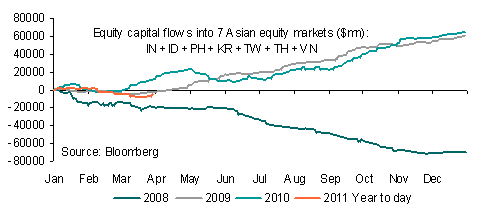
The net result is that equity capital inflows to Asia so far this year are almost flat, a stark contrast from 2009 and 2010 when inflows were much higher at the same point in the year. The odds for further strong inflows do not look good, especially as the Fed ends QE2 by the end of June. While a sharp reversal in capital flows is unlikely, it also seems unlikely that Asia will register anywhere near as strong inflows as the last couple of years.

This will have a significant impact on Asian currencies, whose performance mirrors capital flows into the region. Almost all Asian currencies have dropped against the USD so far this month and could remain vulnerable if outflows continue. Given the relative stability of the USD over recent weeks and imminent end to QE2, the better way to play long Asia FX is very much against the increasingly vulnerable EUR.

The THB has been the worst performing currency this month but its weakness has been attributable to upcoming elections on July 3, which has kept foreign investor sentiment cautious. Thailand has seen an outflow of $812mn from its equity market this month. Polls show the PM Abhisit’s party trailing the opposition and nervousness is likely to persist up to the elections at least. THB weakness is not likely to persist over coming months, with USD/THB forecast at 29.2 by year end.

USD/KRW has been whipsawed over the past week but made up ground despite a continued outflow of equity capital over recent days. KRW has been particularly resilient despite a firmer USD environment and a drop in consumer sentiment in June. Next week the KRW will likely continue to trade positively, helped by a likely firm reading for May industrial production on Thursday. USD/KRW is set to trade in a 1070-1090 range, with direction likely to come from Greece’s parliament vote on its austerity measures.

TWD has traded weaker in June, having been one of the worst performing currencies over the month. USD/TWD does not have a particularly strongly correlation with movements in the USD or risk aversion at present but the currency has suffered from a very sharp outflow of equity capital over recent weeks (biggest outflow out of all Asian countries so far this month). Next week’s interest rate decision on Thursday by the central bank (CBC) will give some direction to the TWD but a 12.5bps increase in policy rates should not come as a big surprise. TWD is likely to trade with a weaker bias but its losses are likely to be capped around the 29.00 level versus USD.
Asian currencies – What’s correlated with what?

Asian currencies as reflected in the performance of the ADXY index have been on bit of a rollercoaster ride over recent weeks, dropping sharply in the face of a resurgent USD (note most Asian currencies have had a high correlation with the movements in the USD index over the past three-months) only to strengthen briefly before resuming weakness. Since the end of last month almost all Asian currencies are weaker, with the biggest falls led by MYR, KRW, SGD and INR.

Correlation analysis shows that Asian currencies are not particularly being influenced by yield differentials at present, with only USD/IDR and USD/PHP possessing a significant correlation with 2-year bond differentials. In the case of the IDR there has been a narrowing in the yield differential with the US over recent weeks as Indonesian yields have dropped, a factor that could be undermining the IDR at present.

Similarly risk aversion does not appear to be playing a major role in influencing Asian currencies, with a low correlation registered between my Risk Aversion Barometer and all Asian currencies over the past three-months. However, equity performance is more important for some currencies, with the SGD, THB, PHP, IDR and TWD all having a high sensitivity to the performance of their local equity market. Interestingly the INR is less sensitive to equity performance even though India has recorded heavy outflows of equity capital over recent weeks.

Asian currencies are likely to continue to track the gyrations of the USD in general over the short-term as has been the case over recent weeks but it will not be a one way bet for the USD. Whilst I remain bullish on the USD’s prospects over the medium term I am cautious about the ability of the USD to sustain its currency bounce given that there has not been any back up in US bond yields or any clarification on what the Fed will do after QE2 has been completed.

Against this background I do not expect Asian currency weakness to extend much further. Top picks for the year are KRW and PHP as well as the CNY. In any case given the strong influence of general USD direction on Asian currencies, I suggest playing long Asian FX positions versus EUR over coming months, especially given that the EUR is likely to slide much further against the USD by year end, with 1.30 remaining my target.

Markets in limbo ahead of policy rate decisions

Markets are generally range-bound ahead of tomorrow’s Japan, Eurozone and UK interest rate decisions, as reflected in the flat performance of equity markets overnight. Risk appetite remains positive though still lower than the high levels seen during most of March. China’s interest rate hike did not change the market’s perspective, with markets reacting well.

Overnight the Fed FOMC minutes reflected a range of opinions on the timing of the end of QE2 and the Fed’s exit strategy but the majority view was to end QE2 as planned at the end of June leaving markets, with little new to digest. The USD was a little undermined by a weaker than expected US March ISM non-manufacturing survey but losses are likely to be limited.

Meanwhile there was more negative peripheral news in Europe, with Moody’s cutting Portugal’s sovereign credit ratings by one notch, with Moody’s highlighting the urgent need for financial support from the EU. Portuguese debt took a hit but eurozone markets in general including the EUR continue to take such news in their stride, with EUR/USD holding above 1.4200. Firm readings for the eurozone final services purchasing managers index (PMI) in March helped to support sentiment, outweighing the negative impact of a drop in eurozone retail sales.

GBP was a key outperformer, helped by a much stronger than expected services PMI, which helped GBP/USD breach 1.63 overnight. Today’s industrial and manufacturing production data will likely reveal firm readings too, helping GBP to consolidate its gains but the currency looks rather rich around current levels, with risks skewed to the downside.

JPY was another mover, having breached 85.00 versus the USD, with USD/JPY now some 6 big figures higher from its post earthquake lows. Japanese authorities will undoubtedly see a measure of success from their joint intervention but the reality is that the shift in bond yields (2-year US / Japan yield differentials have widened by close to 30 basis points since mid March, are finally having some impact on USD/JPY as reflected in the strengthening in short-term correlations.

EUR/USD remains resilient to negative peripheral news such as the Portugal credit ratings downgrade, with further direction from tomorrow’s European Central Bank (ECB) meeting and accompanying statement. The risk that the ECB is not as hawkish as the market has priced in holds some downside risks to EUR.

Asian currencies are holding up well though it looks as though the ADXY (Bloomberg-JP Morgan Asian currency index) may have hit a short term barrier. Range trading for EUR/USD suggests little directional influence for Asian currencies in the short-term. Nonetheless, portfolio capital inflows continue to support Asian FX with all Asian equity markets recording foreign inflows so far this month. In particular, KRW continues to outperform. Note that Korea has recorded a whopping inflow of $1.1bn in equity inflows month-to-date.

Equity Flow Reversal Supports Asian FX

Asian currencies have rebounded smartly from their post Japan earthquake lows on March 16. The ADXY (Bloomberg-JP Morgan Asia Currency index) is now at its highest level since September 1997 reflecting a sharp rebound in capital inflows to the region. The performance of Asian currencies continues to correspond closely with the movement in capital flows.

Although almost all Asian equity markets have registered outflows so far this year (total equity outflows -$6.2bn), the trend is reversing. Over the past month there has been a major slowing in capital outflows for most countries in Asia whilst India, Thailand and the Philippines have actually registered sizeable inflows. South Korea is notable in that there has been a sharp increase in equity capital inflows over the past week.

Although there has been much focus on a rotation of capital flows out of Asia and into developed economies this year, it is worth noting that the pattern of equity flows in Q1 2011 has not been too different from that witnessed in the past couple of years. In both 2009 and 2010 equity outflows were recorded over the two (2010) or three (2009) months of the year before a reversal took place. This pattern looks like it is repeating itself.

Clearly the environment for Asian equity markets is not as supportive as it was last year given the belated tightening in monetary policies being undertaken by many central banks and prospects of an end to QE2 in the US. Whilst this will result in some reduction in capital flows to the region compared to last year, the overall outlook is positive. Easing risk aversion (our risk aversion barometer has already reversed all of its post Japan earthquake spike and is trending lower), positive growth outlook and maintenance of low US rates point to more inflows.

One currency in particular that will benefit is KRW, with a further drop in USD/KRW likely over coming weeks. KRW has already strengthened by around by around 2.7% since its post Japan earthquake low making it the best performing currency since then. Further gains are likely; a test of USD/KRW 1100 is on the cards in the short-term, with the year end target standing at 1050.

Why buy KRW? 1) Korea has registered the biggest improvement in equity capital flows recently, 2) KRW has been the most sensitive Asian currency to risk over the past month and therefore benefits the most as risk appetite improves, 3) Estimated Price/Earnings ratio for Korean equities looks cheap compared to its historical z-score according to our estimates. As a result our quantitative model on USD/KRW based on commodity prices, risk aversion and equity performance highlights the potential for significantly more KRW strength.

Interest Rate Decisions Galore

The Reserve Bank of New Zealand (RBNZ) decision to cut policy rates by a bigger than expected 50bps does not necessarily mark the onset of a new wave of NZD selling. Indeed, whilst the NZD was hit by the rate cut it recovered quickly.

The NZD was aided by comments from the RBNZ Governor Bollard that short term inflation may spike due to the earthquake but this tempered by another RBNZ official who stated that the central bank may hold rates at 2.5% at least until January 2012. The post meeting statement indicated that the RBNZ will not embark on a series of rate cuts, a fact that will provide some relief to the Kiwi. Moreover, the currency looks increasingly oversold especially relative to the AUD as indicated by relative positioning.

Weaker than expected employment data in Australia will also help to stem AUD strength versus NZD. After many months of positive surprises the labour market is showing signs of cracking. Admittedly full time employment rose but this was outweighed by an even bigger drop in part time employment, resulting in a 10.1k fall in overall employment.

Although the AUD is unlikely to face too much downside markets the data will likely dampen expectations of possible rate hikes in the months ahead. My preferred way of playing possible AUD underperformance is via the NZD. AUD/NZD is likely to face plenty of resistance around the 1.3800 level and eventually as indicated by our quantitative models the currency pair is likely to move lower over coming weeks.

In sharp contrast to the RBNZ, the Bank of Korea hiked interest rates by 25bps in a further move to normalize policy. The decision was not much of a surprise and the statement indicated that more rate hikes should be expected. The KRW remains rangebound but the currency remains on path for further appreciation over coming months. The surprise trade deficit in China has weighed on Asian currencies in general but weakness is likely to be limited.

The Bank of England is the next central bank on tap today but is unlikely to hike rates despite the hawkish shift within the Monetary Policy Committee. A rate hike is moving closer but the Bank will likely wait until at least May before moving. Further details about today’s decision will as usual wait for the minutes in two weeks time. GBP looks vulnerable and whilst a rate move today is not expected the currency may lose ground over coming days against the background of a firmer USD.