Week Ahead

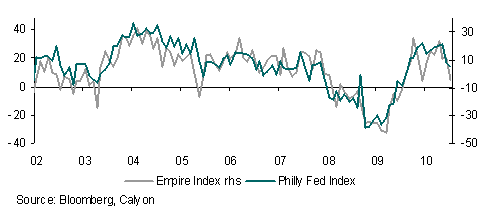
The market mood can be characterised as uncertain and somewhat downbeat, as reflected by the downdraft in US equity markets which posted their second weekly loss last week. Conversely, there has been a bullish run in government bonds, with the notable exception of peripheral debt. Over the last week markets had to contend with more data disappointment, in the wake of soft Japanese Q2 GDP, and a plunge in the August Philly Fed into negative territory, its first contraction since July 2009. Additionally a jump in jobless claims, which hit 500k highlighted the slow improvement in US job market conditions currently underway.

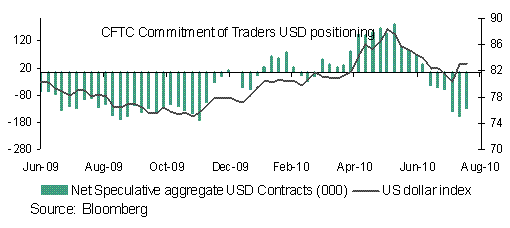
Despite all of this, the USD proved resilient and instead of the usual sell-off in the wake of soft data it benefited instead from increased risk aversion. The USD is set to retain some of this resilience though range-trading is likely to dominate over much of the weak. Reflecting the USD’s firmer stance, speculative positioning in the form of the CFTC IMM data revealed a reduction in aggregate USD short positioning in the latest week and although positioning is well below the three-month average, the improvement over the latest week and current magnitude of short positioning, highlights the potential and scope for further short-covering.
Negative data surprises have forced many to downgrade their forecasts for growth and policy implications, especially in the US. Markets will look for further clarity on the economic outlook this week but it is not clear that anything conclusive will be delivered. At the end of the week Q2 GDP will be revised sharply lower and whilst the data is backward looking it will reveal the weaker momentum of growth going into the second half of the year.

US Housing data will be mixed, with existing home sales set to drop in July as the impact of the expiration of home buyers tax credits continues to sink in whilst new home sales will likely increase but only marginally and will remain well below the April levels. Overall the picture of housing market activity remains bleak and this week’s data will do little to shake this off. On a more positive note July durable goods orders and August Michigan confidence will rise, the latter only marginally though. There will be plenty of attention on Fed Chairman Bernanke’s speech at the Jackson Hole Fed conference at the end of the week, especially given speculation of more quantitative easing in the pipeline.

The European data slate kicks off today with the release of manufacturing and service sector PMIs. Both are likely to register small declines, albeit from high levels. Nonetheless, taken together with a likely drop in the August German IFO survey on Wednesday and weaker June industrial orders tomorrow, the data will highlight that the momentum of growth in the region is coming off the boil, with the robust GDP outcome registered in Q2 2010 highly unlikely to be repeated. Against this background EUR/USD will find it difficult to make any headway. Technically further donwnside is likely over the short-term, with a test of 1.2605 support on the cards

Japan releases its slate of month end releases including jobs data, household spending and CPI. A slight improvement in job market conditions and increased spending will be insufficient to allay growth and deflation concerns, especially with CPI remaining firmly in negative territory. The onus will remain on the authorities to try to engineer a weaker JPY, which remains stubbornly around the 85.00 level versus USD. Talk of a BoJ / MoF meeting today has been dismissed, suggesting the prospect of imminent action is small. Meanwhile, speculative JPY positioning has dropped slightly in the last week but remain close to historical highs.

Aside from various data releases this week markets will digest the outcome of Australia’s federal elections. From the point of view of markets the outcome was the worst possible, with no clear winner as both the incumbent Prime Minister of the ruling Labour Party and opposition Liberal-National Party leader Tony Abbot failed to gain an outright majority. The outcome of a hung parliament will likely keep the AUD on the back foot, with trading in the currency likely be somewhat volatile until a clear outcome is established as both candidates try to garner the support of a handful of independents. However, it is notable that apart from an initial drop the AUD has managed to hold its ground. Nonetheless, the given the fluidity of the political situation there will be few investors wanted to take long positions at current levels around 0.8900 versus USD.
Unloved US Dollar

The USD index is now at its lowest level since May 3 and is showing little sign of turning around. The bulk of USD index weakness overnight came via the EUR and GBP, both of which rose sharply against the USD, with EUR/USD breaching its 90 day moving, hitting a high of 1.2955 and GBP/USD on its way to testing its 200 day moving average, reaching a high of 1.5472. Commodity currencies fared far less positively, perhaps feeling the after effects of the weaker Chinese data this week, with the NZD also dented by weaker than expected inflation data in Q2.

The USD was once again hit by US growth worries. To recap, the US data slate revealed a soft reading for PPI, whilst the July Empire manufacturing index dropped 14.5 points, a far bigger drop than forecast. The Philly Fed index also dropped further in July despite expectations of a small gain. In contrast, June industrial production edged higher, but manufacturing output actually fell. There was a bit of good news in the fact that weekly jobless claims fell more than forecast.

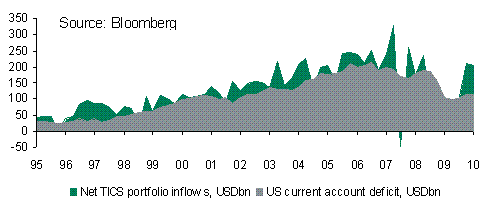
The releases extended the run of weak US data, keeping double-dip fears very much alive. The data have acted to validate the Fed’s cautious growth outlook expressed in the latest FOMC minutes but a double-dip is unlikely. Today’s releases include June CPI, May TIC securities flows, and July Michigan confidence. Another benign inflation report is expected. Consumer confidence is set to slip further against the background of soft data and volatility in equity markets whilst TICS data is forecast to reveal that long term securities flows declined in May compared to the $83 billion inflows registered in April.

The move in the EUR is a making a mockery out of forecasts including my own that had expected renewed downside. The relatively successful Spanish bond auction yesterday helped to ease eurozone sovereign debt concerns further, with a likely strong element of Asian participation. I have still not given up on my EUR negative view given the likelihood of a deteriorating economic outlook in the eurozone and outperfomance of the US economy, but over the short-term the EUR short squeeze may have further to go, with EUR/USD resistance seen at 1.3077.

Equity markets were saved from too much of a beating following the release of better than expected earnings from JP Morgan, a $550mn agreement between Goldman Sachs and the SEC to settle a regulatory case, and news from BP that it has temporarily stemmed the flow of oil from the leak from its Gulf well. Agreement on the US financial reform bill, passed by the Senate yesterday and likely to be signed into law by US President Obama next week, likely helped too.

The tone of the market is likely to be mixed today, with US growth concerns casting a shadow on risk trades. Earnings remain in focus and the big name releases today include BoA, GE and Citigroup but early direction could be negative following news after the US close that Google Inc. profits came in below analysts’ expectations. Data in the US today is unlikely to help sentiment given expectations of more weak outcomes, leaving the USD vulnerable to further selling pressure.

Euro Has That Sinking Feeling

The reaction to the US May jobs report shows that markets are particularly susceptible to negative US news at a time when growth fragilities in Europe are becoming increasingly apparent. Coupled with worries about Hungary, risk aversion has jumped.

Unsurprisingly the EUR took the brunt of pressure. Rhetoric over the weekend may help to assuage some fears but I suspect it is too late now that the cat is out of the bag. Hungary’s government maintained that it will meet this year’s budget deficit target of 3.8% of GDP. European Union officials also attempted to calm market concerns, downplaying any comparison of Hungary to Greece.

The overall EUR/USD downtrend remains intact. Renewed doubts about German participation in the EU/IMF rescue package, with the German constitutional court potentially blocking its contribution, will add to pressure as well as a UK press report titled EUR ‘will be dead in five years’ . The January 1999 EUR/USD introduction level around 1.1830 has now moved squarely into sight.

It is unlikely that data and events this week will do much to reverse the market’s bearish tone. Highlights include the ECB, BoE and RBNZ meetings in Europe, UK and New Zealand, respectively. The ECB (Thursday) is highly unlikely to shift its monetary policy stance. Given some opposition to bond purchases from within the ECB council the comments in the accompanying statement will be closely monitored. The BoE will also leave policy unchanged on the same day but the RBNZ is set to begin its hiking cycle with a 25bps move.

On the data front the US slate includes the Fed’s Beige Book, April trade data, May retail sales and June Michigan confidence. The Beige Book is likely to reveal some improvement in activity with little sign of inflation, whilst the trade deficit is set to widen further due to a higher oil import bill. Retail sales will reveal an autos led increase in the headline reading but more subdued core sales, whilst consumer confidence is set to rise for a second straight month.

There will be more attention on rhetoric from EU officials rather than eurozone data, with the Eurogroup of Finance Minister’s and Ecofin meetings garnering more interest. In Japan, politics will take centre stage, with the new cabinet line up in focus following the confirmation of Naoto Kan as Prime Minister. Comments by the new PM himself will be of interest, especially with regard to combating deflation and in particular any elaboration on his penchant for a weaker JPY.

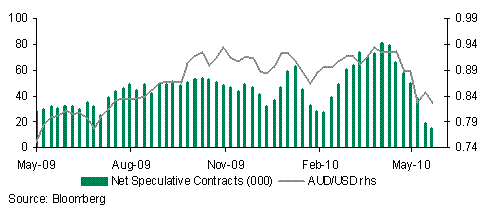
All-in-all, the week is unlikely to see a let up in pressure on risk trades and will start much as the last week ended. Although the market’s attention is on the EUR, it should be noted that the AUD has lost even more ground so far this month although the EUR remains the biggest loser in terms of major currencies so far this year (vs USD). In the case of the AUD the move reflects a massive unwinding of long positioning (as reflected in the latest CFTC IMM data which shows that speculative AUD positioning has dropped to its lowest since March 2009).

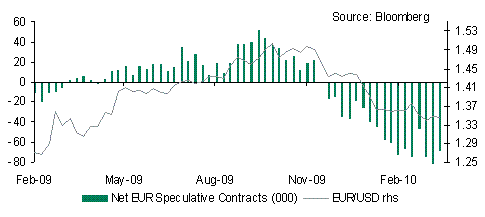
In contrast in the case of the EUR where positioning is already very negative, the move simply reflects deteriorating fundamentals. The fact that European officials are showing little concern about the decline in the EUR (why should they given that the currency is now trading around fair value) and in some cases encouraging it, suggests that there is little to stop EUR/USD from dropping much further and parity is looming a lot closer.

Greek Aid Boosts Euro

Greece is never far from the headlines and the big news over the weekend was once again centred on this small (in terms of economy size) eurozone Country, with the agreement by Eurozone members to provide up to EUR 30 billion in loans to Greece. This will be supplemented by additional contributions from the IMF to the tune of around EUR 15 billion. The rate of around 5% for the three-year fixed loan is well below that yielding on Greek debt but above the International Monetary Fund (IMF) standard lending rate. In other words, the terms of the loan are far more favourable than they would currently face in the market.

After weeks of haggling the decision to detail the amount and terms of a loan for Greece will help reassure markets and likely result in a narrowing in Greek spreads over the near term. Further details will be finalised early in the week including conditions imposed on Greece as well as the exact amount of the IMF contribution but the real test of confidence will be the reception to Greece’s EUR 1.2 billion sale of 3 and 6-month paper at the beginning of the week.

Markets were already embarking on a short covering exercise in EUR/USD early last week according to the latest CFTC IMM report which showed a reduction in net EUR short speculative positions. As a result of the weekend’s agreement the EUR looks set to consolidate its gains into the beginning of this week. Further out, there are still plenty of risks ahead and sellers are likely to emerge around EUR/USD resistance at 1.3696.


Data releases this week will be conducive to maintaining further support for risk appetite whilst shoring up recovery expectations. In particular US March retail sales are set to jump on the back of strong autos spending (consensus 1.2% monthly gain). March industrial production is also likely to record a healthy reading (consensus 0.7% month-on-month), whilst gains in both manufacturing (Empire manufacturing and Philadelphia Fed) and consumer confidence (Michigan confidence) for April are likely.

There will also be plenty of attention on Chinese data this week with a plethora of releases over coming days including FX reserves, GDP, loans data, inflation, retail sales and industrial production. In short, the data will continue to reveal a robust economic performance, which will be good for risk appetite and Asian currencies, but will also add to the pressure to revalue the Chinese currency, CNY, soon.

The USD impact will depend on whether the market reacts to firmer risk appetite or signs of stronger US growth. I suspect the former will apply for now, likely keeping the USD on the back foot early in the week. The main beneficiaries include risk currencies such as AUD, NZD and CAD as well as most Asian currencies. AUD/USD is set to target technical resistance around 0.9407 whilst NZD/USD will set its sights on resistance around 0.7252 over the next few days.

What to watch this week

The 85k drop in US non-farm payrolls in December was obviously disappointing given hopes/expectations/rumours of a positive reading over the month.  There was a small silver lining however, as November payrolls were revised to show a positive reading of +4k, the first monthly gain in jobs since December 2007.  Overall, the US labour market is still gradually improving as the trend in jobless claims and other indicators show. 

The fact that the market took the drop in US payrolls in its stride highlights the fact that recovery is becoming more entrenched despite the occasional set back.  More significantly weaker US jobs disappointment has been countered by strong Chinese trade data, which showed both strong imports and exports growth in December.  Whilst the data, especially the strength in exports, will support calls for a stronger CNY, it also highlights China’s growing influence on world trade and the important role that the country is providing for global economic recovery.

Market resilience in the wake of the drop in US payrolls and positive reaction to Chinese trade data will maintain a “risk on” tone to markets this week.  In particular, the USD is set to start the week on the back foot and despite data last week showing that Eurozone unemployment reached an 11-year high of 10% and growing evidence that the Eurozone economy is falling behind the pace of recovery seen elsewhere, EUR/USD held above technical support (200 day moving average) around 1.4257, and is setting its sights on the 16 December 2009 high of 1.4591 helped by renewed Asian sovereign interest.  

The main event in the Eurozone is the ECB meeting on Thursday no surprises are expected, with the Bank set to keep policy unchanged whilst maintaining current liquidity settings.  The bigger concern for European markets is ongoing fiscal woes in the region, with press reports warning of a ratings downgrade for Portugal and still plenty of attention on Greece and its attempts at deficit reduction.  Fiscal concerns are not going to go away quickly and will clearly act as a restraint on market sentiment for European assets. 

In a holiday shortened week in the US as markets close early on Friday ahead of the 3-day MLK holiday, there are a number of data this week that will shed further light on the shape of US recovery. The main event is the December advance retail sales report on Thursday, which is expected to record a reasonable gain, helped by firm autos sales. 

Preceding this, tomorrow there is expected to be a renewed widening in the US trade deficit in November whilst on Wednesday the Fed’s Beige Book as well as various Fed speakers this week including Bullard, Lockhart, Fisher, Plosser, Evans and Lacker, will give important clues ahead of the January 27 Fed FOMC meeting.  Bullard sounded dovish in his comments in Shanghai, as he highlighted that US interest rates will remain low for some time. 

At the end of the week there will be a heavy slate of releases including December CPI, industrial production, capacity utilization, January Empire manufacturing and Michigan confidence. The outlook for these data is generally positive, with gains expected in both manufacturing and consumer confidence, whilst hard data in the form of industrial production is likely to record a healthy increase and CPI is set to reveal another benign reading.