Speculators bail out of USDs

Risk appetite held up reasonably well last week, with markets failing to be derailed by concerns over Ireland’s banking sector and growing opposition to austerity measures across Europe. The main loser remained the USD, with the USD index hitting a low marginally above 78.00 and speculative positioning as reflected in the CFTC IMM data revealing a further sharp drop in sentiment to its lowest since Dec 2007.

This week is an important one for central bank meetings, with four major central banks deliberating on monetary policy including Bank of Japan (BoJ), Reserve Bank of Australia (RBA), European Central Bank (ECB) and Bank of England (BoE). The major event of the week however, is Friday’s release of the September US employment report. The RBA is set to hike its cash rate by 25bps, the BoJ may announced more easing measures whilst in contrast both the ECB and BoE are unlikely to alter their policy settings.

Whilst the BoJ is widely expected to leave its policy rate unchanged at 0.1%, it may announce further measures against the background of persistent JPY strength, a worsening economic outlook as reflected in last week’s Tankan survey and decline in exports. Japanese press indicate that the BoJ may increase lending of fixed rate 3 to 6 month loans to financial institutions as well as buy more short-term government debt.

The measures alongside risks of further JPY intervention may prevent USD/JPY slipping further but as reflected in the increase in speculative net long JPY positions last week, the market is increasingly testing the resolve of the Japanese authorities. Strong support is seen around USD/JPY 82.80, with the authorities unlikely to allow a break below this technical level in the short-term.

Although we will only see details of the voting in two weeks in the release of the UK BoE Monetary Policy Commitee (MPC) minutes it is likely that there was a three-way split within the MPC as reflected in recent comments, with MPC member Posen appearing to favour more quantitative easing whilst the MPC’s Sentance is set to retain his preference for higher rates. As has been the case over recent months the majority of the MPC are likely to have opted for the status quo.

GBP was a laggard over September as markets continued to fret over potential QE from the BoE. This uncertainty is unlikely to fade quickly suggesting limited gains against the USD and potentially more downside against the EUR. GBP speculative sentiment has improved but notably positioning remains short. EUR/GBP will likely target resistance around 0.8810.

In contrast to GBP the EUR has taken full advantage of USD weakness and looks set to extend its gains. Although there is a risk that speculative positioning will soon become overly stretched it is worth noting that positioning is well below its past highs according to the IMM data. EUR may have received some support from Chinese Premier Wen’s pledge to support Greece, and a stable EUR. Whilst there continues to be risks to the EUR from ongoing peripheral debt concerns such comments likely to be repeated at the EU-Asia summit today and tomorrow, will keep the EUR underpinned for a test of 1.3840.
Euro Has That Sinking Feeling

The reaction to the US May jobs report shows that markets are particularly susceptible to negative US news at a time when growth fragilities in Europe are becoming increasingly apparent. Coupled with worries about Hungary, risk aversion has jumped.

Unsurprisingly the EUR took the brunt of pressure. Rhetoric over the weekend may help to assuage some fears but I suspect it is too late now that the cat is out of the bag. Hungary’s government maintained that it will meet this year’s budget deficit target of 3.8% of GDP. European Union officials also attempted to calm market concerns, downplaying any comparison of Hungary to Greece.

The overall EUR/USD downtrend remains intact. Renewed doubts about German participation in the EU/IMF rescue package, with the German constitutional court potentially blocking its contribution, will add to pressure as well as a UK press report titled EUR ‘will be dead in five years’ . The January 1999 EUR/USD introduction level around 1.1830 has now moved squarely into sight.

It is unlikely that data and events this week will do much to reverse the market’s bearish tone. Highlights include the ECB, BoE and RBNZ meetings in Europe, UK and New Zealand, respectively. The ECB (Thursday) is highly unlikely to shift its monetary policy stance. Given some opposition to bond purchases from within the ECB council the comments in the accompanying statement will be closely monitored. The BoE will also leave policy unchanged on the same day but the RBNZ is set to begin its hiking cycle with a 25bps move.

On the data front the US slate includes the Fed’s Beige Book, April trade data, May retail sales and June Michigan confidence. The Beige Book is likely to reveal some improvement in activity with little sign of inflation, whilst the trade deficit is set to widen further due to a higher oil import bill. Retail sales will reveal an autos led increase in the headline reading but more subdued core sales, whilst consumer confidence is set to rise for a second straight month.

There will be more attention on rhetoric from EU officials rather than eurozone data, with the Eurogroup of Finance Minister’s and Ecofin meetings garnering more interest. In Japan, politics will take centre stage, with the new cabinet line up in focus following the confirmation of Naoto Kan as Prime Minister. Comments by the new PM himself will be of interest, especially with regard to combating deflation and in particular any elaboration on his penchant for a weaker JPY.

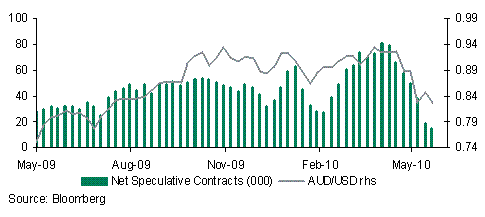
All-in-all, the week is unlikely to see a let up in pressure on risk trades and will start much as the last week ended. Although the market’s attention is on the EUR, it should be noted that the AUD has lost even more ground so far this month although the EUR remains the biggest loser in terms of major currencies so far this year (vs USD). In the case of the AUD the move reflects a massive unwinding of long positioning (as reflected in the latest CFTC IMM data which shows that speculative AUD positioning has dropped to its lowest since March 2009).

In contrast in the case of the EUR where positioning is already very negative, the move simply reflects deteriorating fundamentals. The fact that European officials are showing little concern about the decline in the EUR (why should they given that the currency is now trading around fair value) and in some cases encouraging it, suggests that there is little to stop EUR/USD from dropping much further and parity is looming a lot closer.

Fed keeps the risk trade party going

Risk is back on and the liquidity taps are flowing. Fed Chairman Bernanke noted that it is “not obvious” that US asset prices are out of line with underlying values, comments that were echoed by Fed Vice Chairman Kohn, effectively giving the green light to a further run up in risk trades. The last thing the Fed wants to do is ruin a good party and the comments indicate that the surge in equities over recent months will not be hit by a reversal in monetary policy any time soon.  

Aside from comments by Fed officials risk appetite was also boosted by a stronger than forecast rise in US October retail sales, with US markets choosing to ignore the sharp downward revision to the previous month’s sales, the weaker than forecast ex-autos reading and a surprisingly large drop in the Empire manufacturing survey in November.

Fed comments were not just focussed on the economy and equity markets as Bernanke also tried to boost confidence in the beleaguered USD, highlighting that the Fed is “attentive” to developments in the currency.  He added that the Fed will help ensure that the USD is “strong and a source of global financial stability”.  The comments had a brief impact on the USD and may have given it some support but this is likely to prove short lived. 

The reality is that the Fed is probably quite comfortable with a weak USD given the positive impact on the economy and lack of associated inflation pressures and markets are unlikely to take the Fed’s USD comments too seriously unless there is a real threat of the US authorities doing something to arrest the decline in the USD, a threat which has an extremely low probability.

It is perhaps no coincidence that the Fed is attempting to talk up the USD at the same time that US President Obama meets with Chinese officials.  The comments pre-empt a likely push by China for the US not to implement policies that will undermine the value of the USD but comments by Obama appear to be fairly benign, with the President noting that the US welcomes China’s move to a “more market based currency over time”. The relatively soft tone of these comments will further dampen expectations of an imminent revaluation of the CNY.

Addicted to the medicine

It comes as a relief to markets that G20 officials have agreed it is too early to begin withdrawing massive fiscal, monetary and financial support.   However, it is hardly surprising that officials are not formulating an early exit from emergency measures especially given the ongoing uncertainty about the pace and shape of global economic recovery.  

The latest US jobs report did not help clarify the outlook for markets as a smaller than forecast drop in employment in August (-216k) weighed against a surprise jump in the unemployment rate to a 26-year high of 9.7% and downward revisions to past months employment data.

There is a growing possibility that the Fed’s expectation the unemployment rate will breach 10% by the end of the year looks may be hit even earlier.  Fears about a “jobless recovery” will likely increase as a lack of hiring is set to persist for some time yet. 

The absence of any near term reversal of stimulus measures reduces the risk of a “double dip” recession but at some point there has to be a reckoning. Fiscal positions have blown out for many countries and will eventually require spending cuts, higher taxes and/or privatisation in addition to likely increases in the retirement ages for workers, to rectify them. It is questionable how sustainable recovery will be once such measures begin to be implemented.

In the meantime, it is not even evident that policy is working efficiently. Arguably yields on bonds and corporate debt are lower than they would otherwise have been had it not been for central bank actions but lenders are still not passing the additional liquidity to consumers and households against the background of fears about a rising tide of bad loans and delinquencies.

I would compare this to a patient who came close to death and has finally come off life support as the worst passed but has relied on support in the form of various strong medicines to keep him (or her) going.  The risk that the patient has become overly dependent on the drugs has grown but it is highly unclear how he will fare once he is weaned off.  

Fears about the ability of the patient to stand on his own two feet will increase.  The risk that the patient will relapse is intensifying but his ability to pay for more medicine is already diminishing and his options are running out quickly.