Euro Sentiment Jumps, USD Sentiment Dives

The bounce in the EUR against a broad range of currencies as well as a shift in speculative positioning highlights a sharp improvement in eurozone sentiment. Indeed, the CFTC IMM data reveals that net speculative positioning has turned positive for the first time since mid-November. A rise in the German IFO business confidence survey last week, reasonable success in peripheral bond auctions (albeit at unsustainable yields), hawkish ECB comments and talk of more German support for eurozone peripheral countries, have helped.
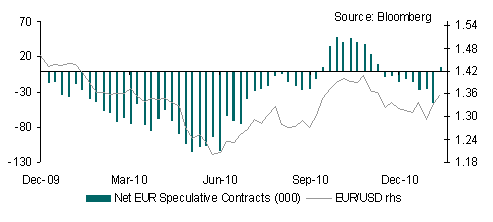
A big driver for EUR at present appears to be interest rate differentials. In the wake of recent commentary from Eurozone Central Bank (ECB) President Trichet following the last ECB meeting there has been a sharp move in interest rate differentials between the US and eurozone. This week’s European data releases are unlikely to reverse this move, with firm readings from the flash eurozone country purchasing managers indices (PMI) today and January eurozone economic sentiment gauges expected.

Two big events will dictate US market activity alongside more Q4 earnings reports. President Obama’s State of The Union address is likely to pay particular attention on the US budget outlook. Although the recent fiscal agreement to extend the Bush era tax cuts is positive for the path of the economy this year the lack of a medium to long term solution to an expanding budget deficit could come back to haunt the USD and US bonds.

The Fed FOMC meeting on Wednesday will likely keep markets treading water over the early part of the week. The Fed will maintain its commitment to its $600 billion asset purchase program. Although there is plenty of debate about the effectiveness of QE2 the program is set to be fully implemented by the end of Q2 2011. The FOMC statement will likely note some improvement in the economy whilst retaining a cautious tone. Markets will also be able to gauge the effects of the rotation of FOMC members, with new member Plosser possibly another dissenter.

These events will likely overshadow US data releases including Q4 real GDP, Jan consumer confidence, new home sales, and durable goods orders. GDP is likely to have accelerated in Q4, confidence is set to have improved, but at a low level, housing market activity will remain burdened by high inventories and durable goods orders will be boosted by transport orders. Overall, the encouraging tone of US data will likely continue but markets will also keep one eye on earnings. Unfortunately for the USD, firm US data are being overshadowed by rising inflation concerns elsewhere.

Against the background of intensifying inflation tensions several rate decisions this week will be of interest including the RBNZ in New Zealand, Norges Bank in Norway and the Bank of Japan. All three are likely to keep policy rates on hold. There will also be plenty of attention on the Bank of England (BoE) MPC minutes to determine their reaction to rising inflation pressures, with a slightly more hawkish voting pattern likely as MPC member Posen could have dropped his call for more quantitative easing (QE). There will also be more clues to RBA policy, with the release of Q4 inflation data tomorrow.

Both the EUR and GBP have benefitted from a widening in interest rate futures differentials. In contrast USD sentiment has clearly deteriorated over recent weeks as highlighted in the shift in IMM positioning, with net short positions increasing sharply. It is difficult to see this trend reversing over the short-term, especially as the Fed will likely maintain its dovish stance at its FOMC meeting this week. This suggests that the USD will remain on the back foot.

EUR/USD takes a crack at 1.50, where now?

It seemed inevitable and finally after flirting with the 1.50 level, EUR/USD managed to break through although there seems to be little momentum in the move, with the currency pair dipping back below 1.50 in the Asian trading session. Contrary to expectations the break above 1.50 did not lead to a sharp stop loss driven move higher. 

Even the break through 1.50 only provoked a limited reaction in the FX options market where implied EUR/USD volatility only moved slightly higher. In fact despite the warnings by ECB President Trichet about “excessive currency volatility” FX options volatility for most currency pairs has been on a downward trajectory over the past few months, implying that the move in EUR/USD and the USD itself has been quite orderly. 

Trichet’s warning is more likely a veiled threat on the level of EUR/USD rather than its volatility, unless of course the ECB chief is seeing something that the FX options market is not. Assuming that EUR/USD closes above 1.50 this week it technically has plenty of open ground on the run up to the record high of 1.6038 hit in July 2008 but there will also be plenty of official resistance to limit its appreciation. Such resistance is limited to rhetoric but it will not be long before markets begin discussing the prospects of actual FX intervention.  

Perhaps the reason that EUR/USD did not move sharply higher following the break of 1.50 was the late sell off in US stocks on Wednesday which helped to fuel some USD short covering.  The USD index is holding just above the 75.00 level but it’s not a big stretch from here to move down to the March 2008 low around 70.698, with the overall tone of broad USD weakness remaining intact and ongoing. 

GBP was helped by relief that the minutes of the BoE meeting showed no inclination to increase the level of quantitative easing despite the ongoing debate within the MPC.   The minutes even sounded slightly upbeat about economic prospects. GBP/USD hit a high of 1.6638 in the wake of these developments due in large part to more short covering whilst EUR/GBP briefly dipped below 0.90.  GBP/USD may find it tough going to make much headway above 1.66 as has been the case over recent months, with strong resistance seen around 1.6661.

Contrasting fortunes for GBP and JPY

The main FX movers over recent days have been JPY and GBP. Japan’s non interventionist FX stance and the approach of fiscal half year end on September 30 have given markets plenty of appetite to push the JPY higher.  In particular a change in Japanese tax rules which waives taxes on repatriated profits suggests there will be more repatriation flows than usual ahead of fiscal half year end.  Such repatriation flows have played a role in the appreciation of the JPY.    

Even if such flows do not actually materialise the mere speculation that they exist will be sufficient to keep the JPY supported.  Helping the JPY on its way is the view that Japanese officials are not particularly concerned about a strengthening JPY although it is worth noting that Japan’s new finance minister Fujii did note that he was carefully watching the JPY’s rise.  Nonetheless, it appears that the new government’s policy in Japan is in sharp contrast to the previous government’s FX policy which favoured a weaker JPY.  

The positive shift in JPY sentiment over recent weeks has been particularly evident in speculative positioning data which reveals that net JPY speculative positions have hit their highest since 3 February 2009, a sharp turnaround from negative net positioning just three months ago.  Further JPY gains are likely over the short term as speculative appetite for the currency continues to improve. 

In contrast to Japan, UK officials appear to be more comfortable with a weaker currency. Recent comments by Bank of England (BoE) Governor King that a weaker GBP would help exporters has weighed on GBP.  Consequently, speculative sentiment for GBP deteriorated particularly sharply last week, with CFTC IMM data revealing the biggest short GBP positioning since early April 2009.  Even though the latest UK Monetary Policy Committee minutes revealed no sign that the BoE is contemplating expanding quantitative easing, GBP continues to be a much unloved currency.  

Some likely improvements in economic data this week may provide relief to GBP but it will prove limited against the weight of negative GBP sentiment.  The Hometrack housing survey revealed a further increase in UK house prices in September and data this week will likely reveal an upside revision to Q2 GDP, and an improvement in manufacturing confidence.  Overall, despite the encouraging data GBP/USD looks vulnerable to a further downside push.

Key events for FX markets this week

Key events this week include the Fed FOMC and G20 meetings .  The G20 meeting is likely to be a non-event as far as markets are concerned.  There will be plenty of discussion about co-ordinating exit strategies but officials are set to repeat the commitment to maintain stimulus policies until recovery proves sustainable.  

There is likely to be little emphasis on currencies despite the fact that the dollar is trading around its lowest level in a year, except perhaps at the fringes of the meeting, with focus in particular on Japan’s new government’s pro yen policy.  

Regulation will also figure high amongst the topics debated but this will have little impact on markets over the short term.  Another topic that could be debated is protectionism, especially in light of the US decision to impose tariffs on Chinese tyres.

Ahead of the G20 meeting the Fed FOMC meeting is unlikely to result in any change in interest rates but the statement is likely to be cautiously upbeat in line with Fed Chairman Bernanke’s recent comments that the recession is “very likely over”.  The statement will be scrutinised for clues to the timing of policy reversal, especially given recent speculation that a couple of FOMC members were advocating an early exit.  Given that the dollar has suffered due to its funding currency appeal, any hint that some Fed officials are turning more hawkish could give the currency some much needed relief but we doubt this will last long. 

In contrast to speculation of a hawkish shift in thinking by some Fed members the Bank of England appears to be moving in the opposite direction.  The MPC minutes on Wednesday will be viewed to determine just how close the BoE was to extending quantitative easing and reducing interest rates on bank reserves at its last meeting. 

Sterling (GBP) has been a clear underperformer over recent weeks and a dovish tint to the minutes will act as another factor weighing on the currency as speculation over further action intensifies ahead of the next meeting.  

Sterling is also struggling against the euro having hit a five month low.  A combination of factors have hit the currency including concerns about quantitative easing expansion, the health of the banking system, and the latest blow coming from a the Bank of England in its Quarterly Bulletin where it states that GBP’s long run sustainable exchange rate may have fallen due to the financial crisis.   

Against this background it is not surprising that sterling was the only major currency against in which speculative positioning actually deteriorated versus the dollar last week (according to the latest CFTC Commitment of Traders report).   It is difficult to see any sterling recovery over the short term against this background, with a re-test of the 9 July low just under GBP/USD 1.60 in focus.

A set back for the pound

The multi week rally in the pound (GBP) has hit a snag as the currency has failed to extend gains above its recent highs around 1.66 against the dollar (USD).  The surprising fall in UK retail sales, with sales dropping by 0.6% from April compared to expectations of a 0.3% increase, dealt GBP another blow.   Sales were down 1.6% from a year earlier.  This is bad news for those that had believed that the UK consumer was enduring the economic downturn with some resilience. 

The reality is that the recovery in the economy will be a bumpy ride.  Whilst there have been some signs of improvement in the economy it is by no means a broad based pattern.  I would warn at getting too carried away with recovery expectations.  There have been clear signs of strengthening in both manufacturing and service sector survey data but they still only point to a gradual recovery in the months ahead. 

Moreover, some UK housing market indicators have pointed to early signs of recovery but a lot of this is due to a lack of supply and at best the housing market is entering a period of stabilisation.   Despite the signs of economic stabilisation the British Chamber of Commerce (BCC) cut its forecasts for the UK economy to -3.8% this year compared to a previous forecast of -2.8%.  

Meanwhile, UK banks continue to restrain credit and may even need more equity capital on top of the $158 billion in capital already raised according to Bank of England governor Mervyn King in his Mansion House speech.  He also warned about a “protracted” economic recovery. The good news is that the BoE is in no rush to take back its aggressive monetary easing and £125 billion asset purchase plan, but unless banks pass the benefits of this onto borrowers the fledgling recovery could stall quite quickly.   

The desire not to act quickly to reverse monetary policy was echoed in the minutes of the June BoE meeting, which revealed a unanimous 9-0 vote to maintain the status quo on policy.  The minutes also noted that the near term risks to the economy had lessened but monetary policy committee members remained cautious about the medium term prospects.  It is likely that the BoE will take several more months to gauge how successful policy has been. 

All of this highlights that GBP will be vulnerable to periodic bouts of profit taking and reversal.  Its ascent from its lows against the USD below 1.40 has been dramatic and rapid.  I believe that much of its gain has been justified especially as it had fallen to extreme levels of undervaluation.  Moreover, aggressive policy actions, both on fiscal and monetary policy, suggest that UK economic recovery will come quicker than Europe. This implies that GBP will at the least continue to recover against the euro (EUR) despite the weak retail sales induced set back.   

I also look for GBP to extend gains against the USD over coming months, with GBP/USD likely to end the year in the 1.70-1.80 region rather than low 1.60s where it is now. Market positioning leaves plenty of scope for GBP short covering over coming weeks adding further potential for recovery.  GBP appreciation will not continue in a straight line however, but set backs going forward should be looked upon as providing opportunities to rebuild long positions.