ECB In Focus

The highlight today is the European Central Bank (ECB) council meeting. Markets have priced in a hawkish stance from the ECB; Euro rates have edged higher whilst EUR/USD has strengthened. The ECB is likely to highlight worries about price developments today paving way for a hike in H2 2011. Watch for any shift in the balance of risks statement in the press conference and upward revisions to inflation and growth forecasts. In terms of liquidity operations the full allotment procedures at the Main Refinancing Operations (MRO) are likely to be extended for another three months.

EUR risks are asymmetric and whilst the currency remains a buy on dips (with technical indicators pointing to a move to 1.4000) the bigger risk is if the ECB does not live up to the hawkish market expectations which could hit EUR given long positioning overhang. Other than this, risk aversion remains elevated according to my barometer, supporting JPY and CHF. US numbers remain upbeat as seen in the ADP private sector jobs report yesterday, which will likely lead to an upward revision to non-farm payrolls forecasts in February (currency consensus 195k). However, the USD impact of positive data is limited against the background of a relatively dovish Fed stance.

Risk aversion spikes

Increased risk aversion overnight in the wake of escalating Middle East tensions gave the USD some support but overall the USD index is gradually drifting towards its early November low around 75.631. The antithesis of USD weakness is strength in most other major currencies.

The USD is being undermined by relatively dovish expectations for US interest rates relative to elsewhere and last night’s semi annual testimony by Fed Chairman Bernanke to the US Senate did nothing to alter this tone, with Bernanke maintaining the emphasis on subdued inflation and elevated unemployment.

The USD index itself has a high (0.82) 3-month correlation with US interest rate futures and over recent weeks as the implied yield has dropped, the USD has lost ground. The prospects of higher US bond yields may eventually provide the USD with support, especially given the prospect of substantial short-covering but in the near term the USD is likely to remain under pressure.

The upbeat run of US data highlights another source of USD support over the medium term, given the likely outperformance of the US economy over coming months. Yesterday’s ISM manufacturing survey and vehicle sales data lend support to this view. Moreover, the rise in employment component of the ISM supports the view of at least a 195k increase in February payrolls.

The Fed’s Beige Book tonight and February ADP jobs report will not alter the USD’s trajectory. The Beige Book is unlikely to reveal anything to worry the Fed in terms of inflation risks although will probably reveal further signs of improved activity. The ADP report will give important clues for Friday’s February non-farm payrolls data although it’s worth noting that last month’s report was way off the mark. In any case neither release is likely to prevent a further drop in the USD.

EUR is a clear beneficiary of expectations of tighter monetary policy by the ECB and the widening interest rate (futures implied yield) differential between the US and eurozone has given the EUR plenty of support recently as reflected in the high correlation with EUR/USD. Further support to the hawkish market stance was given by the upward revision to eurozone 2011 growth and inflation forecasts by the EU. The fact that eurozone inflation increased to 2.4% YoY in February also reinforced expectations of ECB tightening sooner than later.

The ECB press conference following the council meeting tomorrow will likely shape such expectations further, the EUR has already priced in a hawkish ECB stance, limiting the prospects of further appreciation. Notably EUR/USD has failed to break resistance at its year high around 1.3861, which will prove to be a formidable cap in the short-term.

In contrast, the RBA has poured cold water over expectations of further policy rate hikes in Australia. The policy statement following yesterday’s decision to keep the cash rate on hold pointed to an extended pause in the months ahead. Despite this and perhaps because markets have already pared back Australian interest rate expectations AUD rebounded quite smartly from its post meeting low and despite some overnight weakness due to increased risk aversion it will soon verge on a break of resistance at 1.0257.

AUD/NZD has continued to charge ahead having hit a multi-year high above 1.3600. NZD underperformance has been exacerbated by the impact of the recent earthquake, with growth expectations for this year having been sharply revised lower and growing speculation of an interest rate cut. Indeed, such speculation was given further fuel by comments by NZ Prime Minister Key who noted he would welcome a policy rate cut. Nonetheless, my quantitative AUD/NZD model suggests that the cross looks over-extended at current levels, whilst relative speculative positioning supports this view.

Global Themes

It’s definitely been a strange start to the year, with markets taking plenty of time to get their bearings. Some general themes have developed but none have provided clear direction. As a result, the path over coming weeks and months is likely to remain highly volatile and in this respect, currencies, equities and bonds will continue to see strong gyrations.

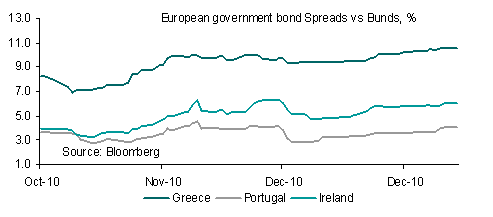
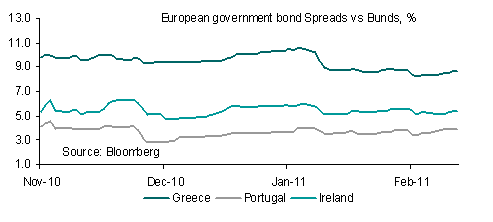
One theme that has been evident since the start of the year is an improvement in sentiment towards the eurozone periphery as hopes of an enlargement/extension of the European Union bailout fund (EFSF) have increased. This is a key reason why the EUR has strengthened this year although nervousness on this front appears to have returned over recent days (note the recent widening in peripheral bond spreads, drop in EUR and European Central Bank purchases of Portuguese debt). It seems that a lot of good news has already been discounted in relation to the eurozone periphery and now markets are in wait and see mode for the EU Council meeting on 24/25 March. There is a strong chance that eventually market expectations will prove overly optimistic and the EUR will drop but more on that later.
The second theme is global inflation concerns, driven by higher food and energy prices. Certainly this has had an impact on interest rate expectations and in some cases resulted in a hawkish shift in central bank language, notably in the eurozone and UK. Although European Central Bank (ECB) President Trichet has toned down his comments on tighter monetary policy compared to the more hawkish rhetoric following the last ECB council meeting, expectations for monetary tightening in the eurozone still look overly hawkish, with a policy rate hike currently being priced in for August/September this year, which looks way too early. The EUR has benefitted from the relative tightening in eurozone interest rate expectations compare to the US but will suffer if and when such expectations are wound down.

Elsewhere in many emerging markets the impact of higher food prices is finding its way even more quickly into higher inflation, forcing central banks to tighten policy. In Asia, the urgency for higher rates is even more significant given that real interest rates (taking into account inflation) are negative in many countries. China has accelerated the pace of its rate hikes over recent months and looks set to continue to tighten policy much further to combat inflation. In India, worries about inflation and the need for further monetary tightening have clearly weighed on equity markets, with more pain to come. Although not the sole cause by any means, in the Middle East and Africa higher food prices are feeding social tensions such as in Egypt.

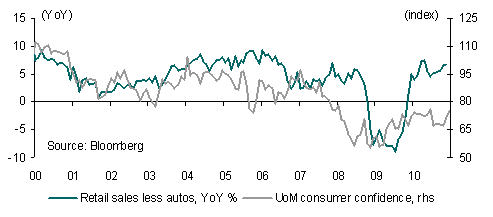
Another clear theme that has developed is the improvement in US economic conditions. The run of US data over recent months has been encouraging, confirming that the economy is gaining momentum. Even the disappointing January non-farm payrolls report has not dashed hopes of recovery, with many other job market indicators pointing to strengthening job conditions such as the declining trend in weekly US jobless claims. Manufacturing, business and consumer confidence measures have strengthened whilst credit conditions are easing, albeit gradually. The US economy is set to outperform many other major economies this year, especially the eurozone, which will be beset with a diverging growth outlook between northern and southern Europe.

Although the US dollar has not yet benefitted from stronger US growth given the still dovish tone of the Fed and ongoing asset purchases in the form of quantitative easing, the rise in US bond yields relative to other countries, will likely propel the dollar higher over 2011 after a rocky start over Q1 2011. In contrast, the EUR at current levels looks too strong and as noted above, hopes of a resolution of eurozone peripheral problems look overdone. EUR/USD levels above 1.3500 provide attractive levels to short the currency. Other growth currencies that will likely continue to do well are commodity currencies such as AUD, NZD and CAD, whilst the outlook for Asian currencies remains positive even despite recent large scale capital outflows. The JPY however, will be one currency that suffers from an adverse yield differential with the US as US bond yields rise relative to Japan.

Econometer.org has been nominated in FXstreet.com’s Forex Best Awards 2011 in the “Best Fundamental Analysis” category. The survey is available at http://www.surveymonkey.com/s/fx_awards_2011

Euro Problems Intensify

Following the bullish build up and increasingly lofty expectations for the US December jobs report the actual outcome was disappointing, at least on the headline reading. Non farm payrolls rose 103k which in reality was not that much less than initial forecasts but the real consensus was somewhat higher following the robust ADP private sector jobs report earlier in the week. There was some mitigation in the 70k upward revisions to October and November and surprisingly large decline in the unemployment rate to 9.4%. Consequently the market impact was less severe than it could have been and even the USD ended higher on the day.

Nonetheless, the data provided a dose of reality to markets’ optimistic expectations and this was reinforced by Fed Chairman Bernanke in testimony on Friday. He highlighted that it will take “considerable time” before the unemployment rate drops to a normal level, which could threaten recovery. Even the drop in the unemployment rate revealed in the December is report is vulnerable to a reversal given it was in part due to a drop in the labour force. This reality provided support to bond markets which may undermine the USD given the drop in bond yields. However, the USD’s anti-EUR credentials suggest that it will remain resilient.

Eurozone’s woes continued to heat up last week as the holiday season relief proved temporary. Stress in peripheral debt markets increased despite buying from the ECB last week and faced with debt sales in Italy, Portugal and Spain this week the pressure is likely to continue over coming days. Whether its worries about a resolution to funding issues and investor haircuts and/or the growing divergence in growth across the eurozone, the EUR continues to look vulnerable in the absence of any resolution to these issues. Having easily slipped below its 200-day moving average EUR/USD will eye support around 1.2767.

US data this week will look upbeat and provide more support for the USD, with December retail sales likely to record a healthy increase both on the headline and ex-autos readings as indicated by strong holiday sales. Similarly industrial production will reveal a solid gain whilst the Beige Book will highlight that economic conditions across the Federal Reserve districts, have continued to improve. The weak spot will remain housing but despite this consumer spending and sentiment are likely to be reported as resilient. The Beige Book is unlikely to reveal much of an inflation threat despite higher commodity prices. This will be echoed in the core CPI reading this week.

Although headline inflation in the eurozone breached the 2.0% threshold in December the ECB is unlikely to use it as an excuse to move towards tighter monetary conditions any time soon. The ECB meeting this week will nonetheless likely note the increase in various inflation gauges in President Trichet’s press statement. Most attention will be focused on any comments that Trichet makes regarding peripheral bond strains. In reality there is little that he can say that will alter market sentiment. Whilst an ongoing commitment to buy debt will help on the margin it will do little to stem the growing tide of negative sentiment towards eurozone assets.

Upside risks to US payrolls

An encouraging run of US data releases over recent weeks became even more solid overnight. In particular the December ADP private sector jobs report revealed a whopping 297k increase, its highest ever reading. Although the outsized gain may be attributable to distortions such as seasonal factors it will lead many to scramble to revise higher estimates for non-farm payrolls to around 200k+ (consensus currently is 150k). Similarly the December ISM non-manufacturing survey came in higher than expected at 57.1, its highest reading since May 2006. Notably the employment component softened in contrast to the ADP data.

Whilst the US outlook appears to be improving the eurozone picture is looking decidedly shaky. Peripheral bonds remain under pressure as reflected in the renewed widening in German-Greek spreads whilst Portugal’s sale of 6m bills revealed good demand but at a much higher yield (3.69% vs. 2.05% in September). Press reports that the Swiss National Bank has stopped accepting Irish government debt as collateral didn’t help matters whilst talk of conditions attached to any Chinese support for eurozone countries also weighed on sentiment.

Adding to concerns is the ongoing political impasse in Belgium where 7 months after elections there has yet to be a new government formed. The risk of a downgrade to the country’s credit ratings is high especially given the lack of progress on deficit reduction. Meanwhile on the data front the Eurozone service sector PMI was stronger than forecast in December at 54.2 but the country breakdown revealed more divergence in economic conditions. This was echoed in the manufacturing PMI. Divergence in growth is likely to widen further this year and whilst the strength of Germany may prevent a sharp slowing in overall growth in the eurozone, growing divergence will make the job of the ECB difficult.

The net result of firmer US data is a broadly stronger USD and higher Treasury yields. The EUR in contrast looks as though it is on the verge of a sharper decline below 1.3000, with technical support seen around 1.2969 whilst the JPY could see further weakness given the move in relative US/Japan bond yields. There will be little direction today from data with just Eurozone sentiment gauges and retail sales tap whilst in the US jobless claims will be in focus. However, there will probably be little movement ahead of the US jobs report tomorrow.