GBP rebounds, RBNZ warns about NZD strength

The Fed unsurprisingly left policy on hold while lowering projections for unemployment and raising forecasts for higher near term inflation. The economy is still expected to grow at a ‘moderate’ pace in coming quarters, with the majority of FOMC members anticipating the first tightening in 2014 or beyond. The one sop to markets was the fact that the Fed is prepared to do more in terms of policy enhancement if needed. This helped to buoy risk assets overnight leaving the USD on the back foot. Data releases are thin on the ground today leaving markets to consolidate gains in a relatively ‘risk on’ environment.

GBP came tumbling down from its highs following news that the UK economy entered a technical recession after GDP surprisingly contracted by 0.2% in Q1. However, the drop was short lived, with GBP/USD recovering from its losses, helped by a stellar reading for UK Nationwide consumer confidence in March. Notably however, Nationwide cautioned that the bounce in confidence could be short lived and we would be cautious of reading too much into the data. GBP gains against the EUR look as though they have reached its limit, and our models suggest that EUR/GBP is trading close to short term ‘fair value’.

There was no change in policy from the RBNZ as expected, with policy rates on hold at 2.5%. However, governor Bollard did attempt to talk the NZD lower while highlighting concerns about the global outlook. Concerns about kiwi strength will raise the spectre of FX intervention although it may also mean a delay in rate hikes. The statement was relatively more positive on the domestic outlook. Although rates are ‘appropriate’ according to the RBNZ we still think there is a good chance of a rate hike in Q3. The NZD ignored Bollard’s comments, firming on the back of improved risk appetite. We still see downside risks to the currency, especially as the current risk environment remains fragile.
Euro decline limited, AUD under pressure

EUR looks like it’s going nowhere fast, with the currency failing to break above 1.33 versus the USD. Nonetheless any drop will be limited as there will be plenty of support for EUR/USD around the 1.30 level. Such support may be required following the disappointing reading for the Eurozone March flash purchasing managers index (PMI) and renewed growth worries even in Germany.

Moreover, there have been plenty of scare stories about ongoing problems in the Eurozone, centring on Portugal and Spain and even speculation of a third Greek bailout being needed at some point.

However, the reality is that the market has reduced its attention on Eurozone debt issues for the time being. Once the latest bout of risk aversion passes, this ought to allowing the EUR some room to push higher, with my short term models highlighting the scope for EUR/USD to edge back towards 1.35 over coming weeks.

AUD has been pummelled this week, alongside its neighbour NZD. Growth worries in China compounded by a weaker than expected March China PMI has piled on the pressure, especially on AUD where economic conditions are increasingly linked with China. My quantitative models highlight ongoing short term downside risks to both AUD and NZD.

However, declines in these currencies will provide better levels to eventually buy as I remain bullish in the medium term even though my valuation metrics reveal that both currencies remain overvalued. My view is built on the prediction that risk appetite will improve further this year, a boon to high beta currencies such as AUD and NZD. Additionally as yield gains importance and carry trades gain attraction AUD will look particularly attractive.

Euro pain, Australian and New Zealand dollars vulnerable

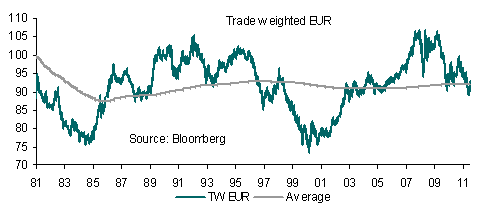
EUR appreciation has been painful for many, especially those looking for a turn in the currency over recent days. Unfortunately, for these investors, the EUR may yet strengthen further in the short term before any reversal is seen. Indeed, using valuations to justify a bearish view may not be a particularly strong argument at present given that the EUR trade weighted index is trading close to its historical average level while IMM data reveals that the speculative market remains significantly short EUR.

Additionally, my quantitative models reveal that the short term ‘fair value’ for EUR/USD is close to 1.40. While longer term fair value is undoubtedly much lower, it could take some time before the EUR declines to such levels. This is not encouraging news for EUR bears but there are some signs that the upmove in EUR/USD may not persist. Currently EUR/USD is trading above its 100-day moving average but since July last year, it has failed to remain above its 100 day moving average level for more than a few days.

There are definite signs that commodity currencies are topping out. Both the AUD and NZD have failed to extend gains over recent weeks. Perhaps valuation concerns are finally begging to catch up with these currencies (both are close to 2 standard deviations from average purchasing power parity while my quantitative models reveals a divergence with short term fair value) while speculative positioning according to IMM data remains at high levels. AUD and NZD even look stretched relative to interest rate differentials.

A wider than forecast January trade deficit in New Zealand did not bode well for the NZD but near term direction for both currencies will still depend on the gyrations in risk appetite given the strong correlation that both AUD and NZD have with risk aversion. Notably the the improvement in risk appetite has stalled in February, leaving AUD and NZD exposed to lofty valuations.

Risk currencies flying high

The first month of 2012 passed rather more positively than anticipated and clearly was a good month for risky assets. Even the beleaguered EUR strengthened despite calls for an extended decline. Assets that were most heavily sold over 2011 were the biggest winners over January. Further signs of improvement in US economic data, receding fears of a China growth crash and even signs of tentative progress in the Eurozone debt crisis mean that sentiment may have finally turned a corner. This has been reinforced by the Fed’s commitment to maintain accommodative monetary policy until the end of 2014 and the ECB’s long term LTRO. I’m not entirely convinced but it wouldn’t pay to buck market optimism just yet.

Interestingly currency markets aren’t necessarily behaving as one would expect. In particular the JPY and CHF, both safe haven currencies, have not weakened despite an improvement in risk appetite. In contrast they have actually strengthened. Other currencies are behaving much as would be expected, especially high beta (risk sensitive) currencies, including AUD, NZD and many emerging market currencies, which have rebounded. Even the EUR has jumped past the 1.30 mark against the USD. Even the slow progress in agreeing on the magnitude of Greek writedowns has failed to dent confidence, with Eurozone peripheral bond yields dropping. Risk / high beta currencies are set to remain well supported over the short term.

Looking ahead the outcome of the US January jobs report at the end of the week as well as a final agreement on Greek debt will help determine whether the positive sentiment for risk assets will be maintained into next week. Meanwhile the USD looks as though it will remain under pressure especially given the continued downward pressure on US bond yields, which only continues to reinforce its role as a funding currency. This explains why both the JPY and CHF have stubbornly refused to weaken as narrowing US versus Japanese and Swiss bond yield differentials have kept these currencies under upward pressure. However, risks of FX intervention by both the Japanese and Swiss authorities suggests that upside may be limited.

Australian and NZ Dollar Outperform

The boost to EUR following the dovish tone of the Fed FOMC statement on Wednesday has faded although the EUR looks well supported against the USD, JPY and GBP. Further gains against the USD will however, be limited to around 1.3201 (21 December 2011 high and 61.8% retracement from its 1.3553 high).

Reports overnight that Greek private lenders were willing to accept a coupon rate below 4% helped to boost confidence of an imminent deal with regard to Greek debt restructruing. Ahead of next week’s EU Summit the EUR will consolidate its gains, with attention focussing on a meeting between German Chancellor Merkel, Italian Prime Minister Monti, and French President Sarkozy on Monday.

USD/JPY has become insensitive to moves in most of its usual drivers. Bond yield differentials have lost influence over recent months despite a very strong relationship in the past. Similarly USD/JPY is also not particularly sensitive to moves in the USD index or risk aversion, with these relationships also breaking down lately according to my correlation calculations. Net foreign portfolio flows should in theory be playing negative for the JPY with outflows from bond and equity flows recorded in 8 of the last 10 weeks.

However, the reality is that USD/JPY remains stubbornly entrenched in a narrow 77-78 range. While a base appears to have been formed around the 77.00 level the upside momentum for the currency pair is weak. I stand by my view of USD/JPY ending the quarter around current levels given the loss of influence of its usual drivers but still look for an eventual move higher.

AUD and NZD have performed extremely well over recent weeks recording the biggest gains among major currencies so far this year. Both currencies have been boosted by improving risk appetite and receding growth worries in China. AUD in particular looks attractive in the wake of the dovish Fed and relative high AUD yield. I continue to believe markets are too dovish on Australian policy rate expectations, with markets pricing in more rate cuts this year beginning in February. Any reversal in easing expectations will support AUD.

AUD is also benefiting from diversification flows, with Russia’s central bank noting that it may begin to buy AUD in February. Nonetheless, AUD/USD gains look overly aggressive in a short space of time, with positioning turning increasingly long. AUD/USD will face strong resistance around 1.0753 over coming days.