FX sensitivity to yield

It’s all about yield. The back up in US bond yields in reaction to the US tax compromise from the Obama administration has been particularly sharp. US 10 year bond yields jumped around 35bps this week prior to a small correction in yields overnight whilst 2s were up 21bps. US bond yields are now back where they were in June, a fact that makes a mockery out of the Fed’s attempts to drive bond yields lower via quantitative easing (QE). Yields elsewhere increased too but by a smaller degree whilst equity market sentiment has been dampened by the rise in global yields although US stocks still ended higher overnight.

There is plenty of commentary discussing the impact on currencies of the move in bond yields so it’s worth looking in more detail how sensitive FX markets have been to yield. The most sensitive currencies i.e. those with the highest 3-month correlations with relative bond yield differentials (2 year) are the AUD/USD, EUR/USD, and of course USD/JPY. However, there is less sensitivity to gyrations in 10 year yields with no currency pair registering a statistically significant correlation with 10-year bond yield differentials over the past 3-months.

Assuming that US bond yields continue to push higher into 2011, with much lager increases in both nominal and yields expected, this means that AUD, EUR and JPY will face the most pressure relative to the USD. Moreover, the stimulus measures agreed by the US administration will likely lead to many analysts penciling in higher growth forecasts over 2011 whilst reducing the prospects of QE3 from taking place, all of which is USD positive. I still retain a degree of caution in Q1 2011, especially with regard to a potential bounce in EUR, especially if the ECB becomes more aggressive in its bond buying, but even so, any EUR rally is likely to prove termporary.

The impact of higher US yields on the AUD may be more limited however, despite the high correlation with relative bond yields, as Australian bond yields are also likely to rise somewhat given the resilience of its economy. This was clearly demonstrated by Australian November employment data released overnight revealing yet another consensus beating outcome of +54.6k, with all the gains coming from full time employment. Against the background of a generally firm USD, the best way to play AUD resilience is via the NZD, with the currency pair likely break through resistance around 1.3220 (21 October high).
Unloved US Dollar

The USD index is now at its lowest level since May 3 and is showing little sign of turning around. The bulk of USD index weakness overnight came via the EUR and GBP, both of which rose sharply against the USD, with EUR/USD breaching its 90 day moving, hitting a high of 1.2955 and GBP/USD on its way to testing its 200 day moving average, reaching a high of 1.5472. Commodity currencies fared far less positively, perhaps feeling the after effects of the weaker Chinese data this week, with the NZD also dented by weaker than expected inflation data in Q2.

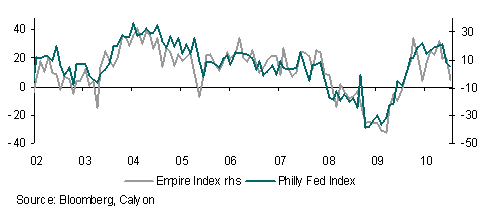
The USD was once again hit by US growth worries. To recap, the US data slate revealed a soft reading for PPI, whilst the July Empire manufacturing index dropped 14.5 points, a far bigger drop than forecast. The Philly Fed index also dropped further in July despite expectations of a small gain. In contrast, June industrial production edged higher, but manufacturing output actually fell. There was a bit of good news in the fact that weekly jobless claims fell more than forecast.

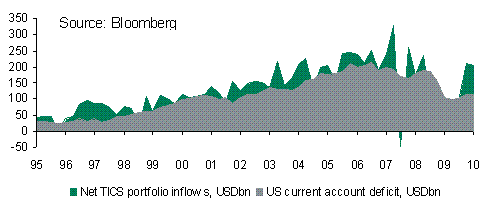
The releases extended the run of weak US data, keeping double-dip fears very much alive. The data have acted to validate the Fed’s cautious growth outlook expressed in the latest FOMC minutes but a double-dip is unlikely. Today’s releases include June CPI, May TIC securities flows, and July Michigan confidence. Another benign inflation report is expected. Consumer confidence is set to slip further against the background of soft data and volatility in equity markets whilst TICS data is forecast to reveal that long term securities flows declined in May compared to the $83 billion inflows registered in April.

The move in the EUR is a making a mockery out of forecasts including my own that had expected renewed downside. The relatively successful Spanish bond auction yesterday helped to ease eurozone sovereign debt concerns further, with a likely strong element of Asian participation. I have still not given up on my EUR negative view given the likelihood of a deteriorating economic outlook in the eurozone and outperfomance of the US economy, but over the short-term the EUR short squeeze may have further to go, with EUR/USD resistance seen at 1.3077.

Equity markets were saved from too much of a beating following the release of better than expected earnings from JP Morgan, a $550mn agreement between Goldman Sachs and the SEC to settle a regulatory case, and news from BP that it has temporarily stemmed the flow of oil from the leak from its Gulf well. Agreement on the US financial reform bill, passed by the Senate yesterday and likely to be signed into law by US President Obama next week, likely helped too.

The tone of the market is likely to be mixed today, with US growth concerns casting a shadow on risk trades. Earnings remain in focus and the big name releases today include BoA, GE and Citigroup but early direction could be negative following news after the US close that Google Inc. profits came in below analysts’ expectations. Data in the US today is unlikely to help sentiment given expectations of more weak outcomes, leaving the USD vulnerable to further selling pressure.

Q2 Economic Review: Double-Dip Recession or Prolonged Recovery?

I was recently interviewed by Sital Ruparelia for his website dedicated to “Career & Talent Management Solutions“, on my views on my view on the Q2 Economic Review: Double-Dip Recession or Prolonged Recovery?

Sital is a regular guest on BBC Radio offering career advice and job search tips to listeners. Being a regular contributor and specialist for several leading on line resources including eFinancial Careers and Career Hub (voted number 1 blog by ‘HR World’), Sital’s career advice has also been featured in BusinessWeek online.

Please see below to read my article

Since we last discussed the economic outlook at the end of quarter 1, much has happened and unfortunately there has not been a great deal of positive news. I retained a cautiously optimistic outlook for economic recovery for the Q1 Economic Review: elections, recovery and underemployment discussion article, but highlighted that recovery would be a long and drawn-out process, with western economies underperforming Asian economies.

The obstacles to recovery discussed then continue to apply now, including consumers paying down debt, high unemployment, tight credit conditions and weak confidence.

Click here to read the rest…

PIIGS fears fuelling risk aversion

Risk aversion has come back with a vengeance over the last 10 days driven by a host of concerns that continue to damage market sentiment. As has been evident over the past year the USD and JPY remain the best currency plays against the background of rising risk aversion and both currencies look well supported.

Market concerns are not going away quickly but some of the fears plaguing markets have at least receded especially on the US political front, with Obama’s State of the Union address, Geithner’s testimony on AIG and Bernanke’s reappointment all passing without too much incident, at least from a market perspective. I still believe that market fears are overblown but it is clearly evident that the market is not in the mood to concur. More pain is likely in the weeks ahead.

Euro-sovereign spreads continue to suffer from the ongoing Greek saga whilst the other major fear remains further monetary tightening in China. Rumours that China is about to imminently revalue the CNY are also running rife. The bigger than expected hike in the reserve ratio in India reflects the fact that Asia is on a faster track to tighten policy than Western economies.

As regular readers probably noticed, my articles on econometer.org have been sporadic recently. This is due to the fact that I have been on the road for the last two weeks giving client seminars across several countries in Asia. Without giving too much away it is evident that pessimism is pervasive and most investors I polled are looking for a “W” or “double dip” profile for economic growth in the G7 economies over coming months. Hardly anyone looked for a “V”.

The other casualty emanating from Greece’s woes, as well as worries that other European PIIGS (Portugal, Italy, Ireland, Greece, Spain) face ratings downgrades, is the EUR. EUR/USD slipped below the psychologically important level of 1.40 this week and is showing no sign of turning around. Warnings by S&P ratings that Portugal faces challenges on the fiscal front show that these sovereign concerns will be with us for a long while yet.

After letting investors believe that the European Commission would offer no support for Greece, there appears to be a growing realization that Greece is not simply a local problem but a Euro wide problem, as noted by European Commission President Barroso. Whilst this may be good for Greek debt the path to recovery is still likely to be a massively painful one, and the EUR may gain little support from this news.

The UK has not escaped the clutches of ratings agencies and warnings by S&P that UK banks are no longer among the “most stable and low-risk” in the world highlights the headwinds faced by GBP at present. The weaker than expected out-turn for Q4 GDP (0.1%) highlights the fact that UK economic recovery is fragile, which in turn plays negatively for the banking sector. This news has put a break on GBP but there appears to be plenty of demand for GBP above 1.600 vs USD.

Optimism dissipates

Markets have been highly fickle so far this year. Optimism about strong recovery led by China – recall the fact that disappointment from the surprisingly weak US non-farm payrolls report in December was outweighed by strong Chinese trade data – has dissipated. Instead of rejoicing at China’s robust GDP report last week, which revealed a 10.7% rise in the fourth quarter of 2009, investors began to fret about whether China would have to move more aggressively to tighten monetary policy. Fuelling these fears was the release of Consumer price data which showed inflation rising above expectations to 1.9% YoY in China.

If such fears were not sufficient to hit risk appetite, US President Obama’s plan to limit the size and trading activities of financial institutions dealt another blow to financial stocks. The plan followed quickly after the Democrats lost the state of Massachusetts to the Republicans and managed to shake confidence in bank stocks whilst fuelling increased risk aversion. Meanwhile, rumblings about Greece continue to weigh on markets and Greek debt spreads continued to widen even as global bond markets rallied.

Following the US administration’s plans to restrict banks’ activities the fact that the rise in risk aversion was US led rather than broad based led to an eventual pull back in the dollar which helped EUR/USD to avoid a break below 1.40. Risk trades including the AUD came under pressure as risk appetite pulled back. A drop in commodity prices did not help. The AUD was also hit by news that Australia’s Henry Tax Review would look to tax miners in the country. As a result AUD/USD dropped below 0.90 though this level is likely to provide good buying levels for those wanted to take medium term AUD long positions. The one currency that did benefit was the JPY which managed to drop below sub 90 levels.

The aftermath of the “Volker Plan” will reverberate around markets this week keeping a lid on equity sentiment. Meanwhile Greece will be in the spotlight especially its bond syndication. A bad outcome could be the trigger for EUR/USD to sustain a move below 1.40 though it looks as though it may find a bottom around current levels, with strong support seen around 1.4029. The German IFO business survey for January will be important to provide some direction for EUR and could be a factor that weighs on the currency if as expected it reveals some loss of momentum in the economy.

Aside from the Fed the other G3 central bank to meet this week is the Bank of Japan but unless the Bank is seen to be serious about fighting deflation, USD/JPY may remain under downward pressure against the background of elevated risk aversion. Below 90.0 there does appear to be plenty of USD/JPY buyers however, suggesting that further upside for the JPY will be limited. USD/JPY will find strong support around 88.84.

Much will depend on the key events in the US this week including the Fed FOMC meeting and the President’s State of the Union speech. USD bulls will look for some indication that the US government is serious about cutting the burgeoning budget deficit. Also watch out for the confirmation vote on the renomination of Bernanke as Fed Chairman which could end up being close. There is a heavy slate of data to contend with including new and existing home sales, consumer confidence, durable goods orders, the first glance at Q4 GDP and Chicago PMI.