USD, EUR and JPY Outlook This Week

The USD lost more ground last week extending its drop from the early October. Interestingly its latest drop has occurred despite an uptick in risk aversion suggesting other factors are at work. Mixed US data and earnings have not given the USD much direction with a downbeat Beige Book counterbalanced by a firmer Philly Fed manufacturing survey and housing starts.

The data have not been sufficiently weak to fuel expectations of more Fed quantitative easing but some Fed officials including Yellen, Tarullo, Evans and Rosengren in indicating that further QE could be considered. The USD has therefore been somewhat undermined but will take its cue from data releases and events in Europe this week.

This data slate will be mixed but on balance will not support more Fed QE. In particular, Q3 Real GDP is expected to come in sharply higher than in Q2, with a 2.5% annual rate expected to be revealed. Other indicators will be less positive, with October consumer confidence set to slip further and remain at a recessionary level, while September durable goods orders will decline by around 1%.

Despite an expected increase in new home sales in September the overall picture of the US housing market will remain very weak. Overall, the USD may find some respite from the GDP report but the data will be seen as backward looking, with the jury still out on the issue of more quantitative easing.

The EUR struggled to make any headway last week amid a barrage of rumors about the outcome of Sunday’s EU Summit. In the event the summit failed to deliver concrete details although there appeared to be some progress in key areas. Attention will now turn to Wednesday’s summit but once again the risk of disappointment is high. EUR/USD will only extend gains if markets are satisfied at the result but this is by no means guaranteed.

Data releases will not be supportive for the EUR this week, with a further deterioration in ‘flash’ eurozone purchasing managers indices (PMIs) and European Commission confidence surveys expected in October but hopes of a concrete resolution at Wednesday’s EU Summit will keep the EUR/USD supported early in the week although it will find strong resistance around 1.3915.

The sensitivity of the JPY to risk aversion has actually fallen over the last three months while the influence of bond yield differentials also appears to have slipped. The fact that USD/JPY continues to remain in a very tight range with little inclination to break in either direction despite gyrations in risk and yield differentials almost appears if the currency pair has been pegged.
Obviously this is not the case but a break out of the current range does not look imminent.

Speculative JPY positioning has dropped over recent weeks while equity and bond flows have overall been negative but this has not been reflected in JPY weakness resulting in increased frustration by Japanese officials. We continue to look for the JPY to weaken over coming months but much will depend on a widening in US / Japan yield differentials and easing risk appetite as both will regain their hold on the currency. In the meantime, the currency will continue to offer little to get excited about.
Currencies At Pivotal Levels

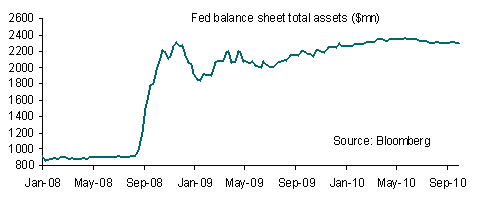
Ahead of today’s highly anticipated Fed FOMC meeting markets are holding their breath to determine exactly what the Fed will deliver. The consensus view is for the Fed to announce a programme of $500 billion in asset purchases spread over a period of 6-months. The reaction in currency markets will depend on the risks around this figure. Should the Fed deliver a bigger outcome, say in the region of $1 trillion or above, the US dollar will likely come under renewed pressure. However, a more cautious amount of asset purchases will be US dollar positive.

It has to be noted that the Fed will likely keep its options open and keep the program open ended depending on the evolution of economic data which it will use to calibrate its asset purchases. The USD will likely trade with a soft tone ahead of the Fed outcome, but with so much in the price, it may be wise to be wary of a sell on rumour, buy on fact outcome.

Whatever the outcome many currencies are at pivotal levels against the USD at present, with AUD/USD flirting around parity following yesterday’s surprise Australian rate hike, EUR/USD holding above 1.4000, GBP/USD resuming gains above 1.600 despite a knock back from weaker than forecast construction data, whilst USD/JPY continues to edge towards 80.00. Also, both AUD and CAD are trading close to parity with the USD. The Fed decision will be instrumental in determining whether the USD continues to remain on the weaker side of these important levels.

Going into the FOMC meeting the USD has remained under pressure especially against Asian currencies as noted by the renewed appreciation in the ADXY (a weighted index of Asian currencies) against the USD this week. Although it appears that the central banks in Asia have the green light to intervene at will following the recent G20 meeting the strength of capital inflows into the region is proving to be a growing headache for policy makers. One option is implementing measures to restrict “hot money” inflows but so far no central bank in the region has shown a willingness to implement measures that are deemed as particularly aggressive.

There has been some concern that Asia’s export momentum was beginning to fade as revealed in September exports and purchasing managers index (PMI) data in the region and this in turn could have acted as a disincentive to inflows of capital, resulting in renewed Asian currency weakness. The jury is still out on this front but its worth noting that Korean exports in October reversed a large part of the decline seen over previous months. Moreover, the export orders component of Korea’s PMI remained firm suggesting that exports will resume their recovery.

Nonetheless, manufacturing PMIs have registered some decline in October in much of Asia suggesting some loss of momentum, with weaker US and European growth likely to impact negatively. However, China’s robust PMI, suggests that this source of support for Asian trade will remain solid. Similarly a rise in India’s manufacturing PMI in October driven largely by domestic demand, highlights the resilience of its economy although with inflation peaking its unlikely that the Reserve Bank of India (RBI) will follow its rate hike on Tuesday with further tightening too quickly.