Another Day, Another Drop In The US Dollar.

The USD index is now close to breaching its November 2009 low around 74.17, with little sign of any turnaround in prospect. A surprise jump in weekly jobless claims to 412k (380k expected) did little to help the USD’s cause whilst higher commodity prices, and in particular energy prices played negatively.

Indeed, many USD crosses have experienced an increase in sensitivity to oil price movements over recent weeks, with the USD on the losing side when oil prices move higher. Commodity currencies including CAD and NOK are the key beneficiaries but EUR/USD is also highly correlated with the price of oil.

Various Fed comments overnight including supportive comments on the USD’s role as a reserve currency have done little to boost USD sentiment despite the generally hawkish slant to comments. A host of US data releases will keep markets busy.

The data are unlikely to deliver any strong surprises but given the growing FX attention on Fed policy, CPI data may take on more importance than usual. Our expectation of a trend like 0.2% increase in core CPI, which is unlikely to cause any consternation within the Fed, suggests that the USD will garner little support.

The ability of the EUR to withstand a torrent of bad news regarding the eurozone periphery is impressive. In particular, peripheral bond yields continue to rise especially Greek yields as expectations of debt restructuring grow. Comments from Germany’s finance minister have added to such expectations. News that the Bank of Spain approved the recapitalisation of 13 bank and that Spanish banks borrowed only EUR 44 billion last month, the lowest since Jan 2008, may have provided some relief.

However, given that markets are already relative hawkish about eurozone interest rates and given growing peripheral worries as well as overly long EUR market positioning, the upside for EUR/USD is looking increasingly restrained, with a break above technical support around 1.4580 likely to be difficult to achieve over the short-term.

AUD and NZD have registered stellar performances over recent weeks as yield attraction has come back to the fore and risk appetite has strengthened. The gains since their post Japan earthquake lows have been in the region of 7.3% and 10.5%, respectively for AUD and NZD.

The additional element of support, especially for AUD has come from central bank diversification, an increasingly important factor for both currencies. The gains in both currencies have been impressive and neither is showing signs of reversing but there are clear risks on the horizon.

One indication of such risks is the fact that market positioning is stretched especially in terms of AUD positioning, with CFTC IMM contracts registering an all time high. The move in AUD especially has been well in excess of what interest rate / yield differentials imply. Whilst I would not suggest entering into short AUD and NZD positions yet, the risks to the downside are clearly intensifying.
Beyond Expectations

Egypt worries continue to reverberate across markets, yet there appears to be growing resilience or at least some perspective being placed on problems there. Encouraging economic data, particularly in the US has helped to shield markets to some extent, with equity market rallying and US bond yields rising last week. The main impact of Egypt and worries about Middle East contagion continues to be felt on oil prices.

Even the mixed US January jobs report has failed to dent market sentiment; the smaller than expected 36k increase in payrolls was largely attributed to severe weather. A further surprising drop in the unemployment rate to 9.0% due mainly to a significant drop in the labor force was also well received by the market.

There will be less market moving releases on tap this week and the data are unlikely to dent recovery hopes. Michigan confidence is set to record an improvement in February whilst the December trade deficit is set to widen to around $41.0 billion. There are also plenty of Federal Reserve speakers this week including a testimony by Chairman Bernanke.

One central bank that has softened its hawkish rhetoric is the European Central Bank (ECB), with President Trichet dampening speculation of an early rate hike last week and alleviating some of the pressure on eurozone interest rate markets. Consequently the EUR fell as the interest rate differential with the USD became somewhat less attractive. The EUR was also undermined by the opposition from some member states to French and German ideas for greater fiscal policy coordination, an aim apparently not shared across euro members.

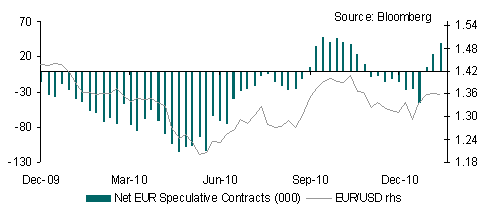
Data in Europe will be largely second tier. The EUR will look increasingly vulnerable to a further drop this week especially given the increase in net positioning over the past week to (1st February) according to the CFTC IMM data. The potential for position squaring looms large as positioning is now well above the three-month average. Stops are seen just below EUR/USD 1.3540.

In the UK the Bank of England policy meeting will take centre stage but there is unlikely to be any change in policy settings. Clues to policy thinking will be available in the monetary policy committee meeting minutes in two weeks times but it seems unlikely that any more members have joined the two voting for a hike at the last meeting.

Recent data have been a little more encouraging helping to wash off the disappointment of the surprise drop in Q4 GDP. The UK industrial production report is likely to be similarly firm on Thursday, with the annual pace accelerating. GBP/USD may however, struggle to make much headway against the background of a firmer USD and the weigh of long positioning, with GBP/USD 1.6279 seen as strong resistance.

There are plenty of releases in Australia this week to focus including the January employment data, consumer confidence, and a testimony by RBA governor Stevens in front of the House of Representatives on Friday. The data slate started off somewhat poorly this week, with December retail sales coming in softer than expected, up 0.2% MoM. AUD/USD is likely to be another currency that may struggle to sustain gains this week but much will depend on data over coming days. Resistance is seen around 1.0255.

On a final note, the weekend’s sporting events highlight how it’s not just economic data or moves in currencies that don’t always go as expected. After a solid run in the Ashes cricket England slumped to a 6-1 series loss to Australia in the one-day series, putting the Ashes win into distant memory. A similarly solid performance by Man United was dented with their unbeaten record broken by bottom of the table Wolves.

Econometer.org has been nominated in FXstreet.com’s Forex Best Awards 2011 in the “Best Fundamental Analysis” category. The survey is available at http://www.surveymonkey.com/s/fx_awards_2011

Your support in the survey is highly appreciated

Edging Towards A Bailout

A confluence of factors have come together to sour market sentiment although there appeared to be some relief, with a soft US inflation reading (core CPI now at 0.6% YoY) and plunge in US October housing starts reinforcing the view that the Fed will remain committed to carry out its full QE2 program, if not more.

However any market relief looks tenuous. Commodity prices remain weak, with the CRB commodities index down 7.4% in just over a week whilst the Baltic Dry Index (a pretty good forward indicator of activity and sentiment) continues to drop, down around 21% since its recent high on 27 October. Moreover, oil prices are also sharply lower. Increasingly the drop in risk assets is taking on the form of a rout and many who were looking for the rally to be sustained into year end are getting their fingers burnt.

Worries about eurozone peripheral countries debt problems remains the main cause of market angst, with plenty of attention on whether Ireland accepts a bailout rumoured to be up EUR 100 billion. Unfortunately Ireland’s reluctance to accept assistance has turned into a wider problem across the eurozone with debt in Portugal, Greece and also Spain suffering. An Irish bailout increasingly has the sense of inevitability about it. When it happens it may offer some short term relief to eurozone markets but Ireland will hardly be inspired by the fact that Greece’s bailout has had little sustainable impact on its debt markets.

Ireland remains the primary focus with discussions being enlarged to include the IMF a well as ECB and EU. What appears to be becoming clearer is that any agreement is likely to involve some form of bank restructuring, with the IMF likely to go over bank’s books during its visit. Irish banks have increasingly relied on ECB funding and a bailout would help reduce this reliance. Notably the UK which didn’t contribute to Greece’s aid package has said that it will back support for Ireland, a likely reaction to potential spillover to UK banks should the Irish situation spiral out of control. Any bailout will likely arrive quite quickly once agreed.

Although accepting a bailout may give Ireland some breathing room its and other peripheral county problems will be far from over. Uncertainties about the cost of recapitalising Ireland’s bank will remain whilst there remains no guarantee that the country’s budget on December 7 (or earlier if speculation proves correct) will be passed. Should Ireland agree to a bailout if may provide the EUR will some temporary relief but FX markets are likely to battle between attention on Fed QE2 and renewed concerns about the eurozone periphery, suggesting some volatile price action in the days and weeks ahead.

Reports of food price controls of and other measures to limit hot money inflows into China as well as prospects for further Chinese monetary tightening, are attacking sentiment from another angle. China’s markets have been hit hard over against the background of such worries, with the Shanghai Composite down around 10% over the past week whilst the impact is also being felt in many China sensitive markets across Asia as well as Australia. For instance the Hang Seng index is down around 7% since its 8 November high.