Greece throws a spanner in the works

Having already retraced around 50% of its losses from its high around 4 April to its low on 27 October the USD index is on a firm footing and looks set to extend gains. The USD is benefitting both from the EUR’s woes and receding expectations of more US quantitative easing in the wake of less negative US data releases.

Whether the USD is able to build on its gains will depend on the outcome of the Fed FOMC meeting, accompanying statement and press conference today. While there have been some noises from Fed officials about the prospects of more QE, the Fed is likely to keep policy settings unchanged, leaving the USD on the front foot.

Greece has thrown a spanner in the works by calling a national referendum on the European deal. The fact that this referendum may not take place until January will bring about a prolonged period of uncertainty and further downside risks for the EUR against the USD and on the crosses. As a result of the increased uncertainty from the referendum, growing doubts about various aspects of last week’s agreement as well as hesitation from emerging market investors to buy into any European investment vehicle, peripheral bond spreads blew out further, and the EUR dropped.

The immediate focus will be on emergency talks today between European leaders in Cannes where Greek Prime Minister Papandreou has been summoned at a time when his grip on power appears to be slipping ahead of a government confidence vote on Friday. EUR/USD looks set to slip to support around 1.3525.

The Swiss National Bank’s floor under EUR/CHF has held up well since it was implemented in early September. How well it can be sustained going forward is questionable especially given that risk aversion is intensifying once again. A weaker than forecast reading for the Swiss October manufacturing PMI yesterday falling further below the 50 boom / bust reading to 46.9 highlights the growing economic risks and consequent pressure to prevent the CHF from strengthening further. However, now that Japan has shown its teeth in the form of FX intervention the CHF may find itself once again as the target of safe haven flows.

Technical indicators revealed that GBP was overbought and its correction lower was well overdue. However, GBP looks in better shape than the EUR even in the wake of some mixed UK data yesterday. On a positive note, UK Q3 GDP surprised on the upside in line with our expectations coming in at 0.5% QoQ. However, the forward looking PMI manufacturing index dropped more than expected in October, down to 47.4 suggesting that UK economic momentum is waning quickly.

EUR/GBP looks set to test its 12 September low around 0.8259 but GBP/USD remains vulnerable to a further pull back against a resurgent USD. Overall, GBP’s resilience despite the implementation of more quantitative easing by the Bank of England has been impressive and I expect it to continue to benefit from its semi safe haven status
Euro fails too hold on to gains

Any improvement in sentiment following the USD liquidity support announcement by various central banks last week is already filtering away against the background of European Union (EU) officials’ failure to make any headway at the Ecofin meeting over the weekend, a delay in the approval of the next bailout tranche for Greece and ongoing collateral dispute between Greece and Finland. On top of all of this German Chancellor Merkel suffered a further setback in regional elections over the weekend.

Greece will remain in focus this week and markets will look for signs that the country is back on track on its austerity plans and its next loan tranche. Prime Minister Papandreou cancelled a trip to the US while the Greek cabinet are apparently deciding on new fiscal measures. Attention will turn to a teleconference today from the Greek Finance Minister with EU and IMF officials.

Speculative sentiment for the EUR has already soured further and according to the latest CFTC IMM report, positioning in EUR is at its lowest since the end of June 2010. EUR/USD will continue to look very vulnerable having already dropped sharply from a high of around 1.3899 in Asian morning trading as the bad weekend news hit the currency. EUR/USD will find some technical support just below 1.3500 this week but any upside is set to prove limited unless some concrete announcements are delivered relating to Greece over coming days.

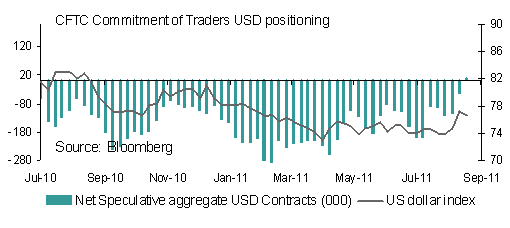
In contrast to the EUR, USD speculative appetite has turned net long for the first time since July 2010. The extended Fed FOMC meeting will help to dictate USD sentiment as markets wait for further measures to stimulate the economy. The Federal Reserve has already committed to hold rates steady until at least mid 2013 and the extended two day meeting this week will likely discuss further options. However, more quantitative easing (QE3) appears unlikely at this stage while an ‘Operation Twist’ type approach is more probable. The USD will benefit from a lack of further quantitative easing but this is largely already priced in.

Greek Decision Delayed

European Union Finance Ministers have agreed that additional funding for Greece will come from both official and private investors, with the later likely through a voluntary rollover of existing Greek debt as per the ‘Vienna Initiative’ of 2009 applied at the time to Emerging Europe. Agreement was reached following the decision by Germany to ease its demands for private sector participation in a debt restructuring. The news brought some relief to markets on Friday.

However, the announcement today that a final decision on a further tranche of aid and a second bailout package will not take place until early July will come as a blow to markets and likely lead to a more cautious start to this week. The onus is now on Greek Prime Minister Papandreou to gain approval for further austerity measures following the recent government cabinet reshuffle and in the face of a no confidence vote tomorrow. Failure to pass the confidence motion could provoke a political crisis, leading to likely contagion across Europe.

Europe has given the Greek government until the end of this month to implement measures including budget cuts and asset sales, with failure to pass further austerity measures likely to lead to a delay of any further aid. There will be plenty of noise surrounding Greece over coming days, with the issue likely to dominate the EU summit in Brussels on June 23-24. In the meantime the EUR/USD looks like it will settle into a range over the short-term, with support around the 100 day moving average of 1.4165.

EUR speculative positioning is currently around its 3-month average, with the market continuing to hold a sizeable long position in EUR/USD according to the CFTC IMM data. The risks remain skewed to the downside as nervousness about a Greek deal grows. Should the Greek Prime Minister pass a no confidence motion there will be some short term relief but tensions are likely to persist for a long while yet. Moreover, other eurozone countries are not in the clear yet as reflected by Moody’s announcement that Italy’s AA2 government bond rating is on review for possible downgrade.

Greece’s trials and tribulations

Two main influences on markets continue to weigh on sentiment. Firstly the trials and tribulations of the eurozone periphery remain centre of attention. The failure of Greek Prime Minister Papandreou to win cross party support for austerity measures at the end of last week highlights the problems Greece is facing both domestically and externally.

Reports that European officials are negotiating tough bailout conditions including major external intervention in terms of tax collection and privatisation suggest that gaining further aid will not be easy. The second weight on market sentiment is global growth concerns, with a string of disappointing data releases over recent weeks leading to an intensification of concerns about the pace of recovery.

Markets will likely remain nervous in this environment and it is difficult to see risk appetite improving to any major degree. This has proven bullish for bond markets, with the tone set to continue this week. Currencies remain in ranges and holidays today in the US and UK will likely result in thin trading. The resilience of the EUR to peripheral concerns has been impressive but at the same time Greek concerns will limit any gains. Meanwhile, gold and precious metals look to remain well supported, with gold’s safe haven bid remaining solid.

USD sentiment has improved sharply according to the latest CFTC IMM report which reveals that net USD short positions have been cut in half over the last two weeks with positioning well above the 3-month average. Conversely net EUR longs continue to shrink as speculative investors off load the currency. The fact that the EUR is not weaker than it is points to the influence of official demand for the currency, especially from Asia.

This week will likely be dominated by ongoing discussions about Greece and given the opposition to austerity measures and potentially strict bailout terms, forging an agreement will not be easy. Reports suggest that around half of Greece’s financing needs until the end of 2013 could be accounted for without new loans via privatisation and changes in terms for private bondholders, with Europe and the IMF needed to lend an additional EUR 30-35 billion on top of the EUR 110 already slated.

Data releases are likely to take a back seat but there will still be plenty of attention on the key release of the week, namely the May US jobs report. The market looks for a 185k increase in payrolls, with the unemployment rate edging lower to 8.9%. This would mark the lowest payrolls reading in 4 months. Clues to the jobs data will be garnered from the May ADP jobs report, ISM manufacturing survey and consumer confidence data earlier in the week.

US Dollar Ugly But Not Hideous

The USD has strengthened by around 5% since the beginning of the month. The move has been particularly sharp this week as higher risk aversion and intensifying fears about the eurozone periphery have given the currency a boost, albeit with the USD remaining one of the least ugly currencies amongst a fairly hideous bunch.

Eurozone country and overall ‘flash’ May purchasing managers indices (PMI) managed to further sour an already fragile mood yesterday, with the data revealing bigger than expected declines, albeit still at levels that are high in absolute terms. Data today is unlikely to result in any improvement in sentiment for eurozone assets, with the Germany IFO Business Climate index likely to slip, albeit from a relatively high level.

The EUR doesn’t need much of an excuse to sell off at present, with a softer IFO likely to provide further reason for investors to offload long positions in the currency. Against this background EUR/USD is likely to sustain a drop below the 1.4000 level, with the 100 day moving average level of 1.3972 likely to be breached shortly.

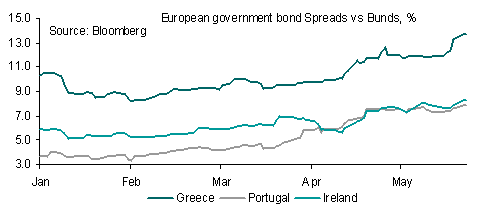
More importantly in terms of sentiment drivers the malaise in the eurozone periphery especially Greece remains the biggest risk for the EUR. As much as officials in Europe and Greece deny speculation of debt restructuring the market is far from convinced as reflected in the widening in peripheral debt spreads.

Greece’s Prime Minister Papandreou’s attempt to push through austerity measures in the Greek parliament yesterday by announcing accelerated asset sale plan and EUR 6 billion in budget cuts have done little to turn market sentiment despite the fact that at the least it shows a willingness to stick to the plan in the face of growing domestic resistance.

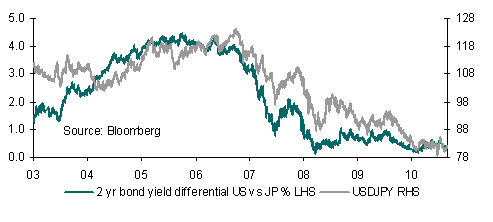
The USD has also edged higher against the JPY over recent days despite a rise in risk aversion. As revealed in the latest IMM data markets have been net long JPY over the past couple of weeks, with positioning well above the 3-month average, suggesting some scope for a liquidation of long positions. Nonetheless, the rise in USD/JPY has occurred despite 2-year US / Japan yield differentials remaining at a relatively low level suggesting that the USD may lose momentum, with USD/JPY resistance around 82.74 likely to cap gains.

GBP has also slid suffering in the wake of a resurgent USD and unconfirmed reports that Moody’s ratings agency is expected to announce that is placing 14 out of 18 UK banks on review for a downgrade. GBP is likely to trade nervously ahead of UK data releases today including public finances and CBI data, with further downside risks opening up. A drop below GBP/USD 1.6000 could see the currency pair test support around 1.5972.