Risk off mood

A ‘risk off’ tone is quickly permeating its way through the market psyche as tensions surrounding the eurozone periphery reach fever pitch. This is reflected in the sharp jump in equity volatility as indicated by the VIX ‘fear’ gauge. Equity markets and risk trades in general look set to remain under pressure in the current climate.

Moreover, the EUR which is finally succumbing to bad news about the periphery will continue to face pressure over the short-term. Against this background economic data will likely be relegated to the background this week but it worth noting that what data there is on tap, is likely to send a weaker message, with data such as durable goods orders in the US as well as various purchasing managers indices (PMI) data in the eurozone today likely to show some slippage.

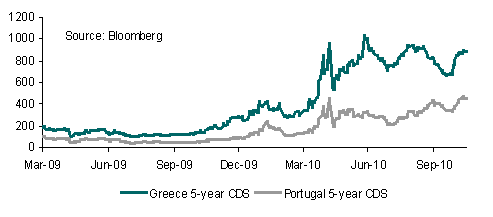
The Greek saga remains at the forefront of market attention, with restructuring speculation remaining high despite various denials over the weekend by Greek and European Central Bank (ECB) officials. News that Norway has frozen payments to Greece, whilst Fitch ratings agency’s downgrades of Greece’s ratings by 3 notches and S&P’s downgrade of Italy’s ratings outlook to negative, have all contributed to the malaise afflicting the periphery.

This weekend’s local election in Spain in which Prime Minister Zapatero and his Socialist Party suffered its worst defeat in more than 30 years leading to a transfer of power in the Spanish regions, will lead to concerns about the ability of the government to carry out much needed legislative changes.

It is difficult to see any improvement in sentiment towards the peripheral Europe and consequently the EUR over the short-term. In Greece, Prime Minister Papandreou will attempt to push through further unpopular austerity measures through parliament this week in advance of a 5th bailout tranche of EUR 12 billion scheduled for next month. This comes at a time when opinion polls show the government losing more support and 80% of those surveyed saying they would not accept more austerity measures.

The deterioration in sentiment for the EUR has been rapid as reflected in the CFTC IMM data, with net long speculative positions now at their lowest since 15 February and heading further downhill. Conversely, USD short covering has been significant though there is still a hefty USD short overhang, which points to more USD short covering as EUR sentiment sours.

Nonetheless, the USD still has plenty of risks hanging over it including the fact that it still suffers from an adverse yield differential (note that 2-year Treasury yields have fallen to the lowest since 6 December 2010). Safe haven currencies in particular CHF are the key beneficiaries and notably EUR/CHF touched a record low around 1.2354 and is showing little sign of any rebound.
Caught In The Headlights

For a prolonged period of time market attention had firmly focused on the Fed and prospects for quantitative easing (QE2). Now that QE has been delivered with little surprise, as the Federal Reserve arguably did a good job of living up to market expectations, it is Europe that is back in the limelight. Until recently the major surprise about Europe was how well the economy and the EUR were doing and how quickly the European Central Bank (ECB) would diverge from the Fed in its policy path.

This all looks premature and as if to confirm the shift in outlook the slowing in eurozone growth in Q4 (0.4% QoQ) revealed last week is likely to mark the beginning of a sharp and diverging deceleration in growth over coming quarters. The EUR may still have some life left in it given the ongoing purchases via recycled intervention flows from Asian central banks but weaker growth and peripheral worries are undermining this vestige of support.

Unfortunately for Europe the region is now not being caste in a good light and the peripheral trio of Ireland, Greece and Portugal are all staring into the headlights with nowhere to run. A crash of sorts seems inevitable but will there be any casualties? Markets are being whipsawed as they determine what will happen next in this slow motion saga.

Irish officials have maintained they do not need any aid package following discussions held over the weekend. Any bailout would likely come from a EUR 60 billion fund from the European Commission meaning a quick distribution but Ireland’s refusal will likely see pressure resume on peripheral debt markets in Europe as well as the EUR.

Portugal is also in the spotlight following comments by its foreign minister that the country may be forced to abandon the EUR if there is a failure to adopt a broad coalition government to deal with the crisis. This sounds like scaremongering but nonetheless highlights the political tensions in the country.

In Greece the second round of regional elections reveals the ruling Pasok party candidates are in the lead, reducing the prospect of early general elections. Nonetheless, this will do little to alleviate pressure as the EU is set to revise higher Greece’s 2009 deficit and debt estimates implying even more difficulty in meeting this year’s targets.

An EU/IMF team will visit Greece to assess progress as well as decide on whether the country should receive its 3rd instalment of a EUR 110 billion loan. Suggestions from PM Papandreou that he does not rule out having to extend the repayment of the loan will not auger well for sentiment. Finally, the government is set to present its 2011 final budget on Thursday, suggesting plenty of event risk this week.

A meeting of EU finance ministers tomorrow and Wednesday will also garner attention. Germany’s stance that investors will only have to take the brunt of losses from debt rescheduling only from 2013 still remains a contentious issue amongst officials even though it is a slightly softer stance than previously stated. Agreement on this as well as pressure on Ireland to accept funding will be key points of discussion.

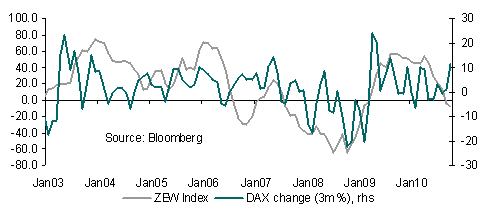
Event wise, an auction of T-bills in Greece tomorrow as well as a Spanish debt auction on Thursday will be watched to determine how far the contagion of Irish woes have spread. The news is unlikely to be good, with higher yields likely. Unfortunately tomorrow’s German November ZEW investor confidence survey will provide further signs of retreating investor sentiment in the wake of renewed peripheral debt concerns.

Better Levels To Sell

It is questionable how long the slight improvement in risk appetite at the beginning of this week lasts given the fickle nature of market sentiment at present and propensity for more disappointment. More than likely any relief will be short-lived given 1) there are still major concerns about fiscal/debt problems in Greece, Spain, Portugal, etc 2) the sharp decline in economic activity that various austerity plans will lead to and 3) rising social/labour unrest due to cuts in spending and hikes in taxes that need to be implemented.

Attention remains firmly fixed on Greece’s woes whilst global growth concerns have reappeared following some disappointing data releases in the US last week as well the decline in China’s manufacturing purchasing managers’ index (PMI) in February, released overnight, which although obscured by the timing of Chinese Lunar New Year holidays, suggests that China’s economy is losing some of its recent strong momentum.

Speculation of a rescue plan for Greece will likely give some support to the beleaguered EUR though it may only end up providing better levels to sell the currency. EU Monetary Affairs Commissioner Rehn is scheduled to meet with Greek Prime Minister Papandreou today against the background of talks about the possibility of EUR 25 billion in aid to Greece using state owned lenders to buy Greek debt. Any aid will likely come with demands for more action to reduce Greece’s yawning budget deficit which will fuel further weakness in economic activity.

A key test of sentiment towards Greece’s austerity plans will be the market reception to an upcoming sale of as much as EUR 5 billion in 10-year Greek bonds. Given the reassurances given by the EU the sale of bonds will likely not be too problematic. As an indication, Greek 10-year bond yields dropped sharply on Friday as sentiment improved.

The bounce in Greek debt was accompanied by a firmer EUR/USD which rebounded to a high of around 1.3667 as markets covered short positions. It’s probably way too early to suggest that the EUR has began a sustainable rally however, and more likely it has settled into a new range, with support around the 2010 low of 1.3444. The latest CFTC Commitment of Traders’ (IMM) data revealed a further increase in net short EUR positioning to a new record low in the week to 23rd February. This highlights both the weight of pessimism on the currency as well as significant potential to rebound.

Conversely, the IMM data reveals that net USD positions are at their highest in almost a year and well above their three-month average, suggesting that USD positioning is looking a bit stretched though its worth noting that positioning is still well off its record high. Nonetheless, with a bailout for Greece in the offing, risk appetite could gain a stronger foothold this week, in turn keeping the USD capped.

As for the EUR, although a lot of bad news is in the price, for the currency to rebound on a sustainable basis it will require fiscal/growth worries to recede. Despite talk of Greek aid, there is a long way to go before Europe’s fiscal/debt problems are resolved.