Greece’s trials and tribulations

Two main influences on markets continue to weigh on sentiment. Firstly the trials and tribulations of the eurozone periphery remain centre of attention. The failure of Greek Prime Minister Papandreou to win cross party support for austerity measures at the end of last week highlights the problems Greece is facing both domestically and externally.

Reports that European officials are negotiating tough bailout conditions including major external intervention in terms of tax collection and privatisation suggest that gaining further aid will not be easy. The second weight on market sentiment is global growth concerns, with a string of disappointing data releases over recent weeks leading to an intensification of concerns about the pace of recovery.

Markets will likely remain nervous in this environment and it is difficult to see risk appetite improving to any major degree. This has proven bullish for bond markets, with the tone set to continue this week. Currencies remain in ranges and holidays today in the US and UK will likely result in thin trading. The resilience of the EUR to peripheral concerns has been impressive but at the same time Greek concerns will limit any gains. Meanwhile, gold and precious metals look to remain well supported, with gold’s safe haven bid remaining solid.

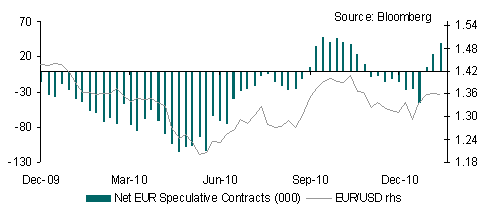
USD sentiment has improved sharply according to the latest CFTC IMM report which reveals that net USD short positions have been cut in half over the last two weeks with positioning well above the 3-month average. Conversely net EUR longs continue to shrink as speculative investors off load the currency. The fact that the EUR is not weaker than it is points to the influence of official demand for the currency, especially from Asia.

This week will likely be dominated by ongoing discussions about Greece and given the opposition to austerity measures and potentially strict bailout terms, forging an agreement will not be easy. Reports suggest that around half of Greece’s financing needs until the end of 2013 could be accounted for without new loans via privatisation and changes in terms for private bondholders, with Europe and the IMF needed to lend an additional EUR 30-35 billion on top of the EUR 110 already slated.

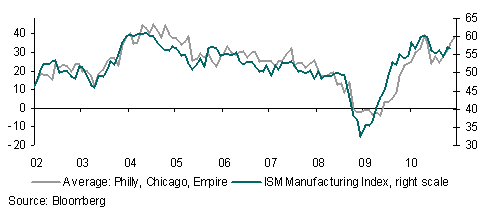
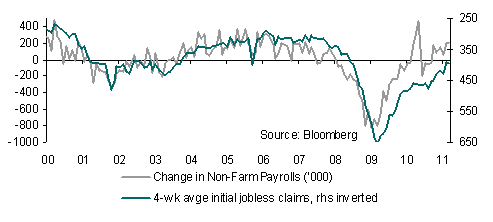
Data releases are likely to take a back seat but there will still be plenty of attention on the key release of the week, namely the May US jobs report. The market looks for a 185k increase in payrolls, with the unemployment rate edging lower to 8.9%. This would mark the lowest payrolls reading in 4 months. Clues to the jobs data will be garnered from the May ADP jobs report, ISM manufacturing survey and consumer confidence data earlier in the week.
Central bank decisions and US payrolls in focus

The USD’s troubles are far from over. Data and events this week will do little to stop the rot. As US Federal Reserve Chairman Bernanke made clear last week the Fed is committed to completing its asset purchase programme by the end of June though there is plenty of debate about what comes after. Reduced growth forecasts and the Fed’s view that price pressures are “transitory” have been sufficient to keep the USD on its knees.

The weaker than expected reading for Q1 US GDP growth at 1.8% QoQ clearly did nothing to alleviate pressure on the USD even though it is widely believed that the soft growth outcome will prove fleeting, with recovery set to pick up pace over the coming months. In truth much will depend on the trajectory for oil prices, especially as petrol prices in the US verge on the psychologically important $4 per gallon mark. Even higher energy prices could dent growth further but lower or stable prices will keep the recovery on track.

The highlight in this holiday shortened week for many countries this week is the US April jobs report at the tail end of the week. Estimates centre on around a 200k gain in payrolls but forecasts will be refined with the release of the ADP private sector jobs report and ISM manufacturing survey earlier in the week. The unemployment rate may prove sticky and will likely remain at 8.8%, a disappointment to those looking for a quicker recovery. The elevated unemployment rate will only reinforce expectations that the Fed will not be quick to reverse policy, with the USD continuing to suffer as a result.

Central bank meetings will be plentiful this week, with the European Central Bank (ECB) and Bank of England (BoE) likely to garner most attention. Recent data in the Eurozone has provided further evidence of growth divergence between North and South, but the EUR has remained resilient to this as well as to increased concerns about the periphery. This make the ECB’s job even tougher than usual when it meets this week and it is unlikely that the Bank will hike rates again so soon, especially given the strength of the EUR. Nonetheless, Trichet will continue to sound hawkish, limiting any damage to the EUR (if any) of no move in policy rates.

Similarly the Bank of England will also remain on the sidelines though this should come as little surprise in the wake of disappointing data recently and a surprise drop in inflation, albeit to still well above the BoE’s target. GBP has made up ground against a generally weak USD but judged against other currencies it has been an underperformer as expectations of monetary tightening have been pared back. Finally, the Reserve Bank of Australia (RBA) is set to remain on hold, but a hike over coming months remains likely even with the AUD at such a high level. Quite frankly although the USD is looking increasingly oversold there is nothing this week that would suggest it will recover quickly.

ECB to Hike, BoJ, BoE & RBA on Hold

The better than expected March US jobs report will likely help to shift the debate further towards the hawkish camp in the Fed. There is little this week to match the potency of payrolls in terms of market moving data this week. Instead attention will focus on a raft of Fed speakers over coming days as well as the minutes of the March 15 FOMC meeting.

This week’s Fed speakers include Lockhart, Evans, Bernanke, Kocherlakota, Plosser and Lacker. Of these only Lockhart and Lacker are non voters. Given the intense focus on recent Fed comments FX markets will be on the lookout for anything that hints a broader Fed support for a quicker hike to interest rates and/or reduction in the Fed’s balance sheet.

In any case the USD may struggle to make much headway ahead of an anticipated European Central Bank (ECB) rate hike of 25 basis point on Thursday. Much will depend on the press statement, however. If the ECB merely validates market expectations of around 75bps of policy rate hikes this year the EUR will struggle to rally.

It may also be possible that once the ECB meeting is out of the way the EUR may finally be susceptible to pressure related to ongoing peripheral tensions. Last week the outcome of the Irish bank stress tests, and political vacuum in Portugal ahead of elections set for June 5 were well absorbed by the EUR but it is questionable whether the dichotomy between widening peripheral bond spreads and the EUR can continue.

The Tankan survey in Japan released today unsurprisingly revealed a deterioration in sentiment. The survey will provide important clues for the Bank of Japan (BoJ) at its meeting on April 6 & 7th. Although a shift in Japan’s ultra easy monetary policy is unlikely whilst strong liquidity provision is set to continue, pressure to do more will likely grow. This will be accentuated by a likely downward revision in the economic outlook by the BoJ.

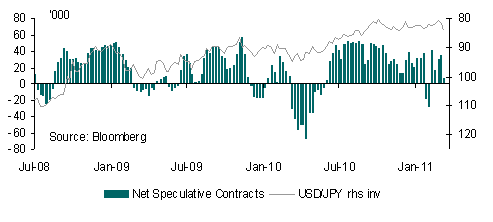
The JPY will not take much direction from this meeting. Nonetheless, its soft tone may continue helped by foreign securities outflows (particularly out of bonds), with USD/JPY eyeing the 16 December high around 84.51. Speculative positioning as reflected in the CFTC IMM data reveals a sharp deterioration in JPY sentiment as the currency evidence that finally the currency maybe regaining its mantle of funding currency.

It is still too early for the Bank of England to hike rates despite elevated inflation readings and MPC members are likely to wait for the May Quarterly Inflation Report before there is decisive shift in favour of raising policy rates. Even then, members will have to grapple with the fact that economic data remains relatively downbeat as reflected in the weaker than expected March manufacturing purchasing managers index (PMI) data.

Today’s PMI construction data will likely paint a similar picture. The fact that a rate hike is not expected by the market will mean GBP should not suffer in the event of a no change decision by the BoE this week but instead will find more direction from a host of data releases including industrial production. GBP has come under growing pressure against the EUR since mid February and a test of the 25 October high of 0.89415 is on the cards this week.

Finally, congratulations to the Indian cricket team who won a well deserved victory in the Cricket World Cup final over the weekend. The celebrations by Indians around the world will go on for a long while yet.

Beyond Expectations

Egypt worries continue to reverberate across markets, yet there appears to be growing resilience or at least some perspective being placed on problems there. Encouraging economic data, particularly in the US has helped to shield markets to some extent, with equity market rallying and US bond yields rising last week. The main impact of Egypt and worries about Middle East contagion continues to be felt on oil prices.

Even the mixed US January jobs report has failed to dent market sentiment; the smaller than expected 36k increase in payrolls was largely attributed to severe weather. A further surprising drop in the unemployment rate to 9.0% due mainly to a significant drop in the labor force was also well received by the market.

There will be less market moving releases on tap this week and the data are unlikely to dent recovery hopes. Michigan confidence is set to record an improvement in February whilst the December trade deficit is set to widen to around $41.0 billion. There are also plenty of Federal Reserve speakers this week including a testimony by Chairman Bernanke.

One central bank that has softened its hawkish rhetoric is the European Central Bank (ECB), with President Trichet dampening speculation of an early rate hike last week and alleviating some of the pressure on eurozone interest rate markets. Consequently the EUR fell as the interest rate differential with the USD became somewhat less attractive. The EUR was also undermined by the opposition from some member states to French and German ideas for greater fiscal policy coordination, an aim apparently not shared across euro members.

Data in Europe will be largely second tier. The EUR will look increasingly vulnerable to a further drop this week especially given the increase in net positioning over the past week to (1st February) according to the CFTC IMM data. The potential for position squaring looms large as positioning is now well above the three-month average. Stops are seen just below EUR/USD 1.3540.

In the UK the Bank of England policy meeting will take centre stage but there is unlikely to be any change in policy settings. Clues to policy thinking will be available in the monetary policy committee meeting minutes in two weeks times but it seems unlikely that any more members have joined the two voting for a hike at the last meeting.

Recent data have been a little more encouraging helping to wash off the disappointment of the surprise drop in Q4 GDP. The UK industrial production report is likely to be similarly firm on Thursday, with the annual pace accelerating. GBP/USD may however, struggle to make much headway against the background of a firmer USD and the weigh of long positioning, with GBP/USD 1.6279 seen as strong resistance.

There are plenty of releases in Australia this week to focus including the January employment data, consumer confidence, and a testimony by RBA governor Stevens in front of the House of Representatives on Friday. The data slate started off somewhat poorly this week, with December retail sales coming in softer than expected, up 0.2% MoM. AUD/USD is likely to be another currency that may struggle to sustain gains this week but much will depend on data over coming days. Resistance is seen around 1.0255.

On a final note, the weekend’s sporting events highlight how it’s not just economic data or moves in currencies that don’t always go as expected. After a solid run in the Ashes cricket England slumped to a 6-1 series loss to Australia in the one-day series, putting the Ashes win into distant memory. A similarly solid performance by Man United was dented with their unbeaten record broken by bottom of the table Wolves.

Econometer.org has been nominated in FXstreet.com’s Forex Best Awards 2011 in the “Best Fundamental Analysis” category. The survey is available at http://www.surveymonkey.com/s/fx_awards_2011

Your support in the survey is highly appreciated

All Eyes On US Jobs Data

Happy New Year!

2010 ended on a sour note especially for eurozone equity markets (and the Australian cricket team) where there has yet to be a resolution to ongoing growth/fiscal/debt tensions.  The EUR strengthened into year end but this looked more like position adjustment than a shift in sentiment and EUR/USD is likely to face stiff resistance around the 1.3500 level this week, with a drop back towards 1.3000 more likely.  In the US there was some disappointment in the form of a surprise drop in December consumer confidence data but pending home sales and the Chicago PMI beat expectations, with the overall tone of US data remaining positive.

There will be plenty to chew on this week in terms of data and events which will provide some much needed direction at the beginning of the year.  The main event is the December US jobs report at the end of the week.   Ahead of this there will be clues from various other job market indicators including the Challenger jobs survey, ADP employment report, and the ISM manufacturing and non-manufacturing surveys.  The data will reflect a modest improvement in job market conditions and the preliminary forecast for December payrolls is for a 135k increase, with private payrolls set to rise by 145k and the unemployment rate likely to fall slightly to 9.7%.

The minutes of the 14 December Fed FOMC meeting (Tue) will also come under scrutiny against the background of rising US bond yields.  In addition, Fed Chairman Bernanke will speak on the monetary and fiscal outlook as well as the US economy to the Senate Budget Panel.   Bernanke will once again defend the use of quantitative easing whilst keeping his options open to extend it if needed.  However, the changing composition of the FOMC with four new members added in 2011 suggests a more hawkish tinge, which will likely make it more difficult to agree on further QE.   In any case, the tax/payroll holiday package agreed by the US administration means that more QE will not be necessary. 

It’s probably not the most auspicious time for new member Estonia to be joining the eurozone especially as much of the speculation last year focussed on a potential break up.  The beginning of the year will likely see ongoing attention on the tribulations of Ireland after its bailout, with looming elections in the country.  Portugal and Spain will also remain in focus as the “two-speed” recovery in 2011 takes shape.  Data releases this week include monetary data in the form of the eurozone December CPI estimate and M3 money supply.  Inflation will tick up to 2% but this ought to be of little concern for the ECB.  Final PMI data and confidence indices will likely paint a picture of slight moderation.   

The USD ended the year on a soft note, with year lows against the CHF and multi year lows vs. AUD registered, but its weakness is unlikely to extend much further.  The key driver will remain relative bond yields and on this front given the prospects for relative US yields to move higher, the USD will likely gain support.  There maybe a soft spot for the USD in Q1 2011 but for most of the rest of the year the USD is set to strengthen especially against the EUR which will increasingly comer under pressure as peripheral tensions and growth divergence weigh on the currency.