Irish bailout leaves EUR unimpressed

As has been the case since the beginning of the global financial crisis policy makers have found themselves under pressure to deliver a solution to a potentially destabilising or even systemic risk before the markets open for a new week in order to prevent wider contagion. Last night was no different and following urgent discussions a EUR 85 billion bailout for Ireland to be drawn down over a period of 7 ½ years was agreed whilst moves towards a permanent crisis mechanism were brought forward. As was evident over a week ago a bailout was inevitable but the terms were the main imponderable.
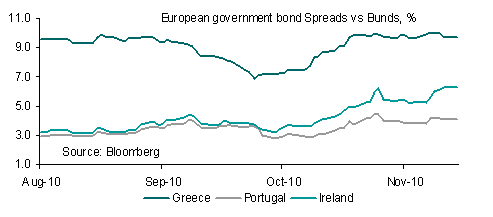
Importantly the financing rate for the package is lower than feared (speculation centered on a rate of 6.7%) but still relatively high at 5.8%. Moreover, no haircuts are required for holders of senior debt of Irish banks and Germany’s call for bondholders to bear the brunt of losses in future crises was watered down. The package will be composed of EUR 45 bn from European governments, EUR 22.5 bn from the IMF and EUR 17.5 bn from Ireland’s cash reserve and national pension fund.

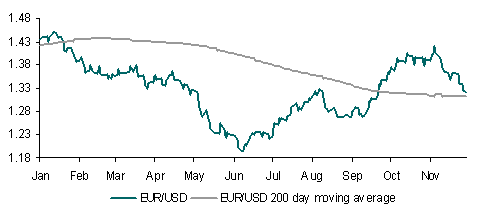
The impact on the EUR was stark, with the currency swinging in a 120 point range and failing to hold its initial rally following the announcement. A break below the 200-day moving average for EUR/USD around 1.3131 will trigger a drop to around 1.3020 technical support. Officials will hope that the bailout offers the currency some deeper support but this already seems to be wishful thinking. The EUR reaction following the Greek bailout in early May does not offer an encouraging comparison; after an initial rally the EUR lost close to 10% of its value over the following few weeks.
Although it should be noted that the bailout appears more generous than initially expected clearly the lack of follow through in terms of EUR upside will come as a blow. The aid package has bought Ireland some breathing space but this could be short lived if Ireland’s budget on December 7 is not passed. Moreover, the bailout will not quell expectations that Portugal and perhaps even Spain will require assistance. Indeed, Portugal is the next focus and the reaction to an auction of 12-month bills on 1 December will be of particular interest.

Taken together with continued tensions on the Korean peninsular, position closing towards year end ongoing Eurozone concerns will likely see a further withdrawal from risk trades over coming weeks. For Asian currencies this spells more weakness and similarly commodity currencies such as AUD and NZD also are likely to face more pressure. The USD remains a net beneficiary even as the Fed continues to print more USDs in the form of QE2.

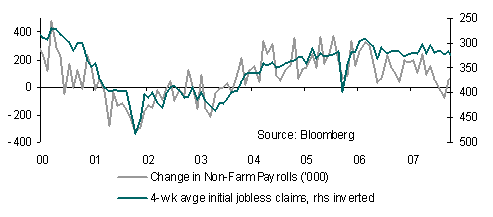
Data and events this week have the potential to change the markets perspective, especially the US November jobs report at the end of the week. There is no doubt that payrolls are on an improving trend (145k consensus) in line with the declining trend in jobless claims but unfortunately the unemployment rate is set to remain stubbornly high at 9.6% and this will be the bigger focus for the Fed and markets as it implies not let up in QE. As usual further clues to the payrolls will be garnered from the ADP jobs report and ISM data on Wednesday.
No FX co-operation

Despite all the jawboning ahead of the IMF / World Bank meetings over the weekend the meeting ended with little agreement on how deal to with the prospects of a “currency war”. US officials continued to sling mud at China for not allowing its currency, the CNY, to appreciate quickly enough whilst China blamed the US for destabilizing emerging economies by flooding them with liquidity due to the Fed’s ultra loose monetary policy stance. Chinese trade data on Wednesday my throw more fuel on to the fire given another strong surplus expected, lending support to those in the US Congress who want to label China as a “currency manipulator”.

Although the IMF communiqué mentioned countries working co-operatively” on currencies there were no details on how such cooperation would take place. The scene is now set for plenty of friction and potential volatility ahead of the November G20 meeting in Seoul. Although many central banks are worrying about USD weakness when was the last time US Treasury Secretary Geithner talked about a strong USD? US officials are probably happy to see the USD falling and are unlikely to support any measure to arrest its decline unless the drop in the USD turns into a rout. In contrast, the strengthening EUR over recent weeks equates to around 50bps of monetary tightening, a fact that could put unwanted strain on Europe’s growth trajectory, especially in the periphery.

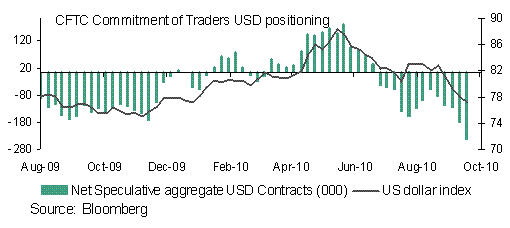
The outcome of the IMF meeting leaves things much as they left off at the end of last week. In other words there is little to stand in the way of further USD weakness apart from the fact that the market is already extremely short USDs. Indeed the latest CFTC IMM data revealed that aggregate net USD positioning came within a whisker of its all time low, with net positions at -241.2k contracts (USD -30 billion), the lowest USD positioning since November 2007. Interestingly and inconsistent with the sharp rise in the EUR, positioning in this currency remains well below its all time highs, supporting the view that rather than speculative investors it is central banks that are pushing the EUR higher.

The US jobs report at the end of last week proved disappointing, with total September payrolls dropping by 95k despite a 64k increase in private payrolls. The data will act to reinforce expectations that the Fed will begin a program of further asset purchases or quantitative easing (QE2) at its November meeting. Data and events this week will give further clues, especially the Fed FOMC minutes tomorrow and speeches from Fed Chairman Bernanke on Thursday and Friday as well as various other Fed speakers on tap.

Recent speeches by Fed officials have highlighted growing support for QE although some have tried to temper expectations. Questions about the timing and size of any new programme, as well as how it will be communicated remain unanswered. Although November seems likely for the Fed to start QE the Fed’s Bullard suggested that the Fed may wait until December. The minutes will be scrutinized for clues on these topics. The Fed is likely to embark on incremental asset purchases with the overall size being data dependent and the USD set to remain under pressure while this happens.

US Dollar Tensions

There was considerable relief, most acutely in the US administration, that the US August jobs report revealed a better than expected outcome. To recap, private sector payrolls increased by 67k vs. an upwardly revised 107k in July whilst total non farm payrolls dropped 54k. The data sets the market up for a positive start to the week in terms of risk appetite despite Friday’s drop in the August US non-manufacturing ISM index, deflating some of the market’s upbeat mood.

Once again I wonder how long positive sentiment can be sustained with so many doubts about recovery prospects and limited ammunition on the fiscal front as well as some reluctance on the monetary front, to provide further stimulus should a double dip become a reality.

Markets will be treated to several major central bank decisions including from the Bank of Japan, Bank of England, Bank of Canada and Reserve Bank of Australia this week. These meetings are set to prove uneventful, with unchanged decisions across the board expected although the Bank of Canada decision is a tough call.

The main US release this week is the Fed’s Beige Book on Wednesday, a report which will help the Fed to prepare for the FOMC meeting on September 21. The evidence contained within it is unlikely to be positive reading, with consumer spending set to be relatively soft and evidence of recovery likely to remain patchy.

On Thursday the US July trade deficit is set to reveal some narrowing and as usual the deficit with China will be of interest given the renewed tensions over FX policy. FX tension seems to be intensifying once again due to the relatively slow pace of CNY appreciation since the June de-pegging as well as political posturing ahead of November US mid-term elections. A deterioration in US trade data, a factor that largely contributed to the soft Q2 GDP outcome in contrast to a strengthening in China’s trade surplus will have added fuel to the fire.

The firmer risk backdrop has put the USD on the back foot, with the USD index dropping sharply overnight. Nonetheless, speculative USD positioning as reflected in the CFTC IMM data reveals further short covering up to the end of August, implying USD speculative sentiment is actually turning less negative.

Another country which has a different sort of tension regarding the USD is Japan. Improving risk appetite will likely prevent the JPY from visiting previous highs against the USD but will do little to reduce FX intervention speculation. Indeed, there was more jawboning over the weekend on the subject, with Japan’s finance minister Noda reiterating that Japan would take decisive action to stem the JPY’s appreciation but adding that coordinated FX intervention was a difficult option. Clearly Japan us unlikely to succeed with unilateral FX intervention.

Political events have added to the debate on FX policy as focus turns to the election for leader of the ruling DPJ party next week, with a battle looming between current Prime Minister Kan and challenger Ozawa. Although Ozawa is unpopular with the electorate he yields plenty of political power, and appea rs to be more inclined towards FX intervention. Having failed to sustain a move above 85.00 the pull back in USD/JPY suggests little appetite to extend gains, likely leaving USD/JPY in a relatively tight range, with strong support around 83.55 and resistance around 85.23.

What goes down must go up

What goes down must go up! A day that began with a stronger than forecast increase in China’s purchasing managers index (PMI) and firm Australian Q2 GDP continued with a surprise jump in the August ISM manufacturing index. The ISM rose to 56.3 from 55.5 in July an outcome that contradicted most of the regional US manufacturing surveys. It was not all positive in terms of data, yesterday however, with a weaker UK manufacturing PMI and unexpected drop in the August US ADP employment report casting a shadow over markets.

Nonetheless, for a change the market decided to act on the good news, with risk assets surging. Despite the improvement in risk appetite it still feels as though the market is grasping for direction. The jump in equities is unlikely to prove durable in an environment characterized by various uncertainties about growth and policy, especially the US.

The next hurdle for markets is the US payrolls data tomorrow. Although the ADP jobs report revealed a surprise 10k decline the employment component of the ISM manufacturing survey strengthened to 60.4, suggesting an improvement in August manufacturing payrolls. Ahead of the payrolls release the US data slate today largely consists of second tier releases including July pending home sales, August chain store sales, weekly jobless claims, and factory orders. It is worth paying particular interest to jobless claims given that the four week moving average has been edging higher, suggesting renewed job market deterioration. The consensus is for a 475k increase in claims, which will still leave the 4-week average at an elevated level.

Given that one of the biggest debates raging through markets at present is whether the Fed will embark on further quantitative easing comments by Fed officials overnight were closely scrutinized for further clues. In the event, Fed Governor Kohn highlighted that the Fed’s reinvestment of the proceeds from mortgage-backed securities will not automatically lead to further QE, suggesting some hesitancy on his part. Meanwhile, Dallas Fed President Fisher noted his reluctance to expand the Fed’s balance sheet until fiscal and regulatory uncertainties are cleared up.

Both sets of comments highlight the difficulty in gaining a consensus within the FOMC for a further increase in QE, suggesting that the hurdle for further balance sheet expansion will be set quite high. Moreover, such comments put the onus on Congress to move quickly in clearing up fiscal policy uncertainties.

As markets flip from risk on to risk off almost on a daily basis the question for today is how sustainable the rally in risk trades will prove to be against the background of so much policy and growth uncertainty. Unfortunately today’s data will provide few clues and markets will turn their attention to tomorrow’s US non-farm payrolls report for further direction. To an extent this suggests that it may be a case of treading water until then. Nonetheless, I still maintain that risk trades remain a sell on rallies over coming weeks

US payrolls clues

Most investors will be glad to see the back of August, a month that marked the biggest monthly decline in US stocks in nine years. The main imponderable is whether September will be any better. A series of manufacturing surveys globally today will do little to restore confidence although there was some good news in a slight increase in China’s official August purchasing managers index (PMI) as well a stronger than forecast increase in Australian Q2 GDP, which will likely provide some short-term relief for risk trades.

There was also some slight solace for markets in terms of US data at least from the point of view that the data was not as disappointing as many recent releases. Although the August Chicago PMI slipped (to 56.7) consumer confidence increased (to 53.5) though admittedly confidence remains at a relatively low level. The job market situation detailed within the consumer confidence report was more pessimistic in August than the previous month, however, with those reporting jobs hard to get moving higher. This sends a negative signal for Friday’s payrolls data.

There will be more clues to Friday’s US jobs report today which will enable any fine tuning of forecasts to take place in the wake of the August ADP employment report and ISM manufacturing survey. Consensus forecasts centre on a 15k increase in private jobs. Despite the slight increase in the Empire manufacturing survey in August, the falls in other manufacturing surveys point to some downside risks to the ISM today, with a simple average of the three pointing to the ISM closer to the 50 mark, which will highlight a loss in US manufacturing momentum.

Manufacturing surveys elsewhere will also be in focus, with the final PMI readings scheduled to be released for the eurozone and UK. There is likely to be confirmation of the slight drop in the eurozone PMI to 55.0 in August while the UK PMI is likely to drop to around 57.0 over the month. Both surveys remain at a relatively high level but it is clear that activity is moderating in H2 2010 from a healthy level in H2. The data will give little support to the EUR but the currency has found a degree of stability over the last couple of days. Nonetheless, a further downward move is in prospect.

The Fed FOMC minutes provided little for markets to get excited about. The minutes noted concerns about large scale asset purchases from some Fed officials, indicating resilience to increasing quantitative easing despite acknowledging increased downside risks to the growth and inflation outlook. It is unclear exactly what will be the trigger for further QE as acknowledged by Fed Chairman Bernanke last week.

The minutes will do little to help market confidence given the hesitancy to pursue further QE and provide further stimulus to the economy but the USD is likely to benefit from the fact that the Fed may not be as eager to expand its balance sheet further. Other currencies that remain beneficiaries in the current risk averse environment are the JPY and CHF. The JPY may find further upside more difficult given ongoing intervention fears but the trend remains for a lower USD/JPY in the coming weeks.