FX / Economic Preview

The European Union (EU) aid package for Greece and extension of collateral requirements by the European Central Bank (ECB) helped return a semblance of confidence to markets. Although the probability of a Greek default now looks extremely small, further austerity measures, fiscal issues in other EU countries and the negative impact on growth that all of this implies, suggest that Europe will be plagued by various problems for some time yet.

As a result of more favourable market conditions Greece is set to launch a syndicated bond issues today or tomorrow of up EUR 5 billion according to press reports. Attention will also turn to Greek debt rollovers, beginning with EUR 8.2 billion on April 20.

Improving sentiment following the Greece deal has extended to the EUR, with the currency bouncing off its lows around 1.3267. EUR/USD will now look to break through resistance around 1.3446, which would set up a test of 1.3516. There is plenty of scope for short-covering to help the EUR as reflected in the latest IMM Commitment of Traders’ report (a gauge of speculative market positioning) which revealed net EUR positions reaching yet another record low in the week to 23rd March. Whilst sovereign/official buying interest may keep EUR/USD supported this week the currency pair is best played as a sell on rallies.
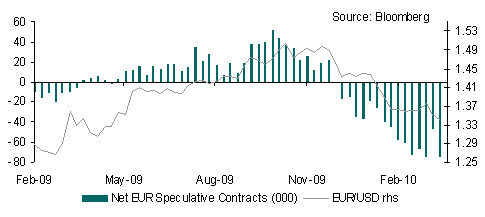
A similar assessment applies for GBP. Speculative sentiment for the currency also hit a record low in the latest week but unlike the Greek deal helping the EUR, last week’s UK budget has done little to boost GBP’s prospects. Moreover, a report in the Financial Times highlighting hedge funds bets against GBP, suggests that there are still plenty of headwinds against the currency.

Volumes are set to thin out this week ahead of upcoming holidays, whilst the US March jobs report at the end of the week will likely prevent moves out of current ranges ahead of its release. The consensus forecast is for a 190k increase in non-farm payrolls though much of this is likely to reflect hiring for the 2010 US consensus and a rebound from adverse weather effects in February.

In Europe March economic confidence surveys will be watched closely to determine how much damage Greece and general fiscal woes are having on sentiment. Some improvement, in line with the Eurozone Purchasing Managers Index (PMI) and the German IFO business confidence survey, is expected, which will help to give further, albeit limited relief to the EUR.

The Japanese data slate kicked off the week in good form, with the release of February retail sales data, revealing its biggest annual increase in 12-years. It is difficult to see the recovery in sales taking much greater hold given persistent deflation pressures however, and part of the gain probably reflects the government’s shopping incentive program.

Aside from industrial production and jobs data in Japan the key release will be the results of the Q1 Tankan survey on Wednesday. The survey of manufacturers’ confidence is set to show further improvement. USD/JPY is likely to remain supported around 91.67 but will need a further widening in US/Japan 10-year bond yield spreads to push higher.
Greek Saga Rumbles On – Does Anybody Care?

The debate over Greece continues to rumble on. France and Spain requested a separate summit meeting of the 16 heads of eurozone countries immediately before the full 27-member EU summit starting tomorrow but this was met with resistance. Meanwhile, Germany has called for “a substantial contribution” from the IMF towards a Greek aid package, whilst maintaining that no EU deal will be reached for Greece at the summit.

Frankly, the whole Greek saga has become extremely boring, with the lack of agreement about how to fix it doing little to inspire confidence. In particular the fractured opinion amongst EU leaders highlights the difficulties in reaching an agreement in a union made up of so many conflicting interests. At most the summit may agree on the conditions for a rescue package for Greece rather than a package itself. This will leave markets unimpressed,

US new home sales data today is likely to paint a slightly better picture with a small gain expected, albeit following the 11.2% plunge in the previous month. Sales will be helped by the extension of the home buyer tax credit. The US February durable goods orders report is also released today, with a small increase expected. A smaller gain in transport orders suggests that the 2.6% jump last month will not be repeated.

In Europe, the key release is the March German IFO business climate survey and a rebound is likely following February’s decline, helped by warmer weather and a weaker EUR. Flash readings of Eurozone March purchasing managers indices (PMIs) are also released but these are unlikely to extend gains from the previous month. Despite expectations of firmer data the EUR/USD is vulnerable to a further decline, with support around 1.3432 in sight for an imminent test.

Attention in the UK will turn to the pre-election Budget and particularly the government’s plans to cut spending and reduce the fiscal deficit. Failure to provide a credible blue print to restore fiscal credibility will damage confidence, heightening the risks of an eventual sovereign ratings downgrade and more pressure on GBP which appears destined for another drop below 1.50 versus USD.

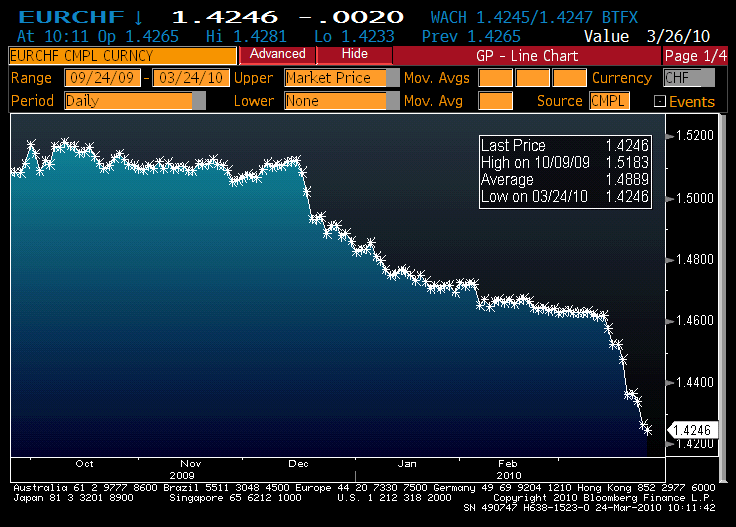
Most currencies have remained within ranges and the most interesting currency pair is EUR/CHF having failed to react to verbal warnings from the Swiss National Bank (SNB) about excessive CHF strength. EUR/CHF looks vulnerable to a further decline unless the SNB follows up rhetoric with action. Even if there is FX intervention by the SNB it may prove to be a temporary barrier to a market with an eye on the psychologically important 1.4000 level.

Despite the pressure on the Japanese government and Bank of Japan (BoJ) to engineer a weaker JPY, export performance has proven resilient, with exports jumping 45.3% on the year in February, helped by the strength of demand from Asia. Unfortunately this is doing little to end Japan’s deflation problem and even if there is less urgency for a weaker JPY to boost exports, JPY weakness will certainly help to reduce deflationary pressures in the economy. USD/JPY is stubbornly clinging to the 90.00 level, with little inclination to move in either direction.

The Ball Is In the EU’s Court

A run of data and events have continued this week’s theme of improving risk appetite. Greece lived up to expectations, with the government announcing a EUR 4.8 billion package of austerity measures amounting to around 2% of GDP. The US ADP jobs data was in line with expectations, with employment dropping by 20k in February, whilst ISM non-manufacturing index delivered an upside surprise to 53.0 in February, contrasting with a weaker eurozone Purchasing Managers Index (PMI).

Greece now believes it has lived up to its part of the bargain and the ball is now in the court of EU countries. However the issue of aid from the EU remains highly sensitive with little sign of any aid forthcoming from EU partners. Moreover, Germany dealt a blow to Greek hopes by stating that financial aid would not be discussed when the Greek Prime Minister visits tomorrow. Failure to provide such assistance could see Greece turn to the IMF. The key test will be the roll over of around EUR 22 billion of debt in April/May.

Markets have reacted positively to recent events, with Greek debt rallying and the EUR strengthening to a high of 1.3727 overnight amidst reports that regulators are investigating hedge fund trades shorting the EUR. The 17 February high of 1.3789 will provide strong resistance to further EUR/USD upside but the currency looks vulnerable to selling on rallies above its 20-day moving average around 1.3631. The EUR will be driven by news about any aid to Greece rather than data whilst the medium term outlook remains bearish.

In the US the steady but gradual recovery in the economy is continuing to take shape. The Fed’s Beige Book revealed that economic activity “continued to expand” but severe snowstorms restrained activity in several districts. Overall, the report revealed little new information following so soon after Fed Chairman Bernanke’s testimony. Today’s US releases are second tier, with a likely upward revision to Q4 non-farm productivity to around 6.5% and a 1.5% increase in January factory orders.

As has been the case recently the weekly jobless claims data will garner more attention than usual given that it has recently signaled deterioration in job conditions. One factor that could have distorted the claims as well as the payrolls data is harsh weather conditions in parts of the US. Indeed, this has led us to cuts in forecasts for February non-farm payrolls scheduled to be released tomorrow, with the real consensus likely to be much weaker than the -65k shown in the Bloomberg survey.

There are four central bank decisions of interest today no change is likely from all of them. Indonesia and Malaysia are both edging towards raising interest rates but are likely to wait until Q2 2010 before hiking. There will be no surprises if the Bank of England (BoE) and European Central Bank (ECB) leave policy unchanged too, but there will be particular interest in the ECB’s announcement on changes in liquidity provision and the BoE’s signals on the potential for further expansion in quantitative easing. A dovish signal from the BoE will deliver GBP a blow, leaving GBP/USD vulnerable to a drop back below 1.50.

Better Levels To Sell

It is questionable how long the slight improvement in risk appetite at the beginning of this week lasts given the fickle nature of market sentiment at present and propensity for more disappointment. More than likely any relief will be short-lived given 1) there are still major concerns about fiscal/debt problems in Greece, Spain, Portugal, etc 2) the sharp decline in economic activity that various austerity plans will lead to and 3) rising social/labour unrest due to cuts in spending and hikes in taxes that need to be implemented.

Attention remains firmly fixed on Greece’s woes whilst global growth concerns have reappeared following some disappointing data releases in the US last week as well the decline in China’s manufacturing purchasing managers’ index (PMI) in February, released overnight, which although obscured by the timing of Chinese Lunar New Year holidays, suggests that China’s economy is losing some of its recent strong momentum.

Speculation of a rescue plan for Greece will likely give some support to the beleaguered EUR though it may only end up providing better levels to sell the currency. EU Monetary Affairs Commissioner Rehn is scheduled to meet with Greek Prime Minister Papandreou today against the background of talks about the possibility of EUR 25 billion in aid to Greece using state owned lenders to buy Greek debt. Any aid will likely come with demands for more action to reduce Greece’s yawning budget deficit which will fuel further weakness in economic activity.

A key test of sentiment towards Greece’s austerity plans will be the market reception to an upcoming sale of as much as EUR 5 billion in 10-year Greek bonds. Given the reassurances given by the EU the sale of bonds will likely not be too problematic. As an indication, Greek 10-year bond yields dropped sharply on Friday as sentiment improved.

The bounce in Greek debt was accompanied by a firmer EUR/USD which rebounded to a high of around 1.3667 as markets covered short positions. It’s probably way too early to suggest that the EUR has began a sustainable rally however, and more likely it has settled into a new range, with support around the 2010 low of 1.3444. The latest CFTC Commitment of Traders’ (IMM) data revealed a further increase in net short EUR positioning to a new record low in the week to 23rd February. This highlights both the weight of pessimism on the currency as well as significant potential to rebound.

Conversely, the IMM data reveals that net USD positions are at their highest in almost a year and well above their three-month average, suggesting that USD positioning is looking a bit stretched though its worth noting that positioning is still well off its record high. Nonetheless, with a bailout for Greece in the offing, risk appetite could gain a stronger foothold this week, in turn keeping the USD capped.

As for the EUR, although a lot of bad news is in the price, for the currency to rebound on a sustainable basis it will require fiscal/growth worries to recede. Despite talk of Greek aid, there is a long way to go before Europe’s fiscal/debt problems are resolved.

Euro Still Vulnerable

Markets have become rather skittish, with attention gyrating between sovereign deficit/debt concerns on the one hand and better news on the corporate and economic front on the other.  This week the latter appears to be gaining the upper hand helped by an easing of concerns about Greece. Although the Greek saga is by no means close to an end, especially given the new deadlines set by the EU Commission on adherence to budget cuts, the chances of the worst case scenario of default or pull out from the EU looks to have diminished. 

Renewed attention on other EU members, especially in light of the derivatives transactions carried out by Greece and potentially by other European countries to disguise the extent of their budget problems suggests that there is still more pain ahead. Nonetheless, it is increasingly clear that investors are differentiating between Europe and the rest of the world much to the chagrin of the EUR.  

Differentiation between the eurozone and the US was particularly apparent in the wake of stronger than forecast earnings and data in the US. Two more companies joined the three-quarters of S&P 500 companies beating earnings forecasts whilst economic reports including US January industrial production and housing starts came in ahead of forecasts.  This pattern is set to continue today, with the US Philly Fed manufacturing index set to increase to around 17 in February from 15.2 in January. 

In contrast, data in Europe has been much less impressive, with for example, the February ZEW survey of investor confidence recording its 5th consecutive decline in February.  The eurozone economic news may look a little better in the form of likely increases in manufacturing Purchasing Managers Indices (PMIs) but unless the data reveals particularly strong readings the growing perception that Europe is falling behind in the recovery process will remain in place.

Despite the improvement in risk appetite the USD has taken a firmer tone, appearing to react more to positive data and implications for a reduction in policy accommodation by the Fed.  In particular, the USD was spurred by the FOMC minutes of the January 26-27 meeting, in which the Fed debated its exit strategy from quantitative easing.  Some officials even went as far as pushing for asset sales in the “near future” to reduce the size of the Fed’s balance sheet.

Even though the USD has taken a firmer tone it will continue to be buffeted by the conflicting forces of improved risk appetite and shifting interest rate expectations.  Correlations reveal that risk is still the dominant FX factor suggesting that there may still be some further downside left for the USD as risk appetite improves. 

Although commodity currencies have also come under pressure due to the generally firmer USD tone overnight, the downside in these currencies is likely to prove limited especially given strong data releases.  For example, data overnight revealed that business confidence rose to its highest level in 15 years in Australia.  Added to upbeat comments from RBA deputy governor Lowe and strong labour market data, it highlights the growing probability of a March rate hike by the RBA.

The EUR remains the weak link and although it may benefit from easing Greek concerns the growing evidence of a relatively slower economic recovery in the eurozone suggests any upside in the EUR will be limited.  Having dropped below technical support around 1.3580, EUR/USD looks vulnerable to a further push lower in the short-term.