The Week Ahead

Equity markets and risk trades have generally performed well over the last couple of weeks, with for example the S&P 500 around 7.5% higher since its late August low, whilst equity and currency volatility have been generally low, the latter despite some hefty FX intervention by the Japanese authorities which did provoke a spike in USD/JPY volatility last week.
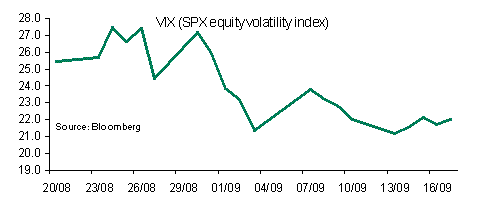
Risk appetite took a knock at the end of last week in the wake of worries that Ireland may seek EU / IMF assistance although this was denied by Irish officials. A similar worry inflicted Portugal, and as a result peripheral bond spreads were hit. Sovereign worries in Europe have not faded quickly and bond auctions in Greece, Spain and Portugal will garner plenty of attention this week. Renewed worries ahead of the auctions suggest that the market reception could be difficult.

Attention will swiftly turn to the outcome of the Fed FOMC meeting tomorrow and in particular at any shift in Fed stance towards additional quantitative easing following the decision at the August FOMC meeting to maintain the size of the Fed’s balance sheet. Given the recent improvement in US economic data the Fed is set to assess incoming data before deciding if further measures are needed.

Housing data in the US will also garner plenty of attention, with several releases scheduled this week. Increases in August housing starts, building permits, existing and new home sales are also expected. Whilst this may give the impression of housing market improvement, for the most part the gains will follow sharp declines previously, with overall housing market activity remaining weak following the expiry of the government tax credit.
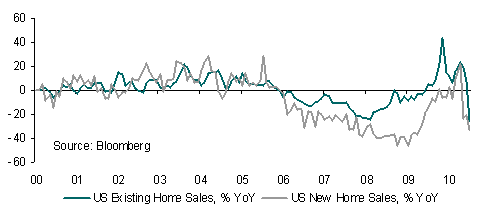
Weakness in house prices taken together with a drop in equity markets over the quarter contributed to a $1.5 trillion drop in US household net wealth in Q2. Wealth had been recovering after its decline from Q2 2007 but renewed weakness over the last quarter will not bode well for consumer spending. Household wealth is around $12.4 trillion lower than its peak at the end of Q2 2007.

Aside from the impact of renewed sovereign concerns, European data will not give the EUR much assistance this week either, with Eurozone September flash PMIs and the German IFO survey of business confidence set to weaken as business and manufacturing confidence comes off the boil. If the Fed maintains its policy stance whilst risk aversion increases over coming days the USD may find itself in a firmer position to recoup some of its losses both against the EUR and other currencies.

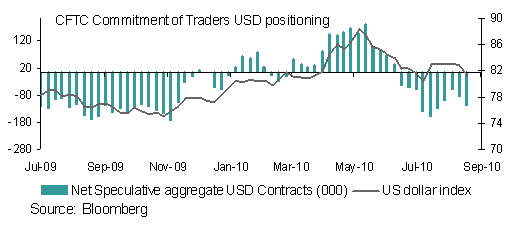
This will leave EUR/USD vulnerable to drop back down to around support in 1.2955 in the very short-term. As indicated by the CTFC IMM data there has been further short EUR position covering last week whilst sentiment for the USD deteriorated, suggesting increased room for short-USD covering in the event of higher risk aversion.
The impact of Sweden’s election outcome over the weekend is unlikely to do much damage to the SEK despite the fact that the coalition government failed to gain an outright majority. EUR/SEK has edged higher over recent days from its low around 9.1528 but SEK selling pressure is unlikely to intensify following the election, with EUR/SEK 9.3070 providing tough technical resistance.
Q2 Economic Review: Double-Dip Recession or Prolonged Recovery?

I was recently interviewed by Sital Ruparelia for his website dedicated to “Career & Talent Management Solutions“, on my views on my view on the Q2 Economic Review: Double-Dip Recession or Prolonged Recovery?

Sital is a regular guest on BBC Radio offering career advice and job search tips to listeners. Being a regular contributor and specialist for several leading on line resources including eFinancial Careers and Career Hub (voted number 1 blog by ‘HR World’), Sital’s career advice has also been featured in BusinessWeek online.

Please see below to read my article

Since we last discussed the economic outlook at the end of quarter 1, much has happened and unfortunately there has not been a great deal of positive news. I retained a cautiously optimistic outlook for economic recovery for the Q1 Economic Review: elections, recovery and underemployment discussion article, but highlighted that recovery would be a long and drawn-out process, with western economies underperforming Asian economies.

The obstacles to recovery discussed then continue to apply now, including consumers paying down debt, high unemployment, tight credit conditions and weak confidence.

Click here to read the rest…

Capital Flowing Out of Europe

When investors’ concerns shift from how low will the EUR go to whether the currency will even exist in its current form, it is blatantly evident that there is a very long way to go to solve the eurozone’s many and varied problems. As many analysts scramble to revise forecasts to catch up with the declining EUR, the question of the long term future of the single currency has become the bigger issue. Although the EUR 750 billion support package was hailed by EU leaders as the means to prevent further damage to the credibility of the EUR, it has failed to prevent a further decline, but instead revealed even deeper splits amongst eurozone countries.

Although the European Central Bank (ECB) confirmed that it bought EUR 16.5 billion in eurozone government bonds in just over a week, with the buying providing major prop to the market, private buyers remain reluctant to renter the market. As a result of the ECB’s sterilised interventions bond markets have stabilised but the EUR is now taking the brunt of the pressure, a reversal of the situation at the beginning of the Greek crisis, when the EUR proved to be far more resilient. Reports that some large institutional investors have exited from Greek and Portuguese debt markets whilst others are positioning for a eurozone without Greece, Portugal and Spain, suggest that the ECB may have taken on more than it has bargained for in its attempts to prop up peripheral eurozone bond markets.

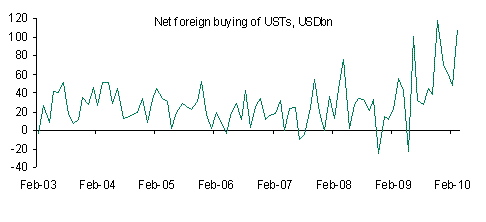
As was evident in the US March Treasury TICS report it appears that a lot of the outflows from Europe are finding their way into US markets. The data revealed that net long-term TIC flows (net US securities purchases by foreign investors) surged to $140.5 billion in March. The bulk of this flow consisted of safe haven buying of US Treasuries ($108.5 billion), although it was notable that securities flows into other asset classes were also strong especially agencies and corporate bonds, which recorded their biggest capital inflow since May 2008. Asian central banks also reversed their net selling of US Treasuries, with China investing the most into Treasuries since September 2009. Anecdotal evidence corroborates this, with central banks in Asia diversifying far less than they were just a few months ago.

This reversal of flows is unlikely to stop anytime soon. It is clear that enhanced austerity measures in the eurozone will result in weaker growth and earnings potential. This will play negatively on the EUR especially given expectations of a superior growth and earnings profile in the US. Evidence of implementation, action and a measure of success on the fiscal front will be necessary to begin the likely long process of turning confidence in the EUR around. This will likely take a long time to be forthcoming. EUR/USD has managed to recover after hitting a low of around 1.2235 but remains vulnerable to further weakness. The big psychological barrier of 1.20 looms followed by the EUR launch rate of around 1.1830.

Criminals Favouring The Euro

It says a lot for a currency when banks stopped accepting it as a means of exchange. The EUR’s woes continue to pile up and the currency received more bad news unrelated to Europe’s fiscal woes when it was announced that banks and foreign exchange bureax in the UK have stopped exchanging EUR 500 banknotes. The rationale was not because the currency is dropping sharply in value though this is also a credible reason, but due to the fact that 90% of the notes were found to be linked to tax evasion, terrorism and other crimes.

EUR/USD came close to the technical support level around 1.2510. Options barriers will likely provide some strong support around this level, temporarily delaying an inevitable drop to the next support at 1.2457. It was not just the EUR that suffered, with GBP faring even worse, in part due to a wider than expected trade deficit, with GBP/USD heading for a test of 1.4500. Sovereign woes continue to depress the EUR in what is turning into a no-win situation. Fresh austerity measures in Greece, Spain and Portugal failed to assuage market fears, and instead the measures have only heightened concerns about social unrest and a weakening growth outlook.

EUR/USD to test 1.2510, GBP/USD heading for 1.4500

Following on from the EUR 750 billion EU / IMF package European governments are starting to hold up to their end of the bargain. Spain announced a bunch of austerity measures. The measures aim at cutting the country’s budget deficit by an additional EUR 15 billion from 11.2% of GDP in 2009 to close to 6% in 2011. This was accompanied by some better economic news as Spain edged out of a close to 2-year recession in Q1 2010.

Evidence that some action is being taken on the fiscal front in Europe accompanied a slightly stronger than expected reading for Eurozone GDP in Q1 2010, helping risk appetite to improve overnight. Portugal was also able to find some success in its sale of EUR 1 billion of 10-year bonds, with a bid to cover ratio of 1.8 and a premium of only 18bps above the yield at April’s sale. Portugal has also pledged to cuts its budget deficit further than initially planned, aiming for a deficit of 7.3% of GDP this year.

Of course, pledges need to be followed by action and implementation and execution will be essential to bring markets back on side given the likely damage inflicted on confidence in the whole EUR project. Continued skepticism explains why EUR/USD has failed to take much notice to the developments in Spain and Portugal, with the currency continuing to languish, heading towards technical support around 1.2510 in the short-term.

The new UK coalition government is also moving quickly to appease markets, with plans to cut the budget deficit in the country by GBP 6 billion this year. The plans failed to have a lasting impact on GBP, which was dealt a blow by the dovish interpretation of the Bank of England’s quarterly inflation report released yesterday. GBP/USD continues to struggle to gain a foothold above 1.5000 and technical indicators suggest the currency pair is still heading lower, with a move to 1.4500 likely over the short-term.