Temporary Euro Relief

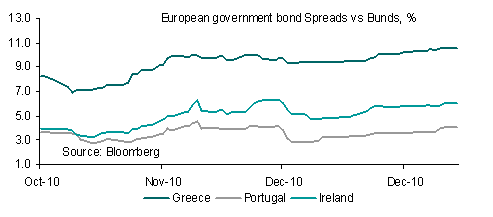
Eurozone peripheral country travails continue to garner most market attention. There was at least a semblance of improvement on this front as peripheral bond spreads with German bunds narrowed on Tuesday but this was largely due to European Central Bank (ECB) bond buying than any improvement in sentiment. The fact that German bund yields also rose helped to narrow bund-peripheral spreads further.

A clearer test of sentiment will be today’s debt sales by Portugal followed by actions by Spain and Italy tomorrow. ECB buying of Portuguese bonds has given some relief to other debt, with Spanish and Italian debt spreads narrowing too. Even Greece managed to sell short term debt (EUR 1.95 bn of 26 week T-bills) but at a higher cost than the previous sale.

Perhaps a stronger boost to sentiment will come from the news that European Union (EU) governments are discussing an increase in the EUR 440 billion bailout fund in recognition of the fact that the fund may prove too small to cope if the crisis spreads to Spain. However, don’t expect a decision anytime soon, with next week’s meeting of EU finance ministers unlikely to agree to such a move. Support (or lack) of from Germany may prove to be a sticking point against the background of domestic political pressure.

Other options being considered include the possibility of the EFSF (European Financial Stability Facility) purchasing bonds in the secondary market and lowering interest rates on EFSF bailout loans. News that Japan will buy 20% of EFSF bonds this month as well as recent supportive comments from China suggest that an increase in the size of the EFSF may be easily funded by such investors. The EUR will gain some support against the background of such speculation but its upside may be restrained around its 200-day moving average at EUR/USD 1.3071.

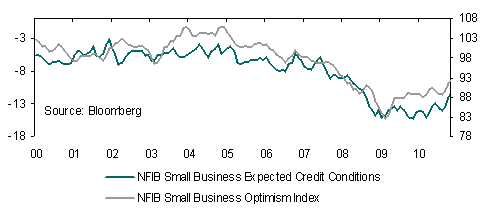
In the US the economic news was not so positive for a change as the National Federation of Independent Business (NFIB) small business optimism survey came in weaker than expected in December, an outcome that will come as a blow given that it suggests some stuttering in the recovery process as well as hiring.
There is only secondary data scheduled today, with most attention on the Fed’s Beige Book later tonight. The survey of Federal Reserve districts will likely reveal a broad based but moderate improvement in economic conditions with the exception of housing activity. A speech by the Fed’s Fisher on Monetary policy will also be in focus. Like the Fed’s Plosser overnight he may highlight some caution about the impact of Fed quantitative easing (QE).

The AUD is increasingly feeling the impact of the flooding in Queensland Australia as the extent of economic damage is revealed. Reserve Bank of Australia (RBA) board member McKibbin estimated that it could knock off at least 1% from economic growth. This may prove too negative and although the flooding will result in a significantly negative impact on growth in Q1 rebuilding and reconstruction will mean that overall growth for 2011 will not be as significantly impacted. Nonetheless, a paring back in RBA policy tightening expectations will see the AUD come under further pressure, with a move down to around AUD/USD 0.9634 on the cards over the short-term.
Euro Problems Intensify

Following the bullish build up and increasingly lofty expectations for the US December jobs report the actual outcome was disappointing, at least on the headline reading. Non farm payrolls rose 103k which in reality was not that much less than initial forecasts but the real consensus was somewhat higher following the robust ADP private sector jobs report earlier in the week. There was some mitigation in the 70k upward revisions to October and November and surprisingly large decline in the unemployment rate to 9.4%. Consequently the market impact was less severe than it could have been and even the USD ended higher on the day.

Nonetheless, the data provided a dose of reality to markets’ optimistic expectations and this was reinforced by Fed Chairman Bernanke in testimony on Friday. He highlighted that it will take “considerable time” before the unemployment rate drops to a normal level, which could threaten recovery. Even the drop in the unemployment rate revealed in the December is report is vulnerable to a reversal given it was in part due to a drop in the labour force. This reality provided support to bond markets which may undermine the USD given the drop in bond yields. However, the USD’s anti-EUR credentials suggest that it will remain resilient.

Eurozone’s woes continued to heat up last week as the holiday season relief proved temporary. Stress in peripheral debt markets increased despite buying from the ECB last week and faced with debt sales in Italy, Portugal and Spain this week the pressure is likely to continue over coming days. Whether its worries about a resolution to funding issues and investor haircuts and/or the growing divergence in growth across the eurozone, the EUR continues to look vulnerable in the absence of any resolution to these issues. Having easily slipped below its 200-day moving average EUR/USD will eye support around 1.2767.

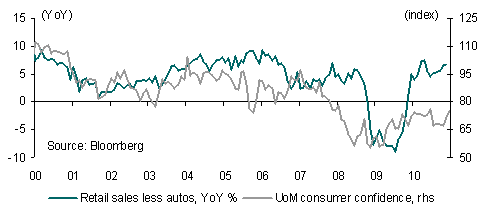
US data this week will look upbeat and provide more support for the USD, with December retail sales likely to record a healthy increase both on the headline and ex-autos readings as indicated by strong holiday sales. Similarly industrial production will reveal a solid gain whilst the Beige Book will highlight that economic conditions across the Federal Reserve districts, have continued to improve. The weak spot will remain housing but despite this consumer spending and sentiment are likely to be reported as resilient. The Beige Book is unlikely to reveal much of an inflation threat despite higher commodity prices. This will be echoed in the core CPI reading this week.

Although headline inflation in the eurozone breached the 2.0% threshold in December the ECB is unlikely to use it as an excuse to move towards tighter monetary conditions any time soon. The ECB meeting this week will nonetheless likely note the increase in various inflation gauges in President Trichet’s press statement. Most attention will be focused on any comments that Trichet makes regarding peripheral bond strains. In reality there is little that he can say that will alter market sentiment. Whilst an ongoing commitment to buy debt will help on the margin it will do little to stem the growing tide of negative sentiment towards eurozone assets.

Upside risks to US payrolls

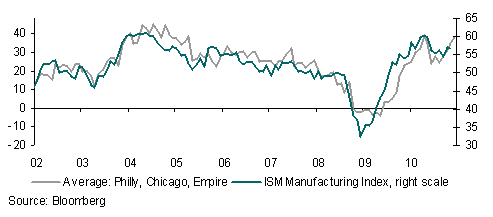
An encouraging run of US data releases over recent weeks became even more solid overnight. In particular the December ADP private sector jobs report revealed a whopping 297k increase, its highest ever reading. Although the outsized gain may be attributable to distortions such as seasonal factors it will lead many to scramble to revise higher estimates for non-farm payrolls to around 200k+ (consensus currently is 150k). Similarly the December ISM non-manufacturing survey came in higher than expected at 57.1, its highest reading since May 2006. Notably the employment component softened in contrast to the ADP data.

Whilst the US outlook appears to be improving the eurozone picture is looking decidedly shaky. Peripheral bonds remain under pressure as reflected in the renewed widening in German-Greek spreads whilst Portugal’s sale of 6m bills revealed good demand but at a much higher yield (3.69% vs. 2.05% in September). Press reports that the Swiss National Bank has stopped accepting Irish government debt as collateral didn’t help matters whilst talk of conditions attached to any Chinese support for eurozone countries also weighed on sentiment.

Adding to concerns is the ongoing political impasse in Belgium where 7 months after elections there has yet to be a new government formed. The risk of a downgrade to the country’s credit ratings is high especially given the lack of progress on deficit reduction. Meanwhile on the data front the Eurozone service sector PMI was stronger than forecast in December at 54.2 but the country breakdown revealed more divergence in economic conditions. This was echoed in the manufacturing PMI. Divergence in growth is likely to widen further this year and whilst the strength of Germany may prevent a sharp slowing in overall growth in the eurozone, growing divergence will make the job of the ECB difficult.

The net result of firmer US data is a broadly stronger USD and higher Treasury yields. The EUR in contrast looks as though it is on the verge of a sharper decline below 1.3000, with technical support seen around 1.2969 whilst the JPY could see further weakness given the move in relative US/Japan bond yields. There will be little direction today from data with just Eurozone sentiment gauges and retail sales tap whilst in the US jobless claims will be in focus. However, there will probably be little movement ahead of the US jobs report tomorrow.

All Eyes On US Jobs Data

Happy New Year!

2010 ended on a sour note especially for eurozone equity markets (and the Australian cricket team) where there has yet to be a resolution to ongoing growth/fiscal/debt tensions.  The EUR strengthened into year end but this looked more like position adjustment than a shift in sentiment and EUR/USD is likely to face stiff resistance around the 1.3500 level this week, with a drop back towards 1.3000 more likely.  In the US there was some disappointment in the form of a surprise drop in December consumer confidence data but pending home sales and the Chicago PMI beat expectations, with the overall tone of US data remaining positive.

There will be plenty to chew on this week in terms of data and events which will provide some much needed direction at the beginning of the year.  The main event is the December US jobs report at the end of the week.   Ahead of this there will be clues from various other job market indicators including the Challenger jobs survey, ADP employment report, and the ISM manufacturing and non-manufacturing surveys.  The data will reflect a modest improvement in job market conditions and the preliminary forecast for December payrolls is for a 135k increase, with private payrolls set to rise by 145k and the unemployment rate likely to fall slightly to 9.7%.

The minutes of the 14 December Fed FOMC meeting (Tue) will also come under scrutiny against the background of rising US bond yields.  In addition, Fed Chairman Bernanke will speak on the monetary and fiscal outlook as well as the US economy to the Senate Budget Panel.   Bernanke will once again defend the use of quantitative easing whilst keeping his options open to extend it if needed.  However, the changing composition of the FOMC with four new members added in 2011 suggests a more hawkish tinge, which will likely make it more difficult to agree on further QE.   In any case, the tax/payroll holiday package agreed by the US administration means that more QE will not be necessary. 

It’s probably not the most auspicious time for new member Estonia to be joining the eurozone especially as much of the speculation last year focussed on a potential break up.  The beginning of the year will likely see ongoing attention on the tribulations of Ireland after its bailout, with looming elections in the country.  Portugal and Spain will also remain in focus as the “two-speed” recovery in 2011 takes shape.  Data releases this week include monetary data in the form of the eurozone December CPI estimate and M3 money supply.  Inflation will tick up to 2% but this ought to be of little concern for the ECB.  Final PMI data and confidence indices will likely paint a picture of slight moderation.   

The USD ended the year on a soft note, with year lows against the CHF and multi year lows vs. AUD registered, but its weakness is unlikely to extend much further.  The key driver will remain relative bond yields and on this front given the prospects for relative US yields to move higher, the USD will likely gain support.  There maybe a soft spot for the USD in Q1 2011 but for most of the rest of the year the USD is set to strengthen especially against the EUR which will increasingly comer under pressure as peripheral tensions and growth divergence weigh on the currency.

Drastic Action Needed

There has been no let up in pressure on eurozone markets and consequently risk aversion continues to increase. The failure of Ireland’s bailout package to stem the haemorrhaging in eurozone bond markets highlights the difficulties in finding in a lasting solution and worsening liquidity conditions in several eurozone bond markets highlights the urgency to act.

Indeed, if spreads continue to widen as they have since late October, by early to mid 2011, Portuguese, Spanish and Italian Euribor spreads would be higher than the EFSF loan spread. In the (admittedly extreme) case that sovereigns could not raise money in the market, peripherals would run out of money early in 2011. Policy makers will try to not let the situation get so out of hand but what can be done to stem the damage?

The European Central Bank (ECB) may be forced to delay its exit strategy by maintaining unlimited liquidity allotments to banks into next year and/or implement further liquidity support measures. The ECB meeting will be closely scrutinized for details, with ECB President Trichet having to adjust policy accordingly. A further option could be for the ECB to step up its bond buying programme which may provide some relief to peripheral eurozone bond markets and the EUR.

Whether this offers a lasting solution however, is debatable. The risk of action by the ECB tomorrow may fuel some caution in the market towards selling the EUR further in the short term and could even prompt some short EUR covering around the meeting which could see EUR/USD regain a sustainable hold above 1.3000 again but this may be temporary, offering better levels to sell.

Meanwhile, speculation of a break up of the eurozone into a core euro and a peripheral euro has intensified given the growing divergence in growth and competitiveness across the region. Such speculation looks far fetched. The eurozone project has been politically driven from the start and over the last 60 years or so internal economic strains have been papered over by politicians. The political will is likely to remain in place even if the divergence in fundamentals across Europe has continued to widen.

Bond market sentiment was not helped by the fact that S&P put Portugal’s ratings on creditwatch negative citing downward economic pressure and concerns over the government’s credit worthiness. Importantly S&P still expects Portugal to remain at investment grade if downgraded. Note that Portugal’s central bank highlighted that the country’s banking sector faced “intolerable” risk unless the government implements planned austerity measures.

In contrast the US story is looking increasingly positive, highlighting that the USD’s strength is not merely a reaction to EUR weakness but more likely inherent and broad improvement in USD sentiment. US consumer confidence, Chicago PMI and the Milwaukee PMI beat forecasts in November, continuing the trend of consensus beating data releases over recent weeks.
Although this does not change the outlook for quantitative easing (QE) as the Fed remains focused on core CPI and the unemployment rate, the data paints an encouraging picture of the economy.