Greece In The Spotlight (again)

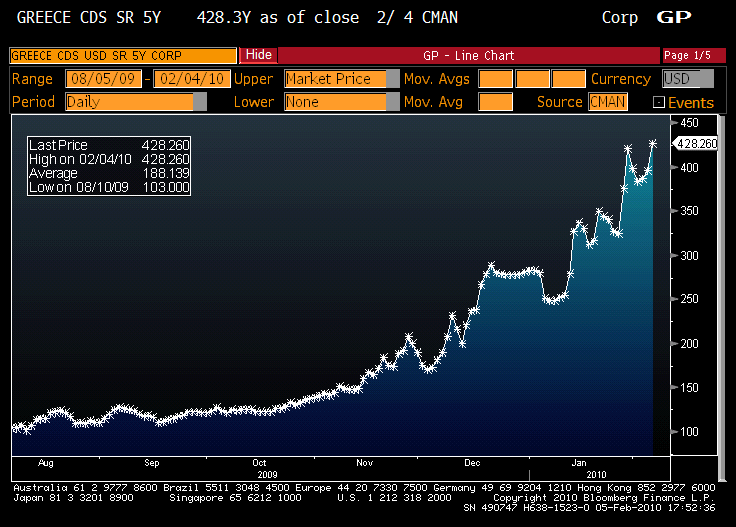
Once again Greek worries are hogging the limelight and although the Greek saga has become a rather tedious affair for markets, concerns are well founded.  The latest issue is whether Greece is willing to adhere to potentially tough measures that would be associated with IMF assistance for the country.  Latest speculation suggests that Greece may side step the IMF to avoid such measures though this was belatedly denied by the Greek authorities. 

Given the huge amount of bonds Greece needs to sell over the coming weeks renewed nervousness does not bode well for a good reception to this issuance. As it is financing costs are rising once again in the wake of a renewed widening in Greek sovereign bond spreads and servicing this debt will add to the economic misery.  Greece has little by way of upside over coming months and years.  Tough and necessary austerity measures mean that sharp growth deterioration is inevitable, deepening recession.

The lack of flexibility for Greece to devalue its way out of its quagmire means much more economic pain with no release valve.   The same applies to the likes of Spain and Portugal.  The overall loser will be the EUR which looks likely to succumb to further weakness in the months ahead; the parity trade remains a prospect. Perversely a weaker EUR may be exactly what is necessary to alleviate some of the pain for Southern European economies though the EUR would need to weaken by much more than we forecast to be of much help.   

Aside from Greek gyrations the overall market tone looks somewhat positive.  The Fed’s dovish minutes of its March 16 meeting in which it marginally downgraded growth and inflation forecasts, highlights that interest rates are unlikely to be raised by the Fed this year. This will keep in place an accommodative policy stance conducive to further improvements in risk appetite.     Moreover, data releases such as the US ISM manufacturing and non-manufacturing surveys, have been generally supportive to recovery,

Easing tensions on China/US exchange rate policy have also helped sentiment as the issue has been put to one side after the US administration delayed the decision whether to officially label China as a currency manipulator.  Pressure from the US Congress suggests that the issue will not be on the back burner for long and the issue of CNY revaluation will likely be a topic at the during the various meetings between US and Chinese officials over coming weeks. 

Nonetheless, the delay in the US Treasury report will work in favour of a Chinese currency revaluation sooner rather than later as China will likely react more favourable to less international pressure to revalue.
Better Levels To Sell

It is questionable how long the slight improvement in risk appetite at the beginning of this week lasts given the fickle nature of market sentiment at present and propensity for more disappointment. More than likely any relief will be short-lived given 1) there are still major concerns about fiscal/debt problems in Greece, Spain, Portugal, etc 2) the sharp decline in economic activity that various austerity plans will lead to and 3) rising social/labour unrest due to cuts in spending and hikes in taxes that need to be implemented.

Attention remains firmly fixed on Greece’s woes whilst global growth concerns have reappeared following some disappointing data releases in the US last week as well the decline in China’s manufacturing purchasing managers’ index (PMI) in February, released overnight, which although obscured by the timing of Chinese Lunar New Year holidays, suggests that China’s economy is losing some of its recent strong momentum.

Speculation of a rescue plan for Greece will likely give some support to the beleaguered EUR though it may only end up providing better levels to sell the currency. EU Monetary Affairs Commissioner Rehn is scheduled to meet with Greek Prime Minister Papandreou today against the background of talks about the possibility of EUR 25 billion in aid to Greece using state owned lenders to buy Greek debt. Any aid will likely come with demands for more action to reduce Greece’s yawning budget deficit which will fuel further weakness in economic activity.

A key test of sentiment towards Greece’s austerity plans will be the market reception to an upcoming sale of as much as EUR 5 billion in 10-year Greek bonds. Given the reassurances given by the EU the sale of bonds will likely not be too problematic. As an indication, Greek 10-year bond yields dropped sharply on Friday as sentiment improved.

The bounce in Greek debt was accompanied by a firmer EUR/USD which rebounded to a high of around 1.3667 as markets covered short positions. It’s probably way too early to suggest that the EUR has began a sustainable rally however, and more likely it has settled into a new range, with support around the 2010 low of 1.3444. The latest CFTC Commitment of Traders’ (IMM) data revealed a further increase in net short EUR positioning to a new record low in the week to 23rd February. This highlights both the weight of pessimism on the currency as well as significant potential to rebound.

Conversely, the IMM data reveals that net USD positions are at their highest in almost a year and well above their three-month average, suggesting that USD positioning is looking a bit stretched though its worth noting that positioning is still well off its record high. Nonetheless, with a bailout for Greece in the offing, risk appetite could gain a stronger foothold this week, in turn keeping the USD capped.

As for the EUR, although a lot of bad news is in the price, for the currency to rebound on a sustainable basis it will require fiscal/growth worries to recede. Despite talk of Greek aid, there is a long way to go before Europe’s fiscal/debt problems are resolved.

What To Watch This Week

As usual the G7 meeting will leave markets with little to chew on. G7 officials maintained their commitment to stimulus measures and timely exit strategies but there was little of note for FX markets aside from the usual comments about wanting to avoid excess FX volatility. There was certainly know step up in pressure on China to strengthen though a report prepared for the meeting did push for countries with inflexible currencies to make adjustments. Meanwhile US officials mouthed the usual “strong dollar” mantra.

Where does this leave markets this week? Well I must admit my bullish view on risk currencies is clearly suffering after a positive start to the year. The pullback in high beta currencies (those with the highest sensitivity to risk aversion) has been dramatic. I have highlighted many of the factors weighing on sentiment in previous posts and whilst I still think the US dollar will find itself under renewed pressure over coming months the current environment remains conducive to more USD and JPY buying and selling of currencies such as the AUD, NZD, CAD, GBP, NOK, SEK, ZAR etc.

Ironically the US and Japan have arguably more severe deficit/debt concerns than some of the European countries under pressure but as most of Japan’s debt is held domestically there is little worry of a collapse in JGBs. Unlike Japan foreign investors hold over half of US debt but are not yet losing confidence with US Treasuries though this may not last unless there is some tangible sign that the burgeoning US budget deficit is being reduced. For now, attention remains firmly focussed on Greece, Spain, Portugal and to a lesser extent Italy.

Like the G7 meeting the US January jobs report released at the end of last week will give little direction for markets. Although the 20k drop in payrolls and revisions to past months were slightly disappointing the surprise drop in the unemployment rate was better news. This week’s data highlights include the January US retail sales report and December trade balance. The sales data is likely to help allay some concerns about faltering economic recovery, with retail sales forecast to rise over the month despite a likely pull back in autos spending.

How will this play out for currencies this week? Overall, the risk off tone is set to continue though the moves are looking increasingly stretched. The USD, JPY and CHF will remain on the front foot whilst risk currencies will remain under pressure. The EUR is set to continue to struggle against the background of eurozone deficit concerns and after its dive through 1.40 last week 1.35 now looms large. Meanwhile, the AUD may also struggle following the recent reassessment of interest rate expectations after the recent Reserve Bank of Australia (RBA) meeting in which interest rates were left unchanged.

UK markets will focus on the Quarterly Inflation Report from the Bank of England though the political situation may hold some interesting implications for GBP if polls continue to show that the gap between the governing Labour party and Conservative opposition continues to narrow. Prospects of a hung parliament will hardly hold any positive implications for GBP, a prospect which could limit any potential for GBP to recover ahead of May elections. The drop below 1.60 for Cable (GBP/USD) could extend further, especially as the BoE has kept the door open to further asset purchases if needed.

Currency Tensions Intensify Ahead of G7

Portugal, Greece and Spain remain firmly in the spotlight but it may not be long before the light broadens to include UK, US and many other countries facing similar difficulties on the fiscal front. Portuguese, Greek and Spanish equities were smashed in the wake of growing concerns and sentiment looks like it will get worse before it gets any better.

Events in each of these countries are not helping matters. In Portugal, parliament began to vote on a bill on financial transfers to the regions, which could damage the ability of the government to reduce the deficit whilst speculation that the Prime Minister is about to resign has intensified. In Greece tax collectors have started a 48-hour strike as social unrest worsens in the wake of the implementation of deficit cutting measures.

Although European officials pour cold water on the idea that the whole EMU Project could unravel bond markets are not taking any chances whilst the EUR looks destined to languish at ever weaker levels until there is a semblance of calm. Meanwhile. the European Central Bank (ECB) has clearly stated that does not want to get involved.

The G7 meeting in Canada will move rapidly into focus this weekend, with a joint press conference expected on Saturday. Sovereign debt concerns and restrictions and banks will likely be addressed whilst the not insignificant matter of China’s currency will also likely be discussed.

US pressure on China to strengthen the CNY has increased as has tensions between the two countries following US arms sales to Taiwan and a scheduled meeting between President Obama and the Dalai Lama.

There is growing speculation that the upcoming US Treasury report in April will label China as a currency manipulator which could result in tensions ratcheting up to a higher level. China holds the cards given the US reliance on Chinese money but with mid-term elections looming in the US and Obama’s promise to double US exports within five years, US pressure on China will intensify as will likely resistance from China.

Selling Risk Trades On Rallies

Disappointing earnings as well as a weaker than expected outcome for data on the health of the US service sector (the ISM non-manufacturing index failed to match expectations, coming in at 50.5 in January versus consensus of 51.0) has weighed on markets, undoing the boost received from the generally positive manufacturing purchasing managers (PMIs) indices earlier in the week. It was not all bad news however, as earnings from Cisco Systems beat expectations Meanwhile US ADP jobs data fell less than expected, dropping 22k whilst data for December was upwardly revised. These are consistent with a flat outcome for January non-farm payrolls.

Various concerns are still weighing on confidence. Sovereign ratings/fiscal concerns remain high amongst these and although much has been made of the narrowing in Greek debt spreads, attention now seems to be turning towards Portugal. Greece is also far from being out of the woods, and whilst the European Commission accepted Greece’s economic plans the country would be placed under much greater scrutiny by the EC.

The US has not escaped either, with Moody’s warning that the US AAA credit rating would come under pressure unless more stringent actions were taken to reduce the country’s burgeoning budget deficit. The move follows the US administration’s forecast of a $1.565 billion budget deficit for 2010, the highest as a proportion of GDP since the second world war, with the overall debt to GDP ratio also forecast to rise further.

The current environment remains negative for risk trades and the pullback in high beta currencies has been particularly sharp over recent weeks. Sentiment for the NZD was dealt a further blow from a surprisingly weak Q4 jobs report in New Zealand. Unemployment rose to a decade high of 7.3% over the quarter whilst employment growth contracted by 0.1%. The pull back in wage pressures will also be noted by interest rate markets, as it takes some of the pressure off the RBNZ to raise rates anytime soon.

Data in Australia will not help sentiment for the AUD too. Australian retail sales dropped by 0.7% in December, a worse than expected outcome. The data will only serve to reinforce market expectations that the RBA will no hike interest rates as quickly as previously expected. Nonetheless, I would caution reading too much into the data, with real retail sales volumes rising by a solid 1.1% over Q4 whilst other data showed a strong 2.2% jump in building approvals.

The overall strategy against this background is to sell risk trades on rallies. There are still too many concerns to point to a sustained improve in risk appetite. Moreover, the market is still long in many major risk currencies. Asian currencies have so far proven more resilient to the recent rise in risk aversion however, a reflection of the fact that a lot of concerns are emanating from the US and Europe. However, Asian currencies will continue to remain susceptible to events in China, especially to any further measures to tighten policy.

Further USD strength against this background is likely, which could see EUR/USD testing support around 1.3748, AUD/USD support around 0.8735, and NZD/USD support around 0.6916.