Awaiting US jobs data

The USD continues to languish as market hopes/expectations of further US Federal Reserve stimulus including possibly more quantitative easing or QE3 weigh on the currency. There may also be some hesitation to buy USDs ahead of tomorrow’s August jobs report. The omens from the US ADP jobs data yesterday were not particularly positive, with a below consensus 91k private jobs reported.

As the Fed FOMC minutes earlier this week highlighted there are a few in the FOMC who are prepared to take more aggressive action which would equate to an even weaker USD. Ahead of the jobs data today’s August ISM manufacturing survey will offer some direction for markets but if our forecast of a sub 50 outcome proves correct it will only play into expectations of more Fed stimulus leaving the USD on the back foot.

EUR/USD struggled to sustain any move above 1.45 this week but has continued to withstand various peripheral bond concerns without too much difficulty, an ability it has managed to maintain for the past several months. Although it has pulled back EUR/USD may struggle to sustain a drop below its 100-day moving average at 1.4362.

Although there have been various fresh worries over recent days such as the collateral issues between Greece and Finland as well as well as questions about German demands for Greece’s bailout, the EUR is likely to remain unperturbed. Whether the EUR will be able to withstand growing evidence of slowing growth in the eurozone is another question altogether, especially as it is leading to a reassessment of European Central Bank (ECB) policy expectations, something that will likely be confirmed at next week’s ECB meeting.

GBP has had problems of its own to deal with and has failed to capitalise on any USD tone while losing ground against the EUR. Data yesterday did not help, with consumer sentiment falling for a third straight month according to the GfK confidence index. It appears that speculation of further Fed monetary stimulus may also be rubbing off on GBP, with potential for more UK QE likely to act as a weight on the currency.

Bank of England MPC member Posen added fuel to the fire in comments that he made supporting the need for central banks to undertake more QE. GBP looks destined for more weakness in the short term, with support around GBP/USD likely 1.6111 likely to be tested. A below 50 reading for the August manufacturing PMI today, will only add to downside pressure.
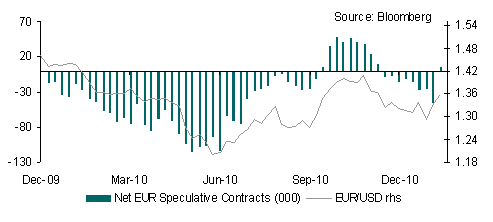
Euro Sentiment Jumps, USD Sentiment Dives

The bounce in the EUR against a broad range of currencies as well as a shift in speculative positioning highlights a sharp improvement in eurozone sentiment. Indeed, the CFTC IMM data reveals that net speculative positioning has turned positive for the first time since mid-November. A rise in the German IFO business confidence survey last week, reasonable success in peripheral bond auctions (albeit at unsustainable yields), hawkish ECB comments and talk of more German support for eurozone peripheral countries, have helped.

A big driver for EUR at present appears to be interest rate differentials. In the wake of recent commentary from Eurozone Central Bank (ECB) President Trichet following the last ECB meeting there has been a sharp move in interest rate differentials between the US and eurozone. This week’s European data releases are unlikely to reverse this move, with firm readings from the flash eurozone country purchasing managers indices (PMI) today and January eurozone economic sentiment gauges expected.

Two big events will dictate US market activity alongside more Q4 earnings reports. President Obama’s State of The Union address is likely to pay particular attention on the US budget outlook. Although the recent fiscal agreement to extend the Bush era tax cuts is positive for the path of the economy this year the lack of a medium to long term solution to an expanding budget deficit could come back to haunt the USD and US bonds.

The Fed FOMC meeting on Wednesday will likely keep markets treading water over the early part of the week. The Fed will maintain its commitment to its $600 billion asset purchase program. Although there is plenty of debate about the effectiveness of QE2 the program is set to be fully implemented by the end of Q2 2011. The FOMC statement will likely note some improvement in the economy whilst retaining a cautious tone. Markets will also be able to gauge the effects of the rotation of FOMC members, with new member Plosser possibly another dissenter.

These events will likely overshadow US data releases including Q4 real GDP, Jan consumer confidence, new home sales, and durable goods orders. GDP is likely to have accelerated in Q4, confidence is set to have improved, but at a low level, housing market activity will remain burdened by high inventories and durable goods orders will be boosted by transport orders. Overall, the encouraging tone of US data will likely continue but markets will also keep one eye on earnings. Unfortunately for the USD, firm US data are being overshadowed by rising inflation concerns elsewhere.

Against the background of intensifying inflation tensions several rate decisions this week will be of interest including the RBNZ in New Zealand, Norges Bank in Norway and the Bank of Japan. All three are likely to keep policy rates on hold. There will also be plenty of attention on the Bank of England (BoE) MPC minutes to determine their reaction to rising inflation pressures, with a slightly more hawkish voting pattern likely as MPC member Posen could have dropped his call for more quantitative easing (QE). There will also be more clues to RBA policy, with the release of Q4 inflation data tomorrow.

Both the EUR and GBP have benefitted from a widening in interest rate futures differentials. In contrast USD sentiment has clearly deteriorated over recent weeks as highlighted in the shift in IMM positioning, with net short positions increasing sharply. It is difficult to see this trend reversing over the short-term, especially as the Fed will likely maintain its dovish stance at its FOMC meeting this week. This suggests that the USD will remain on the back foot.

Speculators bail out of USDs

Risk appetite held up reasonably well last week, with markets failing to be derailed by concerns over Ireland’s banking sector and growing opposition to austerity measures across Europe. The main loser remained the USD, with the USD index hitting a low marginally above 78.00 and speculative positioning as reflected in the CFTC IMM data revealing a further sharp drop in sentiment to its lowest since Dec 2007.

This week is an important one for central bank meetings, with four major central banks deliberating on monetary policy including Bank of Japan (BoJ), Reserve Bank of Australia (RBA), European Central Bank (ECB) and Bank of England (BoE). The major event of the week however, is Friday’s release of the September US employment report. The RBA is set to hike its cash rate by 25bps, the BoJ may announced more easing measures whilst in contrast both the ECB and BoE are unlikely to alter their policy settings.

Whilst the BoJ is widely expected to leave its policy rate unchanged at 0.1%, it may announce further measures against the background of persistent JPY strength, a worsening economic outlook as reflected in last week’s Tankan survey and decline in exports. Japanese press indicate that the BoJ may increase lending of fixed rate 3 to 6 month loans to financial institutions as well as buy more short-term government debt.

The measures alongside risks of further JPY intervention may prevent USD/JPY slipping further but as reflected in the increase in speculative net long JPY positions last week, the market is increasingly testing the resolve of the Japanese authorities. Strong support is seen around USD/JPY 82.80, with the authorities unlikely to allow a break below this technical level in the short-term.

Although we will only see details of the voting in two weeks in the release of the UK BoE Monetary Policy Commitee (MPC) minutes it is likely that there was a three-way split within the MPC as reflected in recent comments, with MPC member Posen appearing to favour more quantitative easing whilst the MPC’s Sentance is set to retain his preference for higher rates. As has been the case over recent months the majority of the MPC are likely to have opted for the status quo.

GBP was a laggard over September as markets continued to fret over potential QE from the BoE. This uncertainty is unlikely to fade quickly suggesting limited gains against the USD and potentially more downside against the EUR. GBP speculative sentiment has improved but notably positioning remains short. EUR/GBP will likely target resistance around 0.8810.

In contrast to GBP the EUR has taken full advantage of USD weakness and looks set to extend its gains. Although there is a risk that speculative positioning will soon become overly stretched it is worth noting that positioning is well below its past highs according to the IMM data. EUR may have received some support from Chinese Premier Wen’s pledge to support Greece, and a stable EUR. Whilst there continues to be risks to the EUR from ongoing peripheral debt concerns such comments likely to be repeated at the EU-Asia summit today and tomorrow, will keep the EUR underpinned for a test of 1.3840.

USD pressure, EUR resilience, GBP whipsawed

Speculation the Fed will begin a new program of asset purchases or QE2 as soon as November is intensifying. The weaker than expected reading for US consumer confidence in September released on Tuesday has only added to this expectation as sentiment continues to be hit by job market concerns. Against this background the USD remains under strong downward pressure, with little sign of any turnaround.

The prospects of further USD debasing as well as intervention in many countries to prevent their currencies from strengthening against the USD continues to power gold prices which hit a new record high having breezed through the $1300 per troy ounce mark. In the current environment it is hard to see gold prices turning much lower although there may be some risk of profit taking in the weeks ahead.

The EUR remains a key beneficiary of USD weakness but this currency has problems of its own to contend with. Indeed, peripheral debt concerns, especially with regard to Ireland and to a lesser extent Portugal have increased, with borrowing costs rising as the yield on their debt widens against core eurozone debt. The stronger EUR will only make it harder for these countries to achieve any sort of recovery and could also damage the stronger exporting countries of Northern Europe led by Germany.

So far however, the EUR has managed to show some impressive resilience to renewed peripheral country sovereign debt concerns including comments by S&P about the high costs of rescuing an Irish Bank. Perhaps the knowledge that there is a still a huge bailout fund from the EU and IMF available if needed and also the prospect that the ECB will increase its buying of eurozone debt, has provided a buffer for the EUR.

At some point the ECB may be forced to join the battle in at least attempting to talk its currency lower but at this stage the central bank is showing no inclination to either talk down the currency or physically intervene to weaken the EUR. In the meantime, EUR/USD is likely to strengthen further despite the likely negative impact on European growth, with the currency likely to set its sights on an eventual break above 1.40.

One currency that may struggle in the wake of expectations of Fed QE2 is GBP. Uncertainty over whether the Bank of England will follow the Fed in implementing further quantitative easing could see GBP lag the gains in other currencies against the USD. Conflicting comments from MPC members Posen who noted that there may be a need for further QE in the UK to support the faltering economy were countered by Sentance who noted that there was no need for more QE. GBP/USD is likely be whipsawed as the debate continues and is set to lose further ground against the EUR.