EUR falls, JPY retraces after intervention

Risk aversion has come back in full force, with various concerns weighing on markets. Once again attention is firmly fixed on the eurozone and worryingly last week’s European Union (EU) rescue agreement has failed to prevent a further widening in eurozone peripheral bond spreads. This will come as a blow to eurozone officials as the agreement was aimed to prevent exactly this.

A lack of detail in the plans announced last week has come back to haunt markets. Moreover, given the event risk of the RBA, ECB and Fed central bank meetings this week plus the US October jobs report at the end of the week, nerves will likely remain frayed over coming days. Overall, the tone will likely be on of selling risk assets on rallies over the short term.

The EUR has unwound a significant part of its gains from last week as various doubts about the eurozone rescue package have surfaced. The measures announced by EU officials have failed to prevent a jump in Italian and Spanish bond yields. News that MF Global has filed for bankruptcy while the Greek Prime Minister has called for a referendum on the EU’s debt deal dealt markets a blow overnight.

As it was doubts had been creeping in due to the lack of detail in the rescue package including but not limited to the lack of specifics on the leveraging of the EFSF bailout fund. The pattern appears to have followed the reaction to previous EU announcements to stem the crisis, namely short lived euphoria followed by a sell off in risk assets. The EUR is likely to struggle further over the near term, with the current pull back likely to extend to around the 21 October low of 1.3705.

Japanese officials had blamed the strength of the JPY on speculative flows and have threatened more FX intervention following yesterday’s Judging by the price action this morning the threat has been followed up by action. In order for USD/JPY to sustain a move higher it will require both a widening in yield differentials and easing risk aversion. Neither are guaranteed to happen any time soon as was evident overnight with risk aversion rising. US data has improved but it is insufficient to provoke a sharp back up in US bond yields.

Consequently in the coming weeks USD/JPY topside momentum will be limited. A break above USD/JPY’s 200 day moving average level of 79.89 could prove decisive in terms of JPY long capitulation and once above this level USD/JPY will target the 11 July high of 80.83. However, this will require further intervention otherwise the underlying trend in JPY will continue to remain positive.
Euro looking rich at current levels

Markets continue to be rumour driven with little concrete news to provide direction. The news that a comprehensive deal by European officials at this Sunday’s EU Summit is now very unlikely has come as a further blow to hopes of a swift resolution to the crisis.

So it seems that Sunday’s meeting will provide a forum to thrash out ideas before a second summit next Wednesday. As a reminder the issues at hand are leveraging the EFSF, banking sector recapitalisation and the extent of private sector participation in Greek debt write downs.

The main disagreement appears to be between Germany and France on method of additional funding the EFSF bailout fund (which has EUR 280billion of firepower left), with Germany and the European Central Bank (ECB) opposed to French demands to utilise the ECB to help back the EFSF with France wanting the facility being turned in a bank. In terms of write downs for Greek bond holders there is a push for at least a 50% reduction compared to the 21% agreed in July.

Separately speculation of the amount of new capital needed for banking sector recapitalisation now revolves around a figure of EUR 80 billion. One spanner in the works is that Chancellor Merkel will have to gain approval from the German parliament before agreeing on further changes to the EFSF, which may delay the process further.

Clearly as this week has gone on the air has continued to seep out of the balloon as the market braces for disappointment. Surprisingly the EUR has held up well and while it has failed to extend gains, hitting a high earlier in the week around 1.3915 but still pricing in some scope for success, at current levels.

Helping the EUR was the fact that the market was very short, and while it could still move higher next week if European officials agree on a plan it still looks like a sell on rallies, with the scope for further gains limited from current rich levels. Good news from Europe next week could see a test of EUR/USD 1.40 but this will prove to be a good selling area further out.

At least there was some good news from Greece for a change as the Prime Minister won a vote to pass further austerity measures to help secure the next tranche (delayed from September) of the bailout despite ongoing protests in the country. The near term focus will be on a meeting of Finance Ministers today ahead of Sunday’s summit.

Euro fails too hold on to gains

Any improvement in sentiment following the USD liquidity support announcement by various central banks last week is already filtering away against the background of European Union (EU) officials’ failure to make any headway at the Ecofin meeting over the weekend, a delay in the approval of the next bailout tranche for Greece and ongoing collateral dispute between Greece and Finland. On top of all of this German Chancellor Merkel suffered a further setback in regional elections over the weekend.

Greece will remain in focus this week and markets will look for signs that the country is back on track on its austerity plans and its next loan tranche. Prime Minister Papandreou cancelled a trip to the US while the Greek cabinet are apparently deciding on new fiscal measures. Attention will turn to a teleconference today from the Greek Finance Minister with EU and IMF officials.

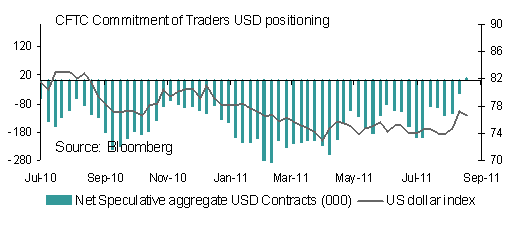
Speculative sentiment for the EUR has already soured further and according to the latest CFTC IMM report, positioning in EUR is at its lowest since the end of June 2010. EUR/USD will continue to look very vulnerable having already dropped sharply from a high of around 1.3899 in Asian morning trading as the bad weekend news hit the currency. EUR/USD will find some technical support just below 1.3500 this week but any upside is set to prove limited unless some concrete announcements are delivered relating to Greece over coming days.

In contrast to the EUR, USD speculative appetite has turned net long for the first time since July 2010. The extended Fed FOMC meeting will help to dictate USD sentiment as markets wait for further measures to stimulate the economy. The Federal Reserve has already committed to hold rates steady until at least mid 2013 and the extended two day meeting this week will likely discuss further options. However, more quantitative easing (QE3) appears unlikely at this stage while an ‘Operation Twist’ type approach is more probable. The USD will benefit from a lack of further quantitative easing but this is largely already priced in.

SNB shakes up FX markets – Pressure now on Japan?

The action by the Swiss National Bank yesterday rippled through FX markets fuelling sharp moves across major currencies. In case you missed it the SNB introduced a currency floor in EUR/CHF at 1.20 and committed itself to buy FX in unlimited amounts. The last time the SNB did something similar was in 1978 when a ceiling was set against the Deutsche Mark. The sharp initial reaction to the news saw EUR/CHF jump by around 8.5% largely as a result of the shock from the announcement.

The SNB will not need to worry about the inflationary implications of pumping CHF into the market while it is clear that the currency is highly overvalued, supporting their cause. However, the real test will be evident over coming days and weeks in the commitment to hold the 1.20 level at a time when the situation in the eurozone periphery continues to deteriorate and demand for CHF remains strong. The risk is that the SNB may have simply set up a target for markets to attack. One other implication of the SNB’s move is that it could be a trigger for an intensification of ‘currency wars’.

The onus is now on the Japanese authorities to act more aggressively especially if safe haven flows focus increasingly on the JPY and less on the CHF given the new EUR/CHF floor. So far FX interventions have clearly not worked as was the case in Switzerland and Japan’s new Prime Minister is likely to want to prove his credentials. Japan has had a tendency to underwhelm with regard to JPY measures in the past and unless there is a major announcement today USD/JPY is likely to move lower again below 77.00.

Scandinavian currencies are also set to be beneficiaries of the SNB’s decision. EUR/SEK has come under increasing downside pressure over recent weeks even as risk aversion has intensified and it appears that safe haven flows out of Europe are now targeting Scandinavian currencies. As the CHF is now less attractive in this respect, the SEK as well as NOK will find themselves under further upside pressure over coming days and weeks. Both NOK and SEK versus EUR and USD have had insignificant correlations with risk over recent months, highlighting their appeal as anti-EUR currencies.

US Ratings Under Threat

The USD succumbed to further pressure overnight as Moody’s Investor Service threatened to place the US Aaa rating on review for downgrade if there is no agreement reached on raising the US debt ceiling. Although the news prompted a rise in US Treasury yields it did little for the USD.

News that the Federal Reserve’s balance sheet expanded to a record $2.772 trillion in the week ending June 1 highlights the ongoing headwinds to the USD from Fed asset purchases. The fact that there is even talk of QE3 in the wake of weak US data suggests that the headwinds will not dissipate quickly.

Direction today will come from the US May jobs report though this is unlikely to deliver any good news for the USD. Forecasts for non-farm payrolls have likely been revised lower to sub 100k compared to the published consensus forecast of 165k following the weaker indications from the May ADP jobs report and ISM data this week. A weak payrolls outcome will only intensify worries about the depth and length of the US ‘soft patch’.

Although market expectations are also likely to have been downwardly revised, something that may cushion the blow to the USD, it will be difficult to get away from the fact that growth in Q2 is weaker than many had thought.

EUR was well supported overnight, boosted by a relatively successful Spanish bond auction yesterday and reports that officials have agreed in principle to a 3-year adjustment plan for Greece covering funding needs to 2013 although there was no confirmation of such an agreement.

As a result, EUR/USD tested 1.45 and looks supported ahead of today’s US payrolls data. EUR’s recovery in general has been impressive but gains above 1.45 are likely to prove more difficult even if an agreement on Greece is close to being achieved.

As usual Japan’s political gyrations are having little impact on the JPY as the currency is instead buffeted by risk aversion swings and yield differentials. In fact USD/JPY has been rather well behaved over recent weeks as indicated by implied options volatility.

Prime Minister Kan’s success in winning a no-confidence motion came at a cost and may provide very little political stability. Kan said will resign as soon as post-earthquake recovery efforts are completed and once he is gone there is likely to be some realignment of existing political parties.

As for the JPY it will remain unscathed by political events. Over the near term USD/JPY is likely to cling to the 81 handle but we maintain our bearish view on the JPY in the medium term under the assumption that there is a sharp widening in US – Japan bond yield differentials.