What goes down must go up

What goes down must go up! A day that began with a stronger than forecast increase in China’s purchasing managers index (PMI) and firm Australian Q2 GDP continued with a surprise jump in the August ISM manufacturing index. The ISM rose to 56.3 from 55.5 in July an outcome that contradicted most of the regional US manufacturing surveys. It was not all positive in terms of data, yesterday however, with a weaker UK manufacturing PMI and unexpected drop in the August US ADP employment report casting a shadow over markets.

Nonetheless, for a change the market decided to act on the good news, with risk assets surging. Despite the improvement in risk appetite it still feels as though the market is grasping for direction. The jump in equities is unlikely to prove durable in an environment characterized by various uncertainties about growth and policy, especially the US.

The next hurdle for markets is the US payrolls data tomorrow. Although the ADP jobs report revealed a surprise 10k decline the employment component of the ISM manufacturing survey strengthened to 60.4, suggesting an improvement in August manufacturing payrolls. Ahead of the payrolls release the US data slate today largely consists of second tier releases including July pending home sales, August chain store sales, weekly jobless claims, and factory orders. It is worth paying particular interest to jobless claims given that the four week moving average has been edging higher, suggesting renewed job market deterioration. The consensus is for a 475k increase in claims, which will still leave the 4-week average at an elevated level.

Given that one of the biggest debates raging through markets at present is whether the Fed will embark on further quantitative easing comments by Fed officials overnight were closely scrutinized for further clues. In the event, Fed Governor Kohn highlighted that the Fed’s reinvestment of the proceeds from mortgage-backed securities will not automatically lead to further QE, suggesting some hesitancy on his part. Meanwhile, Dallas Fed President Fisher noted his reluctance to expand the Fed’s balance sheet until fiscal and regulatory uncertainties are cleared up.

Both sets of comments highlight the difficulty in gaining a consensus within the FOMC for a further increase in QE, suggesting that the hurdle for further balance sheet expansion will be set quite high. Moreover, such comments put the onus on Congress to move quickly in clearing up fiscal policy uncertainties.

As markets flip from risk on to risk off almost on a daily basis the question for today is how sustainable the rally in risk trades will prove to be against the background of so much policy and growth uncertainty. Unfortunately today’s data will provide few clues and markets will turn their attention to tomorrow’s US non-farm payrolls report for further direction. To an extent this suggests that it may be a case of treading water until then. Nonetheless, I still maintain that risk trades remain a sell on rallies over coming weeks
US payrolls clues

Most investors will be glad to see the back of August, a month that marked the biggest monthly decline in US stocks in nine years. The main imponderable is whether September will be any better. A series of manufacturing surveys globally today will do little to restore confidence although there was some good news in a slight increase in China’s official August purchasing managers index (PMI) as well a stronger than forecast increase in Australian Q2 GDP, which will likely provide some short-term relief for risk trades.

There was also some slight solace for markets in terms of US data at least from the point of view that the data was not as disappointing as many recent releases. Although the August Chicago PMI slipped (to 56.7) consumer confidence increased (to 53.5) though admittedly confidence remains at a relatively low level. The job market situation detailed within the consumer confidence report was more pessimistic in August than the previous month, however, with those reporting jobs hard to get moving higher. This sends a negative signal for Friday’s payrolls data.

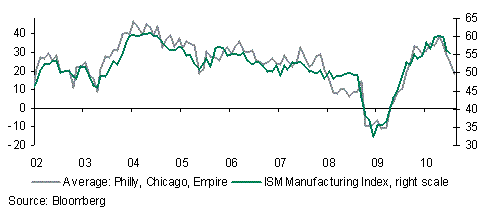
There will be more clues to Friday’s US jobs report today which will enable any fine tuning of forecasts to take place in the wake of the August ADP employment report and ISM manufacturing survey. Consensus forecasts centre on a 15k increase in private jobs. Despite the slight increase in the Empire manufacturing survey in August, the falls in other manufacturing surveys point to some downside risks to the ISM today, with a simple average of the three pointing to the ISM closer to the 50 mark, which will highlight a loss in US manufacturing momentum.

Manufacturing surveys elsewhere will also be in focus, with the final PMI readings scheduled to be released for the eurozone and UK. There is likely to be confirmation of the slight drop in the eurozone PMI to 55.0 in August while the UK PMI is likely to drop to around 57.0 over the month. Both surveys remain at a relatively high level but it is clear that activity is moderating in H2 2010 from a healthy level in H2. The data will give little support to the EUR but the currency has found a degree of stability over the last couple of days. Nonetheless, a further downward move is in prospect.

The Fed FOMC minutes provided little for markets to get excited about. The minutes noted concerns about large scale asset purchases from some Fed officials, indicating resilience to increasing quantitative easing despite acknowledging increased downside risks to the growth and inflation outlook. It is unclear exactly what will be the trigger for further QE as acknowledged by Fed Chairman Bernanke last week.

The minutes will do little to help market confidence given the hesitancy to pursue further QE and provide further stimulus to the economy but the USD is likely to benefit from the fact that the Fed may not be as eager to expand its balance sheet further. Other currencies that remain beneficiaries in the current risk averse environment are the JPY and CHF. The JPY may find further upside more difficult given ongoing intervention fears but the trend remains for a lower USD/JPY in the coming weeks.

FX / Economic Preview

The European Union (EU) aid package for Greece and extension of collateral requirements by the European Central Bank (ECB) helped return a semblance of confidence to markets. Although the probability of a Greek default now looks extremely small, further austerity measures, fiscal issues in other EU countries and the negative impact on growth that all of this implies, suggest that Europe will be plagued by various problems for some time yet.

As a result of more favourable market conditions Greece is set to launch a syndicated bond issues today or tomorrow of up EUR 5 billion according to press reports. Attention will also turn to Greek debt rollovers, beginning with EUR 8.2 billion on April 20.

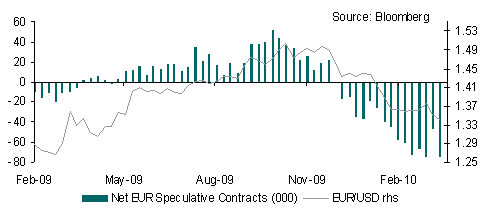
Improving sentiment following the Greece deal has extended to the EUR, with the currency bouncing off its lows around 1.3267. EUR/USD will now look to break through resistance around 1.3446, which would set up a test of 1.3516. There is plenty of scope for short-covering to help the EUR as reflected in the latest IMM Commitment of Traders’ report (a gauge of speculative market positioning) which revealed net EUR positions reaching yet another record low in the week to 23rd March. Whilst sovereign/official buying interest may keep EUR/USD supported this week the currency pair is best played as a sell on rallies.

A similar assessment applies for GBP. Speculative sentiment for the currency also hit a record low in the latest week but unlike the Greek deal helping the EUR, last week’s UK budget has done little to boost GBP’s prospects. Moreover, a report in the Financial Times highlighting hedge funds bets against GBP, suggests that there are still plenty of headwinds against the currency.

Volumes are set to thin out this week ahead of upcoming holidays, whilst the US March jobs report at the end of the week will likely prevent moves out of current ranges ahead of its release. The consensus forecast is for a 190k increase in non-farm payrolls though much of this is likely to reflect hiring for the 2010 US consensus and a rebound from adverse weather effects in February.

In Europe March economic confidence surveys will be watched closely to determine how much damage Greece and general fiscal woes are having on sentiment. Some improvement, in line with the Eurozone Purchasing Managers Index (PMI) and the German IFO business confidence survey, is expected, which will help to give further, albeit limited relief to the EUR.

The Japanese data slate kicked off the week in good form, with the release of February retail sales data, revealing its biggest annual increase in 12-years. It is difficult to see the recovery in sales taking much greater hold given persistent deflation pressures however, and part of the gain probably reflects the government’s shopping incentive program.

Aside from industrial production and jobs data in Japan the key release will be the results of the Q1 Tankan survey on Wednesday. The survey of manufacturers’ confidence is set to show further improvement. USD/JPY is likely to remain supported around 91.67 but will need a further widening in US/Japan 10-year bond yield spreads to push higher.

Better Levels To Sell

It is questionable how long the slight improvement in risk appetite at the beginning of this week lasts given the fickle nature of market sentiment at present and propensity for more disappointment. More than likely any relief will be short-lived given 1) there are still major concerns about fiscal/debt problems in Greece, Spain, Portugal, etc 2) the sharp decline in economic activity that various austerity plans will lead to and 3) rising social/labour unrest due to cuts in spending and hikes in taxes that need to be implemented.

Attention remains firmly fixed on Greece’s woes whilst global growth concerns have reappeared following some disappointing data releases in the US last week as well the decline in China’s manufacturing purchasing managers’ index (PMI) in February, released overnight, which although obscured by the timing of Chinese Lunar New Year holidays, suggests that China’s economy is losing some of its recent strong momentum.

Speculation of a rescue plan for Greece will likely give some support to the beleaguered EUR though it may only end up providing better levels to sell the currency. EU Monetary Affairs Commissioner Rehn is scheduled to meet with Greek Prime Minister Papandreou today against the background of talks about the possibility of EUR 25 billion in aid to Greece using state owned lenders to buy Greek debt. Any aid will likely come with demands for more action to reduce Greece’s yawning budget deficit which will fuel further weakness in economic activity.

A key test of sentiment towards Greece’s austerity plans will be the market reception to an upcoming sale of as much as EUR 5 billion in 10-year Greek bonds. Given the reassurances given by the EU the sale of bonds will likely not be too problematic. As an indication, Greek 10-year bond yields dropped sharply on Friday as sentiment improved.

The bounce in Greek debt was accompanied by a firmer EUR/USD which rebounded to a high of around 1.3667 as markets covered short positions. It’s probably way too early to suggest that the EUR has began a sustainable rally however, and more likely it has settled into a new range, with support around the 2010 low of 1.3444. The latest CFTC Commitment of Traders’ (IMM) data revealed a further increase in net short EUR positioning to a new record low in the week to 23rd February. This highlights both the weight of pessimism on the currency as well as significant potential to rebound.

Conversely, the IMM data reveals that net USD positions are at their highest in almost a year and well above their three-month average, suggesting that USD positioning is looking a bit stretched though its worth noting that positioning is still well off its record high. Nonetheless, with a bailout for Greece in the offing, risk appetite could gain a stronger foothold this week, in turn keeping the USD capped.

As for the EUR, although a lot of bad news is in the price, for the currency to rebound on a sustainable basis it will require fiscal/growth worries to recede. Despite talk of Greek aid, there is a long way to go before Europe’s fiscal/debt problems are resolved.